数据结构实验4---队列的实现
一、实验目的
(1) 理解循环队列的基本概念及逻辑结构。
(2) 掌握循环队列的存取方式。
(3) 能够编写循环队列的入队、出队、判断队满、队空算法。
二、实验内容(根据实验内容可以适当增加主函数和一些辅助算法)
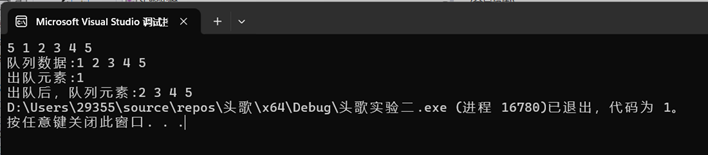
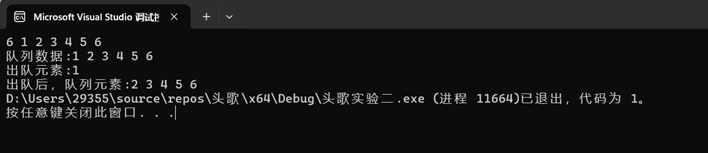
1.基础题:实现循环队列的初始化、判队空、判队满、进队、出队操作。
2.进阶题:汽车轮渡算法
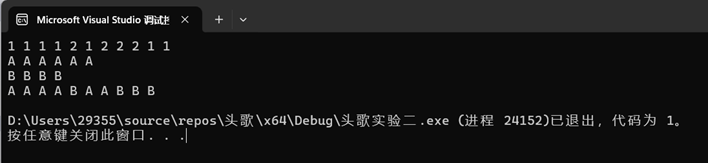
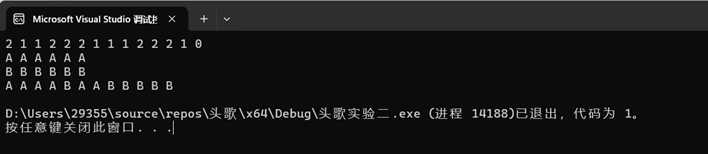
某汽车轮渡口,过江渡船每次能载 10 辆车过江,过江车辆分为客车类和货车类,上渡船有如下规定:同类车先到先上船;客车先于货车上渡船,且每上 4 辆客车,才允许上一辆货车;若等待的客车不足 4 辆,则以货车代替;若无货车等待,允许客车都上船。试设计算法模拟以上渡口管理,可分以下层次:
(1) 实现 10 辆车过江。
(2) 实现 10 辆以上车过江。
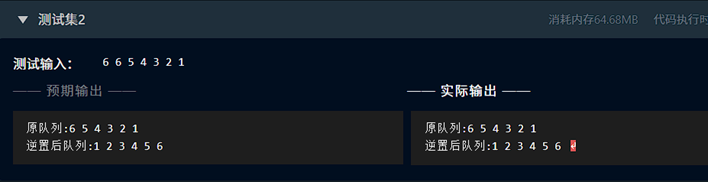
3.附加题:用栈实现队列逆置
利用栈先进后出和队列先进先出的操作特点,将队列中元素依次出队后依次入栈,结束后再将堆栈中元素依次出栈再依次入队,这样操作之后队列中元素就成功逆置。步骤如下:
(1)将元素输入队列中;
(2)以队列的先进先出方式出队各元素并依次插入到栈中;
(3)采用栈的后进先出模式出栈各元素并重新入队,从而实现队列中元素的逆置。
三、实验步骤
第1关-基础题:
#include <iostream>

using namespace std;

#define QMaxlen 100  //队列最大存储容量

typedef int QElemtype;

typedef struct

{

       QElemtype* base;    //队列存储空间的基地址

       int front;          //队首指针

       int rear;           //队尾指针

}SqQueue;


//创建一个空的循环队列Q

int InitQueue(SqQueue& Q)

{

       Q.base = new QElemtype;

       if (!Q.base)

              return 0;

       Q.front = Q.rear = 0;

       return 1;

}


//循环队列入队函数

int InQueue(SqQueue& Q, QElemtype e)

{

       if ((Q.rear + 1) % QMaxlen == Q.front)

              return 0;

       Q.base[Q.rear] = e;

       Q.rear = (Q.rear + 1) % QMaxlen;

       return 1;

}


//循环队列出队函数

int DeQueue(SqQueue& Q, QElemtype& e)

{

       if (Q.rear == Q.front)

              return 0;

       e = Q.base[Q.front];

       Q.front = (Q.front + 1) % QMaxlen;

       return 1;

}


//输出循环队列中数据元素,数据元素以空格隔开

void Print_Queue(SqQueue& Q)

{

       int i;

       for (i = Q.front; i != Q.rear; i = (i + 1) % QMaxlen)

              printf("%d ", Q.base[i]);

}


int main()

{

       SqQueue q;

       QElemtype x;

       int i, m;

       //队列初始化

       InitQueue(q);

       //输入队列长度

       cin >> m;

       //循环输入队列元素

       for (i = 1; i <= m; i++)

       {

              cin >> x;

              InQueue(q, x);

       }

       cout << "队列数据:";

       Print_Queue(q);

       cout << endl;

       DeQueue(q, x);

       //输出出队元素

       cout << "出队元素:" << x << endl;

       cout << "出队后,队列元素:";

       Print_Queue(q);

       return 1;

}
第2关-进阶题:
#include<iostream>

using namespace std;

#define OVERFLOW 0

#define MAXSIZE 100     //队列的最大值

typedef struct {

    char* base;

    int front;

    int rear;

}SqQueue;


//初始化一个队列

void InitSqQueue(SqQueue &Q) {

    Q.base = (char*)malloc(sizeof(char)*MAXSIZE);

    if (!Q.base)

    {

        cout<<"存储分配失败";

        exit(OVERFLOW);

    }

    Q.front = Q.rear = 0;

}


//打印队列

void PrintQueue(SqQueue Q)

{

    if (Q.rear == Q.front)

    {

         cout<<"队空";

         exit(OVERFLOW);

         return;

     }

    int flag = Q.front;

    while (Q.rear != flag)

    {

        cout<<Q.base[flag]<<' ';

        flag=(flag+1)%MAXSIZE;

     }

    cout<<endl;

}


//入队

void EnQueue(SqQueue &Q, char elem)

{

    if ((Q.rear + 1) % MAXSIZE == Q.front)

    {

        cout<<"队满";

        exit(OVERFLOW);

    }

    Q.base[Q.rear] = elem;      //新元素插入队尾

    Q.rear = (Q.rear + 1) % MAXSIZE;        //队尾指针加1

}


//出队

void OutQueue(SqQueue &Q, char &e)

{

    if (Q.front == Q.rear)

    {

        cout<<"队空";

        exit(OVERFLOW);

        return;

    }

    e = Q.base[Q.front];        //将队头元素赋值给e

    Q.front = (Q.front + 1) % MAXSIZE;      //队头指针加1

}


//求队列元素个数

int CountQueue(SqQueue Q)

{

    return (Q.rear - Q.front + MAXSIZE) % MAXSIZE;

}


//判断队列是否为空

int EmptyQueue(SqQueue Q)

{

    if (Q.front == Q.rear)

        return 1;

    else

        return 0;

}


//(1)实现10辆车过江

//(2)实现10辆以上车过江


//10辆车过江

void FerryCars10(SqQueue &Q, SqQueue &Q1, SqQueue &Q2, SqQueue &Q3)

{

    int i = 0, j = CountQueue(Q);//i记录连续上车客车数,j记录船上车数

    while (j < 10)

    {

        if (i < 4 && !EmptyQueue(Q1))

        {  //如果船上客车小于4并且客车队列不为空,则上客车

            char e = 0;

            OutQueue(Q1, e);

            EnQueue(Q, e);

            i++; j++;

        }

        else if (i == 4 && !EmptyQueue(Q2))

        {

//当船上客车等于4且货车队列不为空,则上一辆货车

            char e = 0;

            OutQueue(Q2, e);

            EnQueue(Q, e);

            j++;

            i = 0;

        }

        else

        {

            while (i < 4 && !EmptyQueue(Q2))

            {

                char e = 0;

                OutQueue(Q2, e);

                EnQueue(Q, e);

                i++; j++;

            }

            i = 0;

        }

        if (EmptyQueue(Q1) && EmptyQueue(Q2))

        {

            j = 11;

        }

    }

}

//10辆车过江函数调用

void FerryCars10_Menu()

{

    SqQueue Q,Q1,Q2,Q3;

    InitSqQueue(Q); InitSqQueue(Q1);

    InitSqQueue(Q2); InitSqQueue(Q3);

    int count = 0;

    //请输入来车序列

    while (count<10)

    {

        int choose;

        cin>>choose;

        if (choose == 1)

        {

            EnQueue(Q1, 'A');

            count++;

        }

        else if (choose == 2)

        {

            EnQueue(Q2, 'B');

            count++;

        }

        else if (choose == 0)

            break;

        else

            continue;

    }

    //客车队列

    PrintQueue(Q1);

    //货车队列

    PrintQueue(Q2);

    FerryCars10(Q, Q1, Q2,Q3);

    while (!EmptyQueue(Q))

    {

        char elem;

        OutQueue(Q, elem);

        EnQueue(Q3, elem);      //渡船满后或者无客车货车时将渡船上的车入队Q3

    }

    //渡船队列

    PrintQueue(Q3);

}


//10辆以上的车过江函数

void FerryCars_over10(SqQueue &Q, SqQueue& Q1, SqQueue& Q2,SqQueue& Q3)

{

    while (!EmptyQueue(Q1) && !EmptyQueue(Q2))

    {

        FerryCars10(Q,Q1,Q2,Q3);

        while (!EmptyQueue(Q))

        {

            char elem;

            OutQueue(Q,elem);

            EnQueue(Q3,elem);       //渡船满后或者无客车货车时将渡船上的车入队Q3

        }

    }

}


//10辆以上的车过江函数调用

void FerryCars_over10_Menu()

{

    SqQueue Q, Q1, Q2, Q3;

    InitSqQueue(Q); InitSqQueue(Q1);

    InitSqQueue(Q2); InitSqQueue(Q3);

    //输入1表示客车,输入2表示货车,输入0表示结束

    int choose=3;

    //请输入来车序列

    while (choose != 0)

    {

        cin>>choose;

        if (choose == 1)

        {

            EnQueue(Q1, 'A');

        }

        else if (choose == 2)

        {

            EnQueue(Q2, 'B');

        }

        else if (choose == 0)

        {

            break;

        }


    }

    //客车队列

    PrintQueue(Q1);

    //货车队列

    PrintQueue(Q2);

    FerryCars_over10(Q, Q1, Q2, Q3);

    //渡江队列

    PrintQueue(Q3);

}


int main()

{

    int n;

    //输入1表示10辆车渡江,输入2表示10辆车以上渡江

    cin>>n;

    if(n==1)

           FerryCars10_Menu();

    if(n==2)

           FerryCars_over10_Menu();

    return 1;

}
第3关-附加题:
#include<iostream>

using namespace std;


typedef struct Node {

    int data;

    struct Node* next;

}node;  //队列结点


//定义一个链队列

typedef struct LinkQueue {

    node* front; //队首结点

    node* rear; //队尾结点

}LQ;


//初始化空链队列

LQ InitLQ(LQ LQ) {

    LQ.front = (node*)malloc(sizeof(node));

    LQ.front->data = -1;

    LQ.front->next = NULL;

    LQ.rear = LQ.front; //队首结点和队尾结点是同一个结点

    return LQ;

}


//进栈

node* PushStack(node* LS ,int elem) {  //LS是栈顶结点

    node* new_node = (node*)malloc(sizeof(node)); //创建一个结点

    if (new_node == NULL) {

        cout<<"创建链栈结点失败";

        exit(0);

    }

    else {

        new_node->data = elem;

        new_node->next = LS;

//给新结点指针域赋值,新结点指向当前栈顶结点

        LS = new_node;  //新结点成为新的栈顶结点

        }

    return LS;

}


//入队列

LQ PushQueue(LQ &LQ,int e) {


              node* new_node = (node*)malloc(sizeof(node));//生成新结点

              if (new_node == NULL) {

                      cout<<"创建结点失败";

                      exit(0);

                  }

              new_node->data = e;

        new_node->next = NULL;

        LQ.rear->next = new_node; //在队尾结点处插入新结点

        LQ.rear = new_node;//队尾结点后移

        return LQ;

}


//出栈并进队列

LQ PopStack(LQ LQ,node* LS) {

    while (LS != NULL) {

        node* tmp = LS;

        LS = tmp->next;

        LQ=PushQueue(LQ,tmp->data);

        free(tmp);


        }

    return LQ;

}


//出队列并进栈

node* PopQueue(LQ &LQ,node* LS) {

    while (LQ.front != LQ.rear) {


 //从入队第一个元素开始打印

        LS = PushStack(LS, LQ.front->next->data); //出队元素进栈

        node* tmp = LQ.front;

        LQ.front = LQ.front->next;

        free(tmp);

    }


    return LS;

}


//打印队列全部元素

void ShowLQ(LQ LQ) {

    node* tmp = LQ.front->next;

    while (tmp != NULL) {

        cout<<tmp->data<<' ';

        tmp = tmp->next;

        }

   cout<<endl;

}


int main()

{

    LQ myLQ;

    int n,e;

    node* mystack = NULL;

    myLQ = InitLQ(myLQ);

    cin>>n;

    for(int i=0;i<n;i++)

    {

           cin>>e;

              myLQ=PushQueue(myLQ,e);

       }

       cout<<"原队列:";

       ShowLQ(myLQ);

    mystack=PopQueue(myLQ,mystack);


    myLQ=PopStack(myLQ,mystack);

    cout<<"逆置后队列:";

    ShowLQ(myLQ);

    return 1;

}
四、实验结果
第一关:
第二关:
第三关:

五、实验小结
通过本次实验加深了对循环队列基本算法的熟悉和应用,在实验过程中,我不仅复习了循环队列的基本概念,如循环队列的判空和判满条件,还通过动手编程实现了循环队列的入队、出队和遍历等操作。在实验过程中,我还发现自己在算法实现和代码优化方面存在不足,应该多加强基本操作的练习,才能更好的掌握循环队列的使用。
本次循环队列的实验让我受益匪浅。我不仅加深了对循环队列的理解,还提高了编程能力和解决问题的能力。未来,我将多加强算法实现和代码优化的练习,同时关注循环队列在实际应用中的最新进展,以更好地掌握循环队列的使用。

北京人形旗下天工造物具身智能开源社区,聚焦具身天工与慧思开物两大平台
更多推荐
 10
10 0
0- 0


 已为社区贡献1条内容

所有评论(0)