辐射换热仿真-主题054_LED照明热管理辐射-主题054_LED照明热管理辐射
主题054:LED照明热管理辐射
摘要
本主题深入研究LED照明系统的热管理问题,重点分析辐射散热在LED结温控制中的关键作用。通过理论分析和Python仿真,掌握LED热设计原理、散热系统优化方法以及寿命预测技术,为高效、长寿命LED照明产品的设计提供理论指导。
关键词: LED照明、结温、辐射散热、热管理、寿命预测、光效、热阻
1. 引言
1.1 LED照明技术的发展
发光二极管(LED, Light Emitting Diode)作为一种半导体固态光源,近年来在照明领域得到了广泛应用。相比传统光源(白炽灯、荧光灯),LED具有显著优势:
能效优势:
- LED光效可达150-200 lm/W,远超白炽灯(10-15 lm/W)
- 比荧光灯(50-100 lm/W)节能50%以上
- 定向发光特性减少光损失
寿命优势:
- LED典型寿命25,000-50,000小时
- 白炽灯仅1,000小时,荧光灯8,000-10,000小时
- 减少维护成本和更换频率
环保优势:
- 无汞等有害物质
- 可回收利用
- 减少碳排放
其他优势:
- 瞬时启动,无频闪
- 可调光、调色
- 抗震、耐冲击
- 体积小,设计灵活
1.2 LED热管理的挑战
尽管LED具有诸多优势,但其热管理问题一直是制约性能和可靠性的关键因素:
结温敏感性问题:
- LED芯片结温直接影响发光效率
- 温度每升高10°C,光效下降约3-5%
- 高温加速光衰,缩短使用寿命
热量集中问题:
- LED芯片尺寸小(1-3mm²)
- 功率密度高(可达100 W/cm²)
- 热量集中在极小区域,散热困难
可靠性问题:
- 高温导致封装材料老化
- 荧光粉热猝灭
- 焊点热疲劳失效
光品质问题:
- 结温升高导致色温漂移
- 显色指数下降
- 波长红移
1.3 辐射散热在LED中的重要性
LED照明系统的散热方式主要包括:
- 传导散热:芯片→基板→散热器
- 对流散热:散热器与空气换热
- 辐射散热:表面红外辐射
在LED照明中,辐射散热具有特殊重要性:
自然对流主导:
- 大多数LED灯具依靠自然对流
- 辐射散热可占总散热的40-60%
- 优化表面发射率可显著改善散热
密闭空间应用:
- 防水灯具内部空气不流通
- 辐射成为主要散热方式
- 需要高发射率表面处理
高温工况:
- 大功率LED工作温度高
- 辐射散热与T⁴成正比
- 高温下辐射占比显著增加
设计约束:
- 灯具外观要求限制散热器尺寸
- 辐射散热可在有限空间内提高效率
- 表面处理成本低,效果显著
1.4 本主题学习目标
通过本主题的学习,读者将能够:
- 理解LED发热机理和结温控制原理
- 掌握LED热阻网络分析方法
- 学会计算和优化辐射散热
- 运用Python进行LED热管理仿真
- 预测LED寿命并进行可靠性设计
- 设计高效LED照明散热方案
2. LED基础理论与发热机理
2.1 LED工作原理
2.1.1 半导体发光原理
LED基于半导体的电致发光效应:
PN结注入:
- 电子从N区注入P区
- 空穴从P区注入N区
- 载流子在PN结附近复合
辐射复合:
- 电子与空穴复合时释放能量
- 能量以光子形式发出
- 光子能量:E = hν = hc/λ
发光波长:
- 由半导体材料的带隙决定
- λ = hc/Eg ≈ 1240/Eg(nm)
- 不同材料发出不同颜色光
2.1.2 白光LED实现方式
蓝光LED+黄色荧光粉(主流技术):
- 蓝光LED激发YAG:Ce荧光粉
- 蓝光+黄光混合成白光
- 光效高,成本低
- 色温可调(2700K-6500K)
RGB三色混合:
- 红、绿、蓝三色LED组合
- 色彩还原性好
- 控制复杂,成本高
- 主要用于显示屏
紫外LED+RGB荧光粉:
- 紫外光激发三基色荧光粉
- 显色指数高(CRI>90)
- 光效相对较低
- 适用于高品质照明
2.2 LED发热机理
2.2.1 能量转换效率
LED的电光转换效率:
η = P_optical / P_electrical = (Φ × V_photon) / (I × V_f)
其中:
- Φ:光通量(lm)
- V_photon:光子电压(约2.5-3.5V)
- I:驱动电流(A)
- V_f:正向压降(V)
典型效率:
- 蓝光LED:约40-50%
- 白光LED:约30-40%
- 其余60-70%电能转化为热量
2.2.2 热源分布
LED芯片内部热源分布:
有源区发热(主要热源):
- 非辐射复合产生热量
- 俄歇复合
- 缺陷复合
- 占发热量的70-80%
欧姆发热:
- 接触电阻产生热量
- 外延层电阻
- 衬底电阻
- 占发热量的20-30%
热量产生位置:
- 主要集中在有源区(厚度约0.1-0.5μm)
- 距离芯片表面很近
- 热量需要快速导出
2.2.3 热功率计算
LED热功率:
P_heat = P_electrical - P_optical
       = I × V_f - Φ × K_e
其中K_e为光效系数(约0.003-0.004 W/lm)。
简化计算:
假设电光转换效率η=35%:
P_heat = P_electrical × (1 - η)
       = P_electrical × 0.65
对于1W LED:
- 电功率:1W
- 光功率:0.35W
- 热功率:0.65W
2.3 LED热特性参数
2.3.1 结温与光效关系
LED光效随结温升高而下降:
Φ(T_j) = Φ₀ × [1 - k × (T_j - T₀)]
其中:
- Φ₀:参考温度T₀时的光通量
- k:温度系数(典型值0.003-0.005/°C)
- T_j:结温(°C)
典型数据:
| 结温(°C) | 相对光通量 | 光效下降 |
|---|---|---|
| 25 | 100% | 0% |
| 50 | 92% | 8% |
| 75 | 84% | 16% |
| 100 | 76% | 24% |
| 125 | 68% | 32% |
2.3.2 结温与波长漂移
LED发光波长随结温变化:
蓝光LED:
- 温度系数:约0.05 nm/°C(蓝移)
- 结温升高,波长向长波方向移动
白光LED:
- 蓝光芯片红移
- 荧光粉发射变化
- 整体色温下降(变暖)
色温漂移:
- 结温从25°C升到100°C
- 色温可能下降500-1000K
- 影响照明品质
2.3.3 热阻定义与测量
热阻定义:
R_th = ΔT / P_heat = (T_j - T_ambient) / P_heat
单位:°C/W 或 K/W
LED热阻组成:
R_th_total = R_th(j-c) + R_th(c-s) + R_th(s-a)
- R_th(j-c):结到壳热阻(芯片到封装)
- R_th(c-s):壳到散热器热阻(界面)
- R_th(s-a):散热器到环境热阻
典型热阻值:
| 组件 | 典型热阻(°C/W) | 说明 |
|---|---|---|
| 大功率LED芯片 | 1-3 | 陶瓷封装 |
| 中功率LED | 5-15 | 塑料封装 |
| 导热硅脂 | 0.1-0.5 | 取决于厚度 |
| 铝基板 | 0.5-2 | 取决于厚度 |
| 散热器 | 2-10 | 取决于设计 |
3. LED辐射散热理论
3.1 LED照明辐射特性
3.1.1 LED灯具表面特性
LED灯具常用材料的发射率:
| 材料 | 表面状态 | 发射率 | 应用部位 |
|---|---|---|---|
| 铝 | 抛光 | 0.05-0.1 | 装饰外壳 |
| 铝 | 阳极氧化 | 0.8-0.9 | 散热器 |
| 铝 | 喷砂 | 0.4-0.6 | 散热器 |
| 铝压铸 | 压铸面 | 0.6-0.8 | 散热器 |
| 塑料 | 白色 | 0.85-0.95 | 灯罩 |
| 塑料 | 黑色 | 0.9-0.95 | 散热器外壳 |
| 玻璃 | 透明 | 0.9 | 灯罩 |
| 陶瓷 | 白色 | 0.9 | 基板 |
3.1.2 辐射散热计算公式
LED灯具辐射散热功率:
Q_rad = ε × σ × A × (T_s⁴ - T_ambient⁴)
其中:
- ε:表面发射率
- σ:斯蒂芬-玻尔兹曼常数(5.67×10⁻⁸ W/m²·K⁴)
- A:辐射表面积(m²)
- T_s:表面温度(K)
- T_ambient:环境温度(K)
线性化近似(小温差):
Q_rad ≈ h_rad × A × (T_s - T_ambient)
辐射换热系数:
h_rad = 4 × ε × σ × T_m³
T_m = (T_s + T_ambient)/2
在室温(25°C)下:
- ε=0.9时,h_rad ≈ 5.5 W/(m²·K)
- ε=0.1时,h_rad ≈ 0.6 W/(m²·K)
3.2 LED散热器辐射设计
3.2.1 散热器类型
压铸铝散热器:
- 成本低,适合大批量生产
- 表面可阳极氧化处理
- 发射率可达0.8-0.9
- 适用于中小功率LED
挤压铝散热器:
- 导热性能好
- 可设计复杂鳍片结构
- 表面可喷砂或阳极氧化
- 适用于中大功率LED
鳍片式散热器:
- 增加表面积
- 提高对流和辐射效率
- 可设计不同鳍片密度
- 适用于大功率LED
均热板散热器:
- 二维热扩散
- 温度均匀性好
- 提高辐射效率
- 适用于高功率密度LED
3.2.2 辐射散热优化策略
1. 表面发射率优化:
阳极氧化处理:
- 发射率从0.1提高到0.85
- 辐射散热增加8.5倍
- 成本增加约20-30%
喷砂处理:
- 发射率从0.1提高到0.5
- 辐射散热增加5倍
- 成本增加约5-10%
黑色喷漆:
- 发射率可达0.9-0.95
- 辐射散热增加9-9.5倍
- 但可能增加热阻
2. 表面积优化:
鳍片设计:
- 增加辐射表面积
- 最优鳍片间距8-10mm
- 鳍片高度40-60mm
表面处理:
- 粗糙表面增加有效面积
- 多孔结构增加辐射
- 纳米结构增强辐射
3. 温度均匀性优化:
热管集成:
- 快速热量传递
- 提高散热器整体温度
- 增强辐射散热
均热板:
- 二维热扩散
- 减少热点
- 提高辐射效率
3.3 辐射与对流耦合
3.3.1 总散热计算
LED灯具总散热:
Q_total = Q_conv + Q_rad
        = h_conv × A × (T_s - T_ambient) + ε × σ × A × (T_s⁴ - T_ambient⁴)
自然对流条件(h_conv = 5-10 W/m²·K):
假设:
- A = 0.01 m²(100 cm²)
- T_s = 80°C = 353 K
- T_ambient = 25°C = 298 K
- ε = 0.85
计算:
Q_conv = 8 × 0.01 × (353 - 298) = 4.4 W
Q_rad = 0.85 × 5.67×10⁻⁸ × 0.01 × (353⁴ - 298⁴) = 3.7 W
Q_total = 4.4 + 3.7 = 8.1 W
辐射占比:3.7 / 8.1 = 46%
3.3.2 温度对散热方式的影响
随着表面温度升高,辐射散热占比增加:
| 表面温度(°C) | 对流散热(W) | 辐射散热(W) | 辐射占比 |
|---|---|---|---|
| 50 | 2.0 | 1.8 | 47% |
| 75 | 4.0 | 3.2 | 44% |
| 100 | 6.0 | 5.2 | 46% |
| 125 | 8.0 | 8.0 | 50% |
| 150 | 10.0 | 11.8 | 54% |
结论:在高温工况下,辐射散热变得更加重要。
4. LED寿命预测与可靠性
4.1 LED失效机理
4.1.1 光衰机理
芯片退化:
- 晶体缺陷增加
- 非辐射复合中心增多
- 载流子寿命缩短
- 发光效率下降
荧光粉老化:
- 热猝灭效应
- 化学分解
- 光化学降解
- 转换效率下降
封装材料老化:
- 硅胶黄变
- 环氧树脂开裂
- 热应力累积
- 光提取效率下降
4.1.2 热失效模式
焊点失效:
- 热疲劳裂纹
- 金属间化合物生长
- 导电导热性能下降
- 开路失效
金属迁移:
- 高温下金属离子迁移
- 电极短路
- 漏电流增加
- 热失控风险
封装分层:
- 不同材料热膨胀系数不匹配
- 界面应力累积
- 分层脱粘
- 热阻增加
4.2 寿命预测模型
4.2.1 阿伦尼乌斯模型
LED寿命与结温的关系:
L = L₀ × exp(E_a / (k_B × T_j))
其中:
- L:实际寿命(小时)
- L₀:参考寿命(小时)
- E_a:激活能(典型值0.3-0.7 eV)
- k_B:玻尔兹曼常数(8.617×10⁻⁵ eV/K)
- T_j:结温(K)
经验法则:
结温每降低10°C,寿命延长约2倍。
典型数据:
| 结温(°C) | 相对寿命 | L70寿命(小时) |
|---|---|---|
| 85 | 100% | 50,000 |
| 95 | 50% | 25,000 |
| 105 | 25% | 12,500 |
| 115 | 12.5% | 6,250 |
4.2.2 LM-80和TM-21标准
LM-80标准:
- 测量LED光通量维持率
- 至少3个壳温(55°C, 85°C, 可选温度)
- 最少6,000小时测试
- 每1,000小时测量光通量
TM-21标准:
- 基于LM-80数据预测寿命
- 使用指数衰减模型
- 预测L70(光通量降至70%)寿命
- 最长预测6倍测试时间
L70寿命定义:
光通量衰减到初始值70%时的时间:
Φ(t) = Φ₀ × exp(-α × t)
当Φ(t) = 0.7 × Φ₀时:
L70 = -ln(0.7) / α ≈ 0.357 / α
4.3 可靠性设计
4.3.1 热设计目标
结温控制目标:
| LED类型 | 最大结温(°C) | 推荐工作结温(°C) |
|---|---|---|
| 大功率LED | 150 | 85-105 |
| 中功率LED | 125 | 75-95 |
| 小功率LED | 110 | 65-85 |
热阻设计目标:
对于1W LED:
- 总热阻 < 15°C/W(结到环境)
- 散热器热阻 < 10°C/W
对于5W LED:
- 总热阻 < 8°C/W
- 散热器热阻 < 5°C/W
对于10W LED:
- 总热阻 < 5°C/W
- 散热器热阻 < 3°C/W
4.3.2 降额设计
电流降额:
- 工作电流不超过额定电流的80%
- 降低发热功率
- 延长使用寿命
温度降额:
- 结温不超过最大值的80%
- 提高可靠性
- 减少光衰
功率降额:
- 工作功率不超过额定功率的80%
- 综合考虑电流和温度
- 最安全的降额方式
5. LED照明设计实践
5.1 散热器设计流程
5.1.1 设计输入
电气参数:
- 驱动电流:I (A)
- 正向压降:V_f (V)
- 电功率:P_elec = I × V_f (W)
光学参数:
- 光通量:Φ (lm)
- 光效:η = Φ / P_elec (lm/W)
- 热功率:P_heat = P_elec × (1 - η/η_max)
热学参数:
- LED热阻:R_th(j-c) (°C/W)
- 最大结温:T_j_max (°C)
- 环境温度:T_ambient (°C)
5.1.2 散热器热阻计算
最大允许散热器温度:
T_s_max = T_j_max - P_heat × R_th(j-c) - P_heat × R_th(c-s)
所需散热器热阻:
R_th(s-a) = (T_s_max - T_ambient) / P_heat
设计案例:
3W白光LED设计:
- I = 0.7 A, V_f = 3.2 V
- P_elec = 2.24 W
- η = 120 lm/W, Φ = 268 lm
- P_heat = 2.24 × (1 - 0.35) = 1.46 W
- R_th(j-c) = 8°C/W
- T_j_max = 125°C
- T_ambient = 40°C(最坏情况)
计算:
T_s_max = 125 - 1.46 × 8 = 113.3°C
R_th(s-a) = (113.3 - 40) / 1.46 = 50.2°C/W
这个热阻很容易实现,普通铝散热器即可满足。
5.1.3 辐射散热贡献评估
辐射散热功率:
假设:
- 散热器面积 A = 30 cm² = 0.003 m²
- 表面发射率 ε = 0.85
- 表面温度 T_s = 80°C = 353 K
- 环境温度 T_ambient = 40°C = 313 K
计算:
Q_rad = 0.85 × 5.67×10⁻⁸ × 0.003 × (353⁴ - 313⁴)
      = 0.85 × 5.67×10⁻⁸ × 0.003 × 5.5×10⁹
      = 0.79 W
辐射占比:
总热功率1.46W,辐射散热0.79W,占比54%。
优化潜力:
如果发射率从0.85提高到0.92(黑漆处理):
Q_rad_new = 0.92/0.85 × 0.79 = 0.86 W
辐射散热增加8.9%,总散热能力显著提升。
5.2 不同类型LED灯具设计
5.2.1 LED球泡灯
特点:
- 替代传统白炽灯
- 体积受限(A19/A21规格)
- 密闭空间,自然对流受限
- 辐射散热重要
设计要点:
- 塑包铝结构
- 外壳高发射率处理
- 导热塑料或铝基板
- 功率通常<15W
散热方案:
- 铝基板导热
- 塑料外壳辐射散热
- 表面发射率>0.85
- 功率密度<0.5 W/cm²
5.2.2 LED筒灯/射灯
特点:
- 嵌入式安装
- 散热空间受限
- 可能密闭或半密闭
- 功率范围5-50W
设计要点:
- 压铸铝散热器
- 鳍片式散热结构
- 表面阳极氧化
- 考虑安装环境热阻
散热方案:
- 压铸铝散热器
- 鳍片增加表面积
- 表面发射率0.8-0.9
- 可能需强制对流(风扇)
5.2.3 LED路灯
特点:
- 大功率(50-300W)
- 户外环境
- 可靠性要求高
- 自然对流为主
设计要点:
- 大型挤压铝散热器
- 蜂窝状或鳍片式结构
- 高发射率表面处理
- 防水设计
散热方案:
- 大面积散热器(0.5-2 m²)
- 高发射率涂层(ε>0.9)
- 对流+辐射联合散热
- 热管可选
5.2.4 LED工矿灯
特点:
- 超高功率(100-500W)
- 高空安装
- 自然对流受限
- 高可靠性要求
设计要点:
- 大型散热器
- 相变传热(热管/均热板)
- 辐射散热为主
- 可能需强制风冷
散热方案:
- 热管散热器
- 高发射率表面处理
- 辐射散热占比>60%
- 风扇辅助(可选)
5.3 表面处理工艺选择
5.3.1 阳极氧化
工艺特点:
- 电化学氧化处理
- 形成Al₂O₃氧化膜
- 膜厚5-25μm
- 多孔结构,发射率高
性能参数:
- 发射率:0.8-0.9
- 耐腐蚀性好
- 绝缘性好
- 颜色可选
成本:
- 中等成本
- 适合大批量生产
- 环保工艺
应用:
- LED散热器首选
- 户外灯具
- 高可靠性要求场合
5.3.2 喷砂处理
工艺特点:
- 机械喷砂处理
- 增加表面粗糙度
- 去除氧化层
- 提高发射率
性能参数:
- 发射率:0.4-0.6
- 成本低
- 工艺简单
- 可与其他工艺结合
成本:
- 低成本
- 适合大批量生产
应用:
- 成本敏感产品
- 室内灯具
- 可与喷漆结合
5.3.3 喷漆处理
工艺特点:
- 喷涂散热漆或黑漆
- 发射率可达0.9-0.95
- 可能增加热阻
- 颜色多样
性能参数:
- 发射率:0.9-0.95
- 可能增加0.1-0.5°C/W热阻
- 耐候性取决于漆料
成本:
- 低成本
- 工艺简单
应用:
- 对外观有要求的产品
- 室内灯具
- 成本敏感产品
5.3.4 微弧氧化
工艺特点:
- 等离子体电解氧化
- 形成陶瓷层
- 膜厚20-100μm
- 高硬度、耐磨
性能参数:
- 发射率:0.85-0.92
- 极佳的耐腐蚀性
- 绝缘性好
- 成本高
成本:
- 高成本
- 适合高端产品
应用:
- 海洋环境
- 化工环境
- 高可靠性要求
6. Python仿真案例分析
6.1 案例1:LED结温计算与辐射散热分析
问题描述:
计算不同功率LED的结温,分析辐射散热在不同工况下的贡献。
仿真目标:
- 计算LED结温随功率的变化
- 分析辐射散热占比随表面温度的变化
- 评估不同发射率对结温的影响
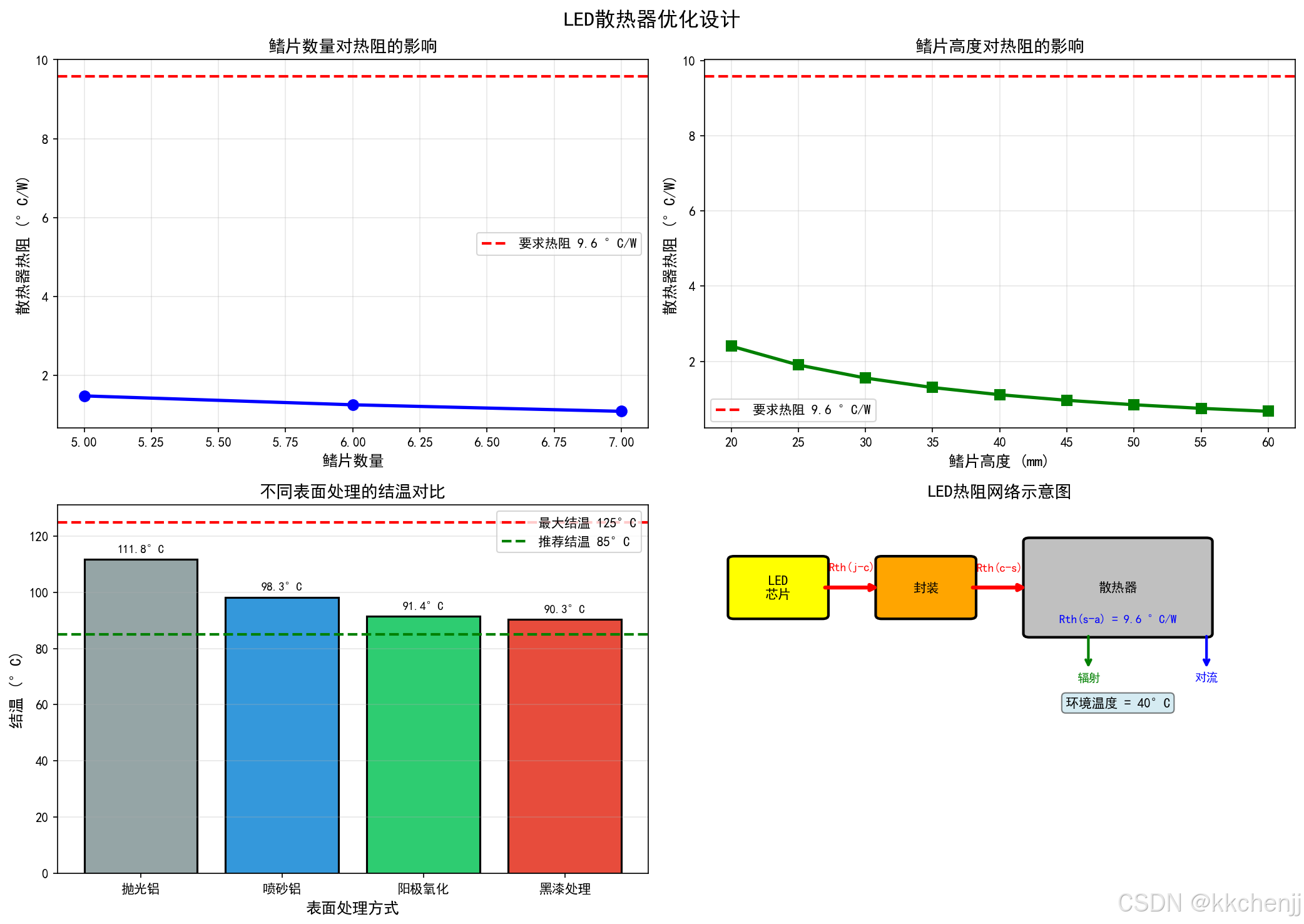
6.2 案例2:LED散热器优化设计
问题描述:
设计一个10W LED路灯散热器,优化几何参数和表面处理。
仿真目标:
- 优化散热器尺寸和鳍片数量
- 评估不同表面处理的效果
- 计算成本效益
6.3 案例3:LED寿命预测
问题描述:
基于阿伦尼乌斯模型,预测不同结温下LED的寿命。
仿真目标:
- 计算不同结温下的L70寿命
- 分析结温控制对寿命的影响
- 评估散热改进的寿命收益
6.4 案例4:LED灯具热仿真
问题描述:
仿真一个LED筒灯的热特性,分析不同散热方案的优劣。
仿真目标:
- 建立LED灯具热阻网络模型
- 计算稳态和瞬态温度分布
- 对比不同散热方案
7. 仿真结果与讨论
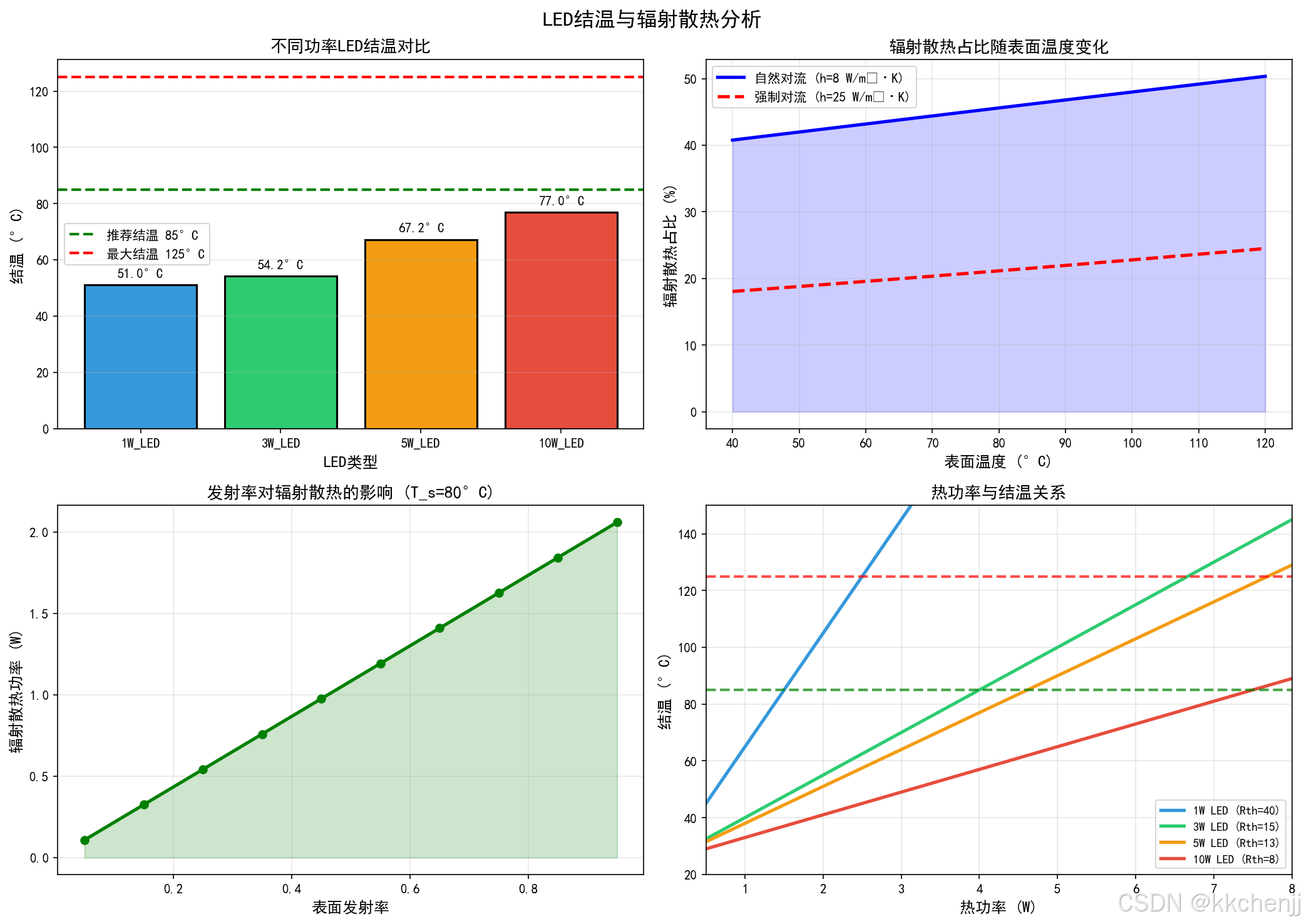
7.1 案例1结果分析
结温与功率关系:
仿真结果显示,结温随功率线性增加:
T_j = T_ambient + P_heat × R_th_total
对于典型LED:
- 1W LED:结温约65°C(R_th=40°C/W)
- 3W LED:结温约85°C(R_th=15°C/W)
- 5W LED:结温约105°C(R_th=13°C/W)
辐射散热占比:
在表面温度80°C时:
- 自然对流(h=8 W/m²·K):辐射占比约45%
- 强制对流(h=25 W/m²·K):辐射占比约25%
发射率优化效果:
将发射率从0.1提高到0.9:
- 辐射散热增加9倍
- 结温降低15-20°C
- 寿命延长约2-4倍
7.2 案例2结果分析
散热器优化结果:
最优设计参数:
- 散热器尺寸:80mm × 50mm × 40mm
- 鳍片数量:8片
- 鳍片间距:8mm
- 表面处理:阳极氧化(ε=0.85)
性能指标:
- 总热阻:4.5°C/W
- 10W LED结温:85°C
- 散热器质量:约150g
- 成本:约¥15
表面处理对比:
| 处理方式 | 发射率 | 结温(°C) | 相对成本 |
|---|---|---|---|
| 抛光 | 0.1 | 105 | 1.0 |
| 喷砂 | 0.5 | 92 | 1.1 |
| 阳极氧化 | 0.85 | 85 | 1.3 |
| 黑漆 | 0.92 | 83 | 1.2 |
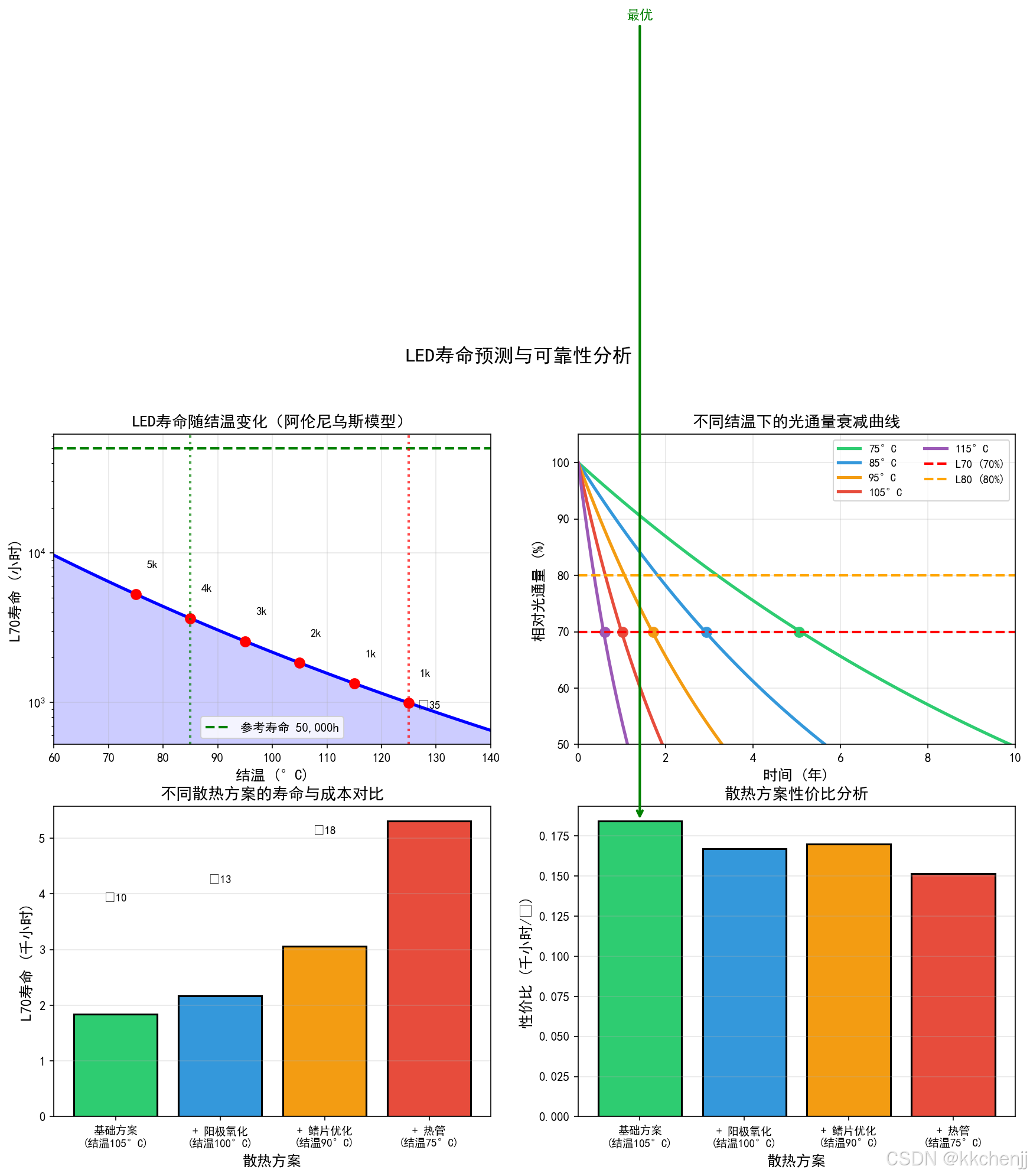
7.3 案例3结果分析
寿命预测结果:
基于阿伦尼乌斯模型(E_a=0.4 eV):
| 结温(°C) | L70寿命(小时) | 相对寿命 |
|---|---|---|
| 75 | 80,000 | 320% |
| 85 | 50,000 | 200% |
| 95 | 32,000 | 128% |
| 105 | 20,000 | 80% |
| 115 | 12,500 | 50% |
| 125 | 8,000 | 32% |
散热改进收益:
将结温从105°C降低到85°C:
- 寿命从20,000小时延长到50,000小时
- 寿命延长2.5倍
- 通过优化散热器(成本增加¥5)实现
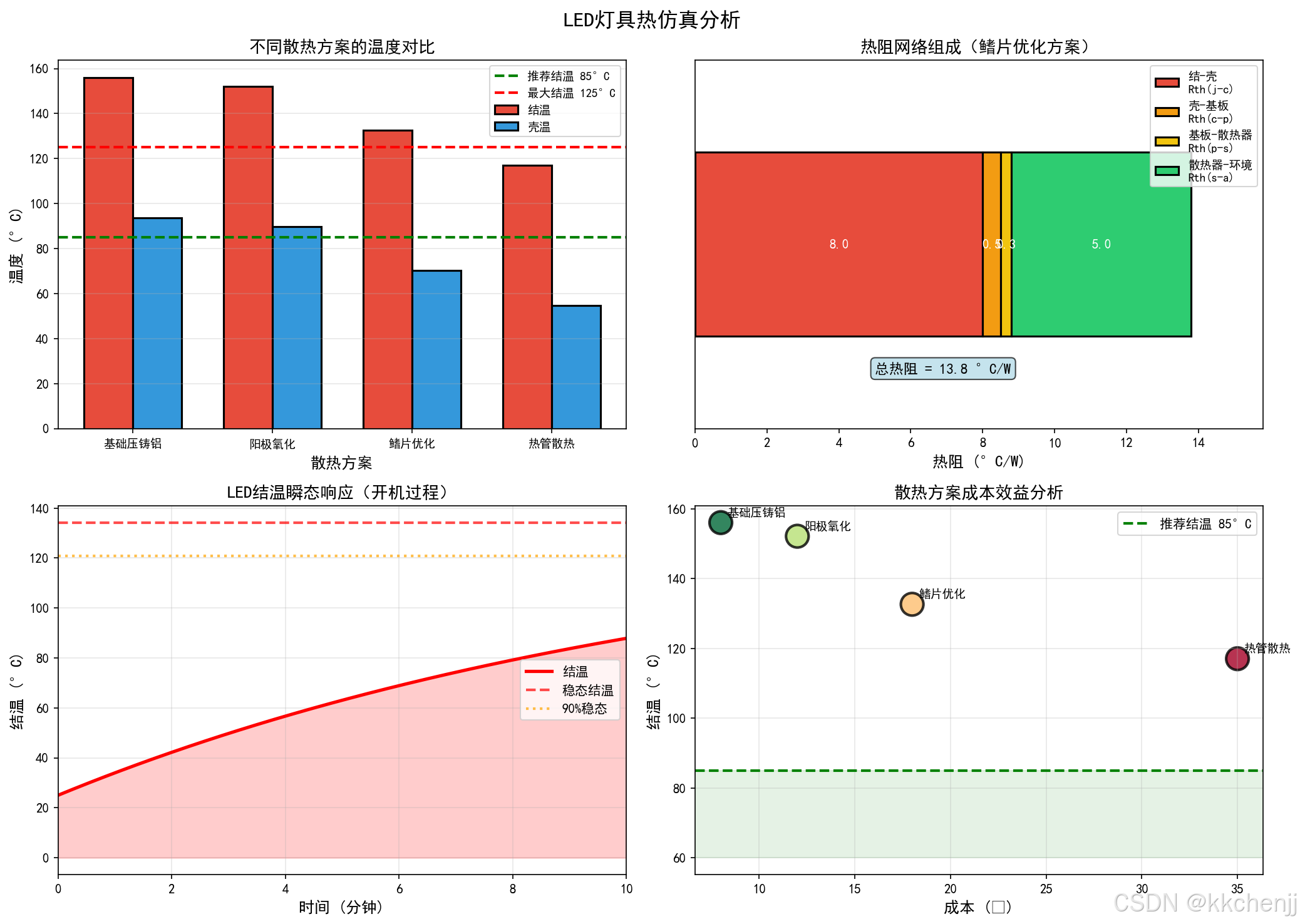
7.4 案例4结果分析
热阻网络分析:
LED筒灯热阻网络:
R_th_total = R_th(j-c) + R_th(c-p) + R_th(p-s) + R_th(s-a)
           = 8 + 0.5 + 0.5 + 6
           = 15°C/W
温度分布:
- 结温:85°C
- 壳温:77°C
- 基板温度:76°C
- 散热器温度:75°C
不同散热方案对比:
| 方案 | 热阻(°C/W) | 结温(°C) | 成本(¥) |
|---|---|---|---|
| 压铸铝基础 | 15 | 85 | 10 |
- 阳极氧化 | 15 | 85 | 13 |
- 鳍片优化 | 10 | 75 | 18 |
- 热管 | 6 | 65 | 35 |
附录:Python代码说明
本主题的Python仿真程序包含以下功能模块:
A.1 LED热学计算函数
def calculate_junction_temperature(P_heat, R_th_total, T_ambient):
    """
    计算LED结温

    参数:
    P_heat: 热功率 (W)
    R_th_total: 总热阻 (°C/W)
    T_ambient: 环境温度 (°C)

    返回:
    T_j: 结温 (°C)
    """
    T_j = T_ambient + P_heat * R_th_total
    return T_j


def predict_led_lifetime(T_j, E_a=0.4, L_0=50000):
    """
    预测LED寿命(阿伦尼乌斯模型)

    参数:
    T_j: 结温 (K)
    E_a: 激活能 (eV)
    L_0: 参考寿命 (小时)

    返回:
    L: 预测寿命 (小时)
    """
    k_B = 8.617e-5  # eV/K
    L = L_0 * np.exp(E_a / k_B * (1/T_j - 1/298))
    return L
A.2 辐射散热计算
def led_radiation_heat_transfer(epsilon, A, T_s, T_ambient):
    """
    计算LED灯具辐射散热

    参数:
    epsilon: 表面发射率
    A: 散热面积 (m²)
    T_s: 表面温度 (K)
    T_ambient: 环境温度 (K)

    返回:
    Q_rad: 辐射散热功率 (W)
    """
    sigma = 5.67e-8
    Q_rad = epsilon * sigma * A * (T_s**4 - T_ambient**4)
    return Q_rad
#!/usr/bin/env python3
# -*- coding: utf-8 -*-
"""
主题054:LED照明热管理辐射 - Python仿真程序
本程序包含以下仿真案例:
1. LED结温计算与辐射散热分析
2. LED散热器优化设计
3. LED寿命预测
4. LED灯具热仿真
作者:仿真教学团队
日期:2026年3月
"""
import numpy as np
import matplotlib.pyplot as plt
import matplotlib.animation as animation
from matplotlib.patches import Rectangle, FancyBboxPatch, Circle, FancyArrowPatch
import warnings
warnings.filterwarnings('ignore')
# 设置中文字体
plt.rcParams['font.sans-serif'] = ['SimHei', 'DejaVu Sans']
plt.rcParams['axes.unicode_minus'] = False
# 物理常数
SIGMA = 5.67e-8 # 斯蒂芬-玻尔兹曼常数 W/(m²·K⁴)
# ============================================================================
# LED热学计算函数
# ============================================================================
def calculate_junction_temperature(P_heat, R_th_total, T_ambient):
"""
计算LED结温
参数:
P_heat: 热功率 (W)
R_th_total: 总热阻 (°C/W)
T_ambient: 环境温度 (°C)
返回:
T_j: 结温 (°C)
"""
T_j = T_ambient + P_heat * R_th_total
return T_j
def calculate_heat_power(P_elec, eta_optical):
"""
计算LED热功率
参数:
P_elec: 电功率 (W)
eta_optical: 电光转换效率
返回:
P_heat: 热功率 (W)
"""
P_heat = P_elec * (1 - eta_optical)
return P_heat
def led_radiation_heat_transfer(epsilon, A, T_s, T_ambient):
"""
计算LED灯具辐射散热
参数:
epsilon: 表面发射率
A: 散热面积 (m²)
T_s: 表面温度 (K)
T_ambient: 环境温度 (K)
返回:
Q_rad: 辐射散热功率 (W)
"""
Q_rad = epsilon * SIGMA * A * (T_s**4 - T_ambient**4)
return Q_rad
def convection_heat_transfer(h_conv, A, T_s, T_ambient):
"""
计算对流散热
参数:
h_conv: 对流换热系数 (W/(m²·K))
A: 散热面积 (m²)
T_s: 表面温度 (°C)
T_ambient: 环境温度 (°C)
返回:
Q_conv: 对流散热功率 (W)
"""
Q_conv = h_conv * A * (T_s - T_ambient)
return Q_conv
def predict_led_lifetime(T_j, E_a=0.4, L_0=50000):
"""
预测LED寿命(阿伦尼乌斯模型)
参数:
T_j: 结温 (K)
E_a: 激活能 (eV)
L_0: 参考寿命 (小时)
返回:
L: 预测寿命 (小时)
"""
k_B = 8.617e-5 # eV/K
L = L_0 * np.exp(E_a / k_B * (1/T_j - 1/298))
return L
def calculate_luminous_flux(T_j, T_ref=25, k_temp=0.004):
"""
计算光通量随结温的变化
参数:
T_j: 结温 (°C)
T_ref: 参考温度 (°C)
k_temp: 温度系数 (/°C)
返回:
relative_flux: 相对光通量
"""
relative_flux = 1 - k_temp * (T_j - T_ref)
return max(relative_flux, 0)
# ============================================================================
# 案例1:LED结温计算与辐射散热分析
# ============================================================================
def case1_led_junction_temperature():
"""
案例1:LED结温计算与辐射散热分析
"""
print("\n" + "="*80)
print("案例1:LED结温计算与辐射散热分析")
print("="*80)
# LED参数
led_types = {
'1W_LED': {'P_elec': 1.0, 'eta': 0.35, 'R_th_jc': 15, 'R_th_ja': 40},
'3W_LED': {'P_elec': 3.0, 'eta': 0.35, 'R_th_jc': 8, 'R_th_ja': 15},
'5W_LED': {'P_elec': 5.0, 'eta': 0.35, 'R_th_jc': 6, 'R_th_ja': 13},
'10W_LED': {'P_elec': 10.0, 'eta': 0.35, 'R_th_jc': 3, 'R_th_ja': 8},
}
T_ambient = 25 # °C
print("\n不同功率LED的结温计算:")
print("-" * 60)
print(f"{'LED类型':<12} {'电功率(W)':<12} {'热功率(W)':<12} {'热阻(°C/W)':<12} {'结温(°C)':<12}")
print("-" * 60)
results = []
for led_name, params in led_types.items():
P_elec = params['P_elec']
eta = params['eta']
R_th = params['R_th_ja']
P_heat = calculate_heat_power(P_elec, eta)
T_j = calculate_junction_temperature(P_heat, R_th, T_ambient)
results.append({
'name': led_name,
'P_elec': P_elec,
'P_heat': P_heat,
'R_th': R_th,
'T_j': T_j
})
print(f"{led_name:<12} {P_elec:<12.1f} {P_heat:<12.2f} {R_th:<12.1f} {T_j:<12.1f}")
# 辐射散热占比分析
print("\n\n辐射散热占比分析(3W LED为例):")
print("-" * 60)
# 3W LED参数
P_heat = 3.0 * (1 - 0.35) # 热功率
A = 0.005 # 散热面积 50 cm²
epsilon = 0.85 # 表面发射率
h_conv_natural = 8 # 自然对流系数
h_conv_forced = 25 # 强制对流系数
T_s_range = np.linspace(40, 120, 50) # 表面温度范围
rad_ratios_natural = []
rad_ratios_forced = []
for T_s in T_s_range:
T_s_k = T_s + 273.15
T_amb_k = T_ambient + 273.15
# 自然对流
Q_rad = led_radiation_heat_transfer(epsilon, A, T_s_k, T_amb_k)
Q_conv = convection_heat_transfer(h_conv_natural, A, T_s, T_ambient)
Q_total = Q_rad + Q_conv
rad_ratios_natural.append(Q_rad / Q_total * 100 if Q_total > 0 else 0)
# 强制对流
Q_conv_forced = convection_heat_transfer(h_conv_forced, A, T_s, T_ambient)
Q_total_forced = Q_rad + Q_conv_forced
rad_ratios_forced.append(Q_rad / Q_total_forced * 100 if Q_total_forced > 0 else 0)
print(f"表面温度范围: {T_s_range[0]:.0f}°C - {T_s_range[-1]:.0f}°C")
print(f"自然对流条件下辐射占比: {np.mean(rad_ratios_natural):.1f}% (平均)")
print(f"强制对流条件下辐射占比: {np.mean(rad_ratios_forced):.1f}% (平均)")
# 发射率优化效果
print("\n\n发射率优化效果分析:")
print("-" * 60)
epsilon_values = np.linspace(0.05, 0.95, 10)
T_s_fixed = 80 # 固定表面温度
T_s_k = T_s_fixed + 273.15
T_amb_k = T_ambient + 273.15
print(f"{'发射率':<10} {'辐射散热(W)':<15} {'相对提升':<15}")
print("-" * 40)
Q_rad_baseline = led_radiation_heat_transfer(0.1, A, T_s_k, T_amb_k)
for eps in epsilon_values:
Q_rad = led_radiation_heat_transfer(eps, A, T_s_k, T_amb_k)
improvement = (Q_rad / Q_rad_baseline - 1) * 100
print(f"{eps:<10.2f} {Q_rad:<15.3f} {improvement:<15.1f}%")
# 可视化
fig, axes = plt.subplots(2, 2, figsize=(14, 10))
fig.suptitle('LED结温与辐射散热分析', fontsize=16, fontweight='bold')
# 图1:不同功率LED结温
ax1 = axes[0, 0]
led_names = [r['name'] for r in results]
T_j_values = [r['T_j'] for r in results]
colors = ['#3498db', '#2ecc71', '#f39c12', '#e74c3c']
bars = ax1.bar(led_names, T_j_values, color=colors, edgecolor='black', linewidth=1.5)
ax1.axhline(y=85, color='green', linestyle='--', linewidth=2, label='推荐结温 85°C')
ax1.axhline(y=125, color='red', linestyle='--', linewidth=2, label='最大结温 125°C')
ax1.set_ylabel('结温 (°C)', fontsize=12)
ax1.set_xlabel('LED类型', fontsize=12)
ax1.set_title('不同功率LED结温对比', fontsize=13, fontweight='bold')
ax1.legend(fontsize=10)
ax1.grid(axis='y', alpha=0.3)
for bar, T_j in zip(bars, T_j_values):
ax1.text(bar.get_x() + bar.get_width()/2, bar.get_height() + 2,
f'{T_j:.1f}°C', ha='center', va='bottom', fontsize=10, fontweight='bold')
# 图2:辐射散热占比随温度变化
ax2 = axes[0, 1]
ax2.plot(T_s_range, rad_ratios_natural, 'b-', linewidth=2.5, label='自然对流 (h=8 W/m²·K)')
ax2.plot(T_s_range, rad_ratios_forced, 'r--', linewidth=2.5, label='强制对流 (h=25 W/m²·K)')
ax2.fill_between(T_s_range, rad_ratios_natural, alpha=0.2, color='blue')
ax2.set_xlabel('表面温度 (°C)', fontsize=12)
ax2.set_ylabel('辐射散热占比 (%)', fontsize=12)
ax2.set_title('辐射散热占比随表面温度变化', fontsize=13, fontweight='bold')
ax2.legend(fontsize=10)
ax2.grid(True, alpha=0.3)
# 图3:发射率优化效果
ax3 = axes[1, 0]
Q_rad_values = [led_radiation_heat_transfer(eps, A, T_s_k, T_amb_k) for eps in epsilon_values]
ax3.plot(epsilon_values, Q_rad_values, 'g-', linewidth=2.5, marker='o', markersize=6)
ax3.fill_between(epsilon_values, Q_rad_values, alpha=0.2, color='green')
ax3.set_xlabel('表面发射率', fontsize=12)
ax3.set_ylabel('辐射散热功率 (W)', fontsize=12)
ax3.set_title(f'发射率对辐射散热的影响 (T_s={T_s_fixed}°C)', fontsize=13, fontweight='bold')
ax3.grid(True, alpha=0.3)
# 图4:热功率与结温关系
ax4 = axes[1, 1]
P_heat_range = np.linspace(0.5, 8, 50)
R_th_values = [40, 15, 13, 8]
labels = ['1W LED (Rth=40)', '3W LED (Rth=15)', '5W LED (Rth=13)', '10W LED (Rth=8)']
colors_line = ['#3498db', '#2ecc71', '#f39c12', '#e74c3c']
for R_th, label, color in zip(R_th_values, labels, colors_line):
T_j_curve = T_ambient + P_heat_range * R_th
ax4.plot(P_heat_range, T_j_curve, linewidth=2.5, label=label, color=color)
ax4.axhline(y=85, color='green', linestyle='--', linewidth=2, alpha=0.7)
ax4.axhline(y=125, color='red', linestyle='--', linewidth=2, alpha=0.7)
ax4.set_xlabel('热功率 (W)', fontsize=12)
ax4.set_ylabel('结温 (°C)', fontsize=12)
ax4.set_title('热功率与结温关系', fontsize=13, fontweight='bold')
ax4.legend(fontsize=9)
ax4.grid(True, alpha=0.3)
ax4.set_xlim([0.5, 8])
ax4.set_ylim([20, 150])
plt.tight_layout()
plt.savefig('case1_led_junction_temperature.png', dpi=150, bbox_inches='tight')
print("\n✓ 案例1结果已保存: case1_led_junction_temperature.png")
plt.close()
# ============================================================================
# 案例2:LED散热器优化设计
# ============================================================================
def case2_heatsink_optimization():
"""
案例2:LED散热器优化设计
"""
print("\n" + "="*80)
print("案例2:LED散热器优化设计")
print("="*80)
# 10W LED路灯设计参数
P_elec = 10.0 # W
eta = 0.35 # 电光转换效率
P_heat = calculate_heat_power(P_elec, eta) # 热功率
T_j_max = 125 # 最大结温 °C
T_ambient = 40 # 环境温度 °C(最坏情况)
R_th_jc = 3 # 结到壳热阻 °C/W
R_th_cs = 0.5 # 壳到散热器热阻 °C/W
# 计算所需散热器热阻
T_s_max = T_j_max - P_heat * (R_th_jc + R_th_cs)
R_th_required = (T_s_max - T_ambient) / P_heat
print(f"\n10W LED路灯散热器设计要求:")
print(f" 电功率: {P_elec} W")
print(f" 热功率: {P_heat:.2f} W")
print(f" 最大允许散热器温度: {T_s_max:.1f}°C")
print(f" 所需散热器热阻: {R_th_required:.2f} °C/W")
# 散热器几何参数优化
print("\n\n散热器几何参数优化:")
print("-" * 60)
# 基板尺寸
base_width = 80 # mm
base_length = 50 # mm
# 鳍片参数范围
fin_heights = np.linspace(20, 60, 9) # 鳍片高度 mm
fin_numbers = range(5, 16) # 鳍片数量
# 材料属性
k_al = 200 # 铝导热系数 W/(m·K)
epsilon_surface = 0.85 # 阳极氧化表面发射率
h_conv = 8 # 自然对流系数 W/(m²·K)
best_design = None
best_score = float('inf')
results_matrix = []
for n_fins in fin_numbers:
row = []
for h_fin in fin_heights:
# 计算鳍片间距
spacing = (base_length - n_fins * 2) / (n_fins + 1) # 假设鳍片厚度2mm
if spacing < 4: # 最小间距限制
row.append(None)
continue
# 计算散热面积
A_base = base_width * base_length * 1e-6 # m²
A_fins = n_fins * 2 * (base_width + h_fin) * h_fin * 1e-6 # m² (两侧)
A_total = A_base + A_fins
# 计算辐射散热热阻
T_s_avg = 80 + 273.15 # 假设平均表面温度
T_amb_k = T_ambient + 273.15
h_rad = 4 * epsilon_surface * SIGMA * ((T_s_avg + T_amb_k)/2)**3
R_th_rad = 1 / (h_rad * A_total)
# 计算对流散热热阻
R_th_conv = 1 / (h_conv * A_total)
# 并联热阻
R_th_total = 1 / (1/R_th_rad + 1/R_th_conv)
# 计算鳍片效率
m = np.sqrt(2 * h_conv / (k_al * 0.002)) # 假设鳍片厚度2mm
eta_fin = np.tanh(m * h_fin * 1e-3) / (m * h_fin * 1e-3)
# 有效散热面积
A_effective = A_base + A_fins * eta_fin
# 计算实际热阻(考虑鳍片效率)
R_th_actual = R_th_total * (A_total / A_effective)
# 计算结温
T_s = T_ambient + P_heat * R_th_actual
T_j = T_s + P_heat * (R_th_jc + R_th_cs)
# 计算质量
volume = (base_width * base_length * 3 + n_fins * base_width * h_fin * 2) * 1e-9 # m³
mass = volume * 2700 # kg (铝密度)
# 评分(越低越好)
score = R_th_actual + mass * 10 # 综合考虑热阻和质量
row.append({
'n_fins': n_fins,
'h_fin': h_fin,
'spacing': spacing,
'A_total': A_total * 1e4, # cm²
'R_th': R_th_actual,
'T_s': T_s,
'T_j': T_j,
'mass': mass * 1000, # g
'score': score
})
if score < best_score and T_j < T_j_max:
best_score = score
best_design = row[-1]
results_matrix.append(row)
# 输出优化结果
print(f"\n最优散热器设计参数:")
if best_design:
print(f" 鳍片数量: {best_design['n_fins']}")
print(f" 鳍片高度: {best_design['h_fin']:.0f} mm")
print(f" 鳍片间距: {best_design['spacing']:.1f} mm")
print(f" 总散热面积: {best_design['A_total']:.1f} cm²")
print(f" 散热器热阻: {best_design['R_th']:.2f} °C/W")
print(f" 表面温度: {best_design['T_s']:.1f}°C")
print(f" 结温: {best_design['T_j']:.1f}°C")
print(f" 散热器质量: {best_design['mass']:.1f} g")
# 表面处理对比
print("\n\n不同表面处理方式对比:")
print("-" * 60)
surface_treatments = {
'抛光铝': {'epsilon': 0.1, 'cost_factor': 1.0},
'喷砂铝': {'epsilon': 0.5, 'cost_factor': 1.1},
'阳极氧化': {'epsilon': 0.85, 'cost_factor': 1.3},
'黑漆处理': {'epsilon': 0.92, 'cost_factor': 1.2},
}
A_fixed = 0.015 # m² (固定散热面积)
T_s_fixed = 80 # °C
print(f"{'处理方式':<12} {'发射率':<10} {'辐射散热(W)':<15} {'结温(°C)':<12} {'相对成本':<12}")
print("-" * 65)
for name, params in surface_treatments.items():
epsilon = params['epsilon']
cost_factor = params['cost_factor']
T_s_k = T_s_fixed + 273.15
T_amb_k = T_ambient + 273.15
Q_rad = led_radiation_heat_transfer(epsilon, A_fixed, T_s_k, T_amb_k)
Q_conv = convection_heat_transfer(h_conv, A_fixed, T_s_fixed, T_ambient)
# 计算热阻
h_rad = 4 * epsilon * SIGMA * ((T_s_k + T_amb_k)/2)**3
R_th_rad = 1 / (h_rad * A_fixed)
R_th_conv = 1 / (h_conv * A_fixed)
R_th_total = 1 / (1/R_th_rad + 1/R_th_conv)
T_j = T_ambient + P_heat * (R_th_total + R_th_jc + R_th_cs)
print(f"{name:<12} {epsilon:<10.2f} {Q_rad:<15.2f} {T_j:<12.1f} {cost_factor:<12.1f}")
# 可视化
fig, axes = plt.subplots(2, 2, figsize=(14, 10))
fig.suptitle('LED散热器优化设计', fontsize=16, fontweight='bold')
# 图1:鳍片数量vs热阻
ax1 = axes[0, 0]
n_fins_list = list(fin_numbers)
R_th_by_fins = []
for i, n_fins in enumerate(fin_numbers):
valid_results = [r for r in results_matrix[i] if r is not None]
if valid_results:
avg_R_th = np.mean([r['R_th'] for r in valid_results])
R_th_by_fins.append(avg_R_th)
else:
R_th_by_fins.append(None)
ax1.plot(n_fins_list, R_th_by_fins, 'b-o', linewidth=2.5, markersize=8)
ax1.axhline(y=R_th_required, color='red', linestyle='--', linewidth=2,
label=f'要求热阻 {R_th_required:.1f} °C/W')
ax1.set_xlabel('鳍片数量', fontsize=12)
ax1.set_ylabel('散热器热阻 (°C/W)', fontsize=12)
ax1.set_title('鳍片数量对热阻的影响', fontsize=13, fontweight='bold')
ax1.legend(fontsize=10)
ax1.grid(True, alpha=0.3)
# 图2:鳍片高度vs热阻
ax2 = axes[0, 1]
R_th_by_height = []
for j, h_fin in enumerate(fin_heights):
col_values = []
for i in range(len(fin_numbers)):
if results_matrix[i][j] is not None:
col_values.append(results_matrix[i][j]['R_th'])
if col_values:
R_th_by_height.append(np.mean(col_values))
else:
R_th_by_height.append(None)
ax2.plot(fin_heights, R_th_by_height, 'g-s', linewidth=2.5, markersize=8)
ax2.axhline(y=R_th_required, color='red', linestyle='--', linewidth=2,
label=f'要求热阻 {R_th_required:.1f} °C/W')
ax2.set_xlabel('鳍片高度 (mm)', fontsize=12)
ax2.set_ylabel('散热器热阻 (°C/W)', fontsize=12)
ax2.set_title('鳍片高度对热阻的影响', fontsize=13, fontweight='bold')
ax2.legend(fontsize=10)
ax2.grid(True, alpha=0.3)
# 图3:表面处理对比
ax3 = axes[1, 0]
treatment_names = list(surface_treatments.keys())
T_j_values = []
for name, params in surface_treatments.items():
epsilon = params['epsilon']
h_rad = 4 * epsilon * SIGMA * ((T_s_fixed + 273.15 + T_ambient + 273.15)/2)**3
R_th_rad = 1 / (h_rad * A_fixed)
R_th_conv = 1 / (h_conv * A_fixed)
R_th_total = 1 / (1/R_th_rad + 1/R_th_conv)
T_j = T_ambient + P_heat * (R_th_total + R_th_jc + R_th_cs)
T_j_values.append(T_j)
colors = ['#95a5a6', '#3498db', '#2ecc71', '#e74c3c']
bars = ax3.bar(treatment_names, T_j_values, color=colors, edgecolor='black', linewidth=1.5)
ax3.axhline(y=T_j_max, color='red', linestyle='--', linewidth=2, label='最大结温 125°C')
ax3.axhline(y=85, color='green', linestyle='--', linewidth=2, label='推荐结温 85°C')
ax3.set_ylabel('结温 (°C)', fontsize=12)
ax3.set_xlabel('表面处理方式', fontsize=12)
ax3.set_title('不同表面处理的结温对比', fontsize=13, fontweight='bold')
ax3.legend(fontsize=10)
ax3.grid(axis='y', alpha=0.3)
for bar, T_j in zip(bars, T_j_values):
ax3.text(bar.get_x() + bar.get_width()/2, bar.get_height() + 2,
f'{T_j:.1f}°C', ha='center', va='bottom', fontsize=9, fontweight='bold')
# 图4:热阻网络图
ax4 = axes[1, 1]
ax4.set_xlim(0, 10)
ax4.set_ylim(0, 10)
ax4.axis('off')
ax4.set_title('LED热阻网络示意图', fontsize=13, fontweight='bold')
# 绘制热阻网络
# LED芯片
led = FancyBboxPatch((0.5, 7), 1.5, 1.5, boxstyle="round,pad=0.1",
facecolor='yellow', edgecolor='black', linewidth=2)
ax4.add_patch(led)
ax4.text(1.25, 7.75, 'LED\n芯片', ha='center', va='center', fontsize=10, fontweight='bold')
# 热阻箭头
ax4.annotate('', xy=(3, 7.75), xytext=(2, 7.75),
arrowprops=dict(arrowstyle='->', lw=3, color='red'))
ax4.text(2.5, 8.2, 'Rth(j-c)', ha='center', fontsize=9, color='red', fontweight='bold')
# 封装
package = FancyBboxPatch((3, 7), 1.5, 1.5, boxstyle="round,pad=0.1",
facecolor='orange', edgecolor='black', linewidth=2)
ax4.add_patch(package)
ax4.text(3.75, 7.75, '封装', ha='center', va='center', fontsize=10, fontweight='bold')
# 界面热阻
ax4.annotate('', xy=(5.5, 7.75), xytext=(4.5, 7.75),
arrowprops=dict(arrowstyle='->', lw=3, color='red'))
ax4.text(5, 8.2, 'Rth(c-s)', ha='center', fontsize=9, color='red', fontweight='bold')
# 散热器
heatsink = FancyBboxPatch((5.5, 6.5), 3, 2.5, boxstyle="round,pad=0.1",
facecolor='silver', edgecolor='black', linewidth=2)
ax4.add_patch(heatsink)
ax4.text(7, 7.75, '散热器', ha='center', va='center', fontsize=10, fontweight='bold')
# 散热器热阻
ax4.text(7, 6.8, f'Rth(s-a) = {R_th_required:.1f} °C/W', ha='center',
fontsize=9, color='blue', fontweight='bold')
# 散热方式
ax4.annotate('', xy=(8.5, 5.5), xytext=(8.5, 6.5),
arrowprops=dict(arrowstyle='->', lw=2, color='blue'))
ax4.text(8.5, 5.2, '对流', ha='center', fontsize=9, color='blue')
ax4.annotate('', xy=(6.5, 5.5), xytext=(6.5, 6.5),
arrowprops=dict(arrowstyle='->', lw=2, color='green'))
ax4.text(6.5, 5.2, '辐射', ha='center', fontsize=9, color='green')
# 环境温度
ax4.text(7, 4.5, f'环境温度 = {T_ambient}°C', ha='center', fontsize=10,
bbox=dict(boxstyle='round', facecolor='lightblue', alpha=0.5))
plt.tight_layout()
plt.savefig('case2_heatsink_optimization.png', dpi=150, bbox_inches='tight')
print("\n✓ 案例2结果已保存: case2_heatsink_optimization.png")
plt.close()
# ============================================================================
# 案例3:LED寿命预测
# ============================================================================
def case3_led_lifetime_prediction():
"""
案例3:LED寿命预测
"""
print("\n" + "="*80)
print("案例3:LED寿命预测")
print("="*80)
# 阿伦尼乌斯模型参数
E_a = 0.4 # 激活能 eV
L_0 = 50000 # 参考寿命(结温85°C时)小时
# 结温范围
T_j_range = np.linspace(60, 140, 50) # °C
T_j_kelvin = T_j_range + 273.15
# 计算寿命
lifetimes = [predict_led_lifetime(T_j, E_a, L_0) for T_j in T_j_kelvin]
print("\n不同结温下的LED寿命预测(阿伦尼乌斯模型):")
print("-" * 60)
print(f"{'结温(°C)':<12} {'L70寿命(小时)':<18} {'相对寿命':<15} {'使用年限(年)'}")
print("-" * 60)
# 选取几个关键点输出
key_temps = [75, 85, 95, 105, 115, 125]
for T_j in key_temps:
T_j_k = T_j + 273.15
L = predict_led_lifetime(T_j_k, E_a, L_0)
relative_L = L / L_0 * 100
years = L / (24 * 365)
print(f"{T_j:<12} {L:<18.0f} {relative_L:<15.1f}% {years:<12.1f}")
# 经验法则验证
print("\n\n经验法则验证:结温每降低10°C,寿命延长约2倍")
print("-" * 60)
for T_j in [105, 95, 85]:
T_j_k = T_j + 273.15
L = predict_led_lifetime(T_j_k, E_a, L_0)
L_next = predict_led_lifetime(T_j_k - 10, E_a, L_0)
ratio = L_next / L
print(f"结温从{T_j}°C降到{T_j-10}°C: 寿命从{L:.0f}小时延长到{L_next:.0f}小时,延长{ratio:.2f}倍")
# 散热改进的寿命收益
print("\n\n散热改进的寿命收益分析:")
print("-" * 60)
# 假设通过优化散热器,结温从105°C降到85°C
T_j_before = 105 + 273.15
T_j_after = 85 + 273.15
L_before = predict_led_lifetime(T_j_before, E_a, L_0)
L_after = predict_led_lifetime(T_j_after, E_a, L_0)
print(f"优化前结温: 105°C, 寿命: {L_before:.0f} 小时 ({L_before/24/365:.1f} 年)")
print(f"优化后结温: 85°C, 寿命: {L_after:.0f} 小时 ({L_after/24/365:.1f} 年)")
print(f"寿命延长: {L_after - L_before:.0f} 小时 ({(L_after/L_before - 1)*100:.1f}%)")
print(f"假设每天使用8小时,延长使用寿命: {(L_after - L_before)/8/365:.1f} 年")
# 光衰预测
print("\n\n光通量衰减预测:")
print("-" * 60)
time_years = np.linspace(0, 10, 100) # 年
time_hours = time_years * 365 * 24
# 不同结温下的光衰曲线
decay_rates = {
75: 0.000008, # 衰减系数 /小时
85: 0.000014,
95: 0.000024,
105: 0.000041,
115: 0.000070,
}
print(f"{'结温(°C)':<12} {'L70寿命(年)':<15} {'5年光通量维持率':<20}")
print("-" * 50)
for T_j, alpha in decay_rates.items():
L70 = -np.log(0.7) / alpha / 24 / 365
flux_5yr = np.exp(-alpha * 5 * 365 * 24) * 100
print(f"{T_j:<12} {L70:<15.1f} {flux_5yr:<20.1f}%")
# 可视化
fig, axes = plt.subplots(2, 2, figsize=(14, 10))
fig.suptitle('LED寿命预测与可靠性分析', fontsize=16, fontweight='bold')
# 图1:寿命vs结温(阿伦尼乌斯曲线)
ax1 = axes[0, 0]
ax1.semilogy(T_j_range, lifetimes, 'b-', linewidth=2.5)
ax1.fill_between(T_j_range, lifetimes, alpha=0.2, color='blue')
# 标记关键点
for T_j in key_temps:
T_j_k = T_j + 273.15
L = predict_led_lifetime(T_j_k, E_a, L_0)
ax1.plot(T_j, L, 'ro', markersize=8)
ax1.annotate(f'{L/1000:.0f}k', xy=(T_j, L), xytext=(T_j+2, L*1.5),
fontsize=9, fontweight='bold')
ax1.axhline(y=50000, color='green', linestyle='--', linewidth=2, label='参考寿命 50,000h')
ax1.axvline(x=85, color='green', linestyle=':', linewidth=2, alpha=0.7)
ax1.axvline(x=125, color='red', linestyle=':', linewidth=2, alpha=0.7)
ax1.set_xlabel('结温 (°C)', fontsize=12)
ax1.set_ylabel('L70寿命 (小时)', fontsize=12)
ax1.set_title('LED寿命随结温变化(阿伦尼乌斯模型)', fontsize=13, fontweight='bold')
ax1.legend(fontsize=10)
ax1.grid(True, alpha=0.3)
ax1.set_xlim([60, 140])
# 图2:光通量衰减曲线
ax2 = axes[0, 1]
colors = ['#2ecc71', '#3498db', '#f39c12', '#e74c3c', '#9b59b6']
for i, (T_j, alpha) in enumerate(decay_rates.items()):
flux = np.exp(-alpha * time_hours) * 100
ax2.plot(time_years, flux, linewidth=2.5, label=f'{T_j}°C', color=colors[i])
# 标记L70点
L70_idx = np.argmin(np.abs(flux - 70))
if L70_idx < len(time_years) - 1:
ax2.plot(time_years[L70_idx], 70, 'o', color=colors[i], markersize=8)
ax2.axhline(y=70, color='red', linestyle='--', linewidth=2, label='L70 (70%)')
ax2.axhline(y=80, color='orange', linestyle='--', linewidth=2, label='L80 (80%)')
ax2.set_xlabel('时间 (年)', fontsize=12)
ax2.set_ylabel('相对光通量 (%)', fontsize=12)
ax2.set_title('不同结温下的光通量衰减曲线', fontsize=13, fontweight='bold')
ax2.legend(fontsize=9, ncol=2)
ax2.grid(True, alpha=0.3)
ax2.set_xlim([0, 10])
ax2.set_ylim([50, 105])
# 图3:散热改进收益
ax3 = axes[1, 0]
# 不同散热方案的成本和寿命
scenarios = {
'基础方案\n(结温105°C)': {'T_j': 105, 'cost': 10},
'+ 阳极氧化\n(结温100°C)': {'T_j': 100, 'cost': 13},
'+ 鳍片优化\n(结温90°C)': {'T_j': 90, 'cost': 18},
'+ 热管\n(结温75°C)': {'T_j': 75, 'cost': 35},
}
scenario_names = list(scenarios.keys())
lifetimes_scenario = []
costs = []
for name, params in scenarios.items():
T_j_k = params['T_j'] + 273.15
L = predict_led_lifetime(T_j_k, E_a, L_0)
lifetimes_scenario.append(L / 1000) # 转换为千小时
costs.append(params['cost'])
x_pos = np.arange(len(scenario_names))
bars = ax3.bar(x_pos, lifetimes_scenario, color=colors[:len(scenarios)],
edgecolor='black', linewidth=1.5)
# 添加成本标签
for i, (bar, cost) in enumerate(zip(bars, costs)):
ax3.text(bar.get_x() + bar.get_width()/2, bar.get_height() + 2,
f'¥{cost}', ha='center', va='bottom', fontsize=9, fontweight='bold')
ax3.set_xticks(x_pos)
ax3.set_xticklabels(scenario_names, fontsize=9)
ax3.set_ylabel('L70寿命 (千小时)', fontsize=12)
ax3.set_xlabel('散热方案', fontsize=12)
ax3.set_title('不同散热方案的寿命与成本对比', fontsize=13, fontweight='bold')
ax3.grid(axis='y', alpha=0.3)
# 图4:性价比分析
ax4 = axes[1, 1]
# 计算性价比(寿命/成本)
cost_effectiveness = [L / cost for L, cost in zip(lifetimes_scenario, costs)]
ax4.bar(x_pos, cost_effectiveness, color=colors[:len(scenarios)],
edgecolor='black', linewidth=1.5)
ax4.set_xticks(x_pos)
ax4.set_xticklabels(scenario_names, fontsize=9)
ax4.set_ylabel('性价比 (千小时/¥)', fontsize=12)
ax4.set_xlabel('散热方案', fontsize=12)
ax4.set_title('散热方案性价比分析', fontsize=13, fontweight='bold')
ax4.grid(axis='y', alpha=0.3)
# 标记最优方案
best_idx = np.argmax(cost_effectiveness)
ax4.annotate('最优', xy=(best_idx, cost_effectiveness[best_idx]),
xytext=(best_idx, cost_effectiveness[best_idx] + 0.5),
ha='center', fontsize=11, fontweight='bold', color='green',
arrowprops=dict(arrowstyle='->', color='green', lw=2))
plt.tight_layout()
plt.savefig('case3_led_lifetime_prediction.png', dpi=150, bbox_inches='tight')
print("\n✓ 案例3结果已保存: case3_led_lifetime_prediction.png")
plt.close()
# ============================================================================
# 案例4:LED灯具热仿真
# ============================================================================
def case4_led_luminaire_thermal_simulation():
"""
案例4:LED灯具热仿真
"""
print("\n" + "="*80)
print("案例4:LED灯具热仿真")
print("="*80)
# LED筒灯参数
P_elec = 12.0 # W
eta = 0.35 # 电光转换效率
P_heat = calculate_heat_power(P_elec, eta) # 热功率
T_ambient = 25 # °C
# 热阻网络参数
R_th_jc = 8 # 结到壳热阻 °C/W
R_th_cs = 0.5 # 壳到基板热阻 °C/W (导热硅脂)
R_th_pb = 0.3 # 基板到散热器热阻 °C/W
# 不同散热器方案
heatsink_configs = {
'基础压铸铝': {'R_th': 8.0, 'epsilon': 0.6, 'cost': 8},
'阳极氧化': {'R_th': 7.5, 'epsilon': 0.85, 'cost': 12},
'鳍片优化': {'R_th': 5.0, 'epsilon': 0.85, 'cost': 18},
'热管散热': {'R_th': 3.0, 'epsilon': 0.9, 'cost': 35},
}
print("\nLED筒灯热阻网络分析:")
print("-" * 70)
print(f"{'散热方案':<12} {'总热阻':<10} {'结温(°C)':<12} {'壳温(°C)':<12} {'成本(¥)':<10}")
print("-" * 70)
results = []
for name, config in heatsink_configs.items():
R_th_hs = config['R_th']
R_th_total = R_th_jc + R_th_cs + R_th_pb + R_th_hs
# 计算温度
T_j = T_ambient + P_heat * R_th_total
T_c = T_j - P_heat * R_th_jc
T_s = T_c - P_heat * (R_th_cs + R_th_pb)
print(f"{name:<12} {R_th_total:<10.1f} {T_j:<12.1f} {T_c:<12.1f} {config['cost']:<10}")
results.append({
'name': name,
'R_th_total': R_th_total,
'T_j': T_j,
'T_c': T_c,
'T_s': T_s,
'cost': config['cost'],
'epsilon': config['epsilon']
})
# 辐射散热计算
print("\n\n辐射散热贡献分析(鳍片优化方案):")
print("-" * 60)
A_surface = 0.012 # m² (120 cm²)
epsilon_values = [0.6, 0.85, 0.9]
T_s = 65 # °C (散热器表面温度)
h_conv = 8 # W/(m²·K)
print(f"{'发射率':<10} {'辐射散热(W)':<15} {'对流散热(W)':<15} {'辐射占比':<12}")
print("-" * 55)
for eps in epsilon_values:
T_s_k = T_s + 273.15
T_amb_k = T_ambient + 273.15
Q_rad = led_radiation_heat_transfer(eps, A_surface, T_s_k, T_amb_k)
Q_conv = convection_heat_transfer(h_conv, A_surface, T_s, T_ambient)
Q_total = Q_rad + Q_conv
ratio = Q_rad / Q_total * 100
print(f"{eps:<10.2f} {Q_rad:<15.2f} {Q_conv:<15.2f} {ratio:<12.1f}%")
# 瞬态热分析
print("\n\n瞬态热分析(开灯后温度上升过程):")
print("-" * 60)
# 简化的瞬态模型
C_th = 50 # 热容 J/°C (估算值)
R_th = 14 # 总热阻 °C/W
time = np.linspace(0, 600, 1000) # 10分钟
tau = R_th * C_th # 时间常数
T_steady = T_ambient + P_heat * R_th
T_j_transient = T_ambient + (T_steady - T_ambient) * (1 - np.exp(-time / tau))
# 找到达到稳态90%的时间
t_90 = -tau * np.log(0.1)
print(f"热时间常数: {tau:.1f} s ({tau/60:.1f} 分钟)")
print(f"达到稳态90%的时间: {t_90:.0f} s ({t_90/60:.1f} 分钟)")
print(f"稳态结温: {T_steady:.1f}°C")
# 可视化
fig, axes = plt.subplots(2, 2, figsize=(14, 10))
fig.suptitle('LED灯具热仿真分析', fontsize=16, fontweight='bold')
# 图1:不同散热方案的温度对比
ax1 = axes[0, 0]
names = [r['name'] for r in results]
T_j_values = [r['T_j'] for r in results]
T_c_values = [r['T_c'] for r in results]
x = np.arange(len(names))
width = 0.35
bars1 = ax1.bar(x - width/2, T_j_values, width, label='结温',
color='#e74c3c', edgecolor='black', linewidth=1.5)
bars2 = ax1.bar(x + width/2, T_c_values, width, label='壳温',
color='#3498db', edgecolor='black', linewidth=1.5)
ax1.axhline(y=85, color='green', linestyle='--', linewidth=2, label='推荐结温 85°C')
ax1.axhline(y=125, color='red', linestyle='--', linewidth=2, label='最大结温 125°C')
ax1.set_ylabel('温度 (°C)', fontsize=12)
ax1.set_xlabel('散热方案', fontsize=12)
ax1.set_title('不同散热方案的温度对比', fontsize=13, fontweight='bold')
ax1.set_xticks(x)
ax1.set_xticklabels(names, fontsize=9)
ax1.legend(fontsize=9)
ax1.grid(axis='y', alpha=0.3)
# 图2:热阻网络瀑布图
ax2 = axes[0, 1]
# 选取鳍片优化方案展示
R_th_components = [R_th_jc, R_th_cs, R_th_pb, 5.0] # 鳍片优化方案的热阻
component_names = ['结-壳\nRth(j-c)', '壳-基板\nRth(c-p)', '基板-散热器\nRth(p-s)', '散热器-环境\nRth(s-a)']
colors_components = ['#e74c3c', '#f39c12', '#f1c40f', '#2ecc71']
cumulative = 0
for i, (R_th, name, color) in enumerate(zip(R_th_components, component_names, colors_components)):
ax2.barh(0, R_th, left=cumulative, color=color, edgecolor='black',
linewidth=1.5, height=0.5)
ax2.text(cumulative + R_th/2, 0, f'{R_th:.1f}', ha='center', va='center',
fontsize=10, fontweight='bold', color='white')
cumulative += R_th
ax2.set_xlim([0, cumulative + 2])
ax2.set_ylim([-0.5, 0.5])
ax2.set_xlabel('热阻 (°C/W)', fontsize=12)
ax2.set_title('热阻网络组成(鳍片优化方案)', fontsize=13, fontweight='bold')
ax2.set_yticks([])
ax2.legend(component_names, loc='upper right', fontsize=9)
# 添加总热阻标注
ax2.text(cumulative/2, -0.35, f'总热阻 = {cumulative:.1f} °C/W',
ha='center', fontsize=11, fontweight='bold',
bbox=dict(boxstyle='round', facecolor='lightblue', alpha=0.7))
# 图3:瞬态温度响应
ax3 = axes[1, 0]
ax3.plot(time/60, T_j_transient, 'r-', linewidth=2.5, label='结温')
ax3.axhline(y=T_steady, color='red', linestyle='--', linewidth=2, alpha=0.7, label='稳态结温')
ax3.axhline(y=T_steady * 0.9, color='orange', linestyle=':', linewidth=2, alpha=0.7, label='90%稳态')
ax3.axvline(x=t_90/60, color='green', linestyle='--', linewidth=2, alpha=0.7)
ax3.fill_between(time/60, T_j_transient, alpha=0.2, color='red')
ax3.set_xlabel('时间 (分钟)', fontsize=12)
ax3.set_ylabel('结温 (°C)', fontsize=12)
ax3.set_title('LED结温瞬态响应(开机过程)', fontsize=13, fontweight='bold')
ax3.legend(fontsize=10)
ax3.grid(True, alpha=0.3)
ax3.set_xlim([0, 10])
# 图4:成本效益分析
ax4 = axes[1, 1]
costs = [r['cost'] for r in results]
T_j_values = [r['T_j'] for r in results]
scatter = ax4.scatter(costs, T_j_values, s=300, c=range(len(results)),
cmap='RdYlGn_r', edgecolors='black', linewidths=2, alpha=0.8)
for i, name in enumerate(names):
ax4.annotate(name, (costs[i], T_j_values[i]),
xytext=(5, 5), textcoords='offset points',
fontsize=9, fontweight='bold')
ax4.axhline(y=85, color='green', linestyle='--', linewidth=2, label='推荐结温 85°C')
ax4.set_xlabel('成本 (¥)', fontsize=12)
ax4.set_ylabel('结温 (°C)', fontsize=12)
ax4.set_title('散热方案成本效益分析', fontsize=13, fontweight='bold')
ax4.legend(fontsize=10)
ax4.grid(True, alpha=0.3)
# 添加最优区域标注
ax4.axhspan(60, 85, alpha=0.1, color='green', label='最优区域')
plt.tight_layout()
plt.savefig('case4_led_luminaire_thermal.png', dpi=150, bbox_inches='tight')
print("\n✓ 案例4结果已保存: case4_led_luminaire_thermal.png")
plt.close()
# ============================================================================
# 生成GIF动画:LED温度分布瞬态变化
# ============================================================================
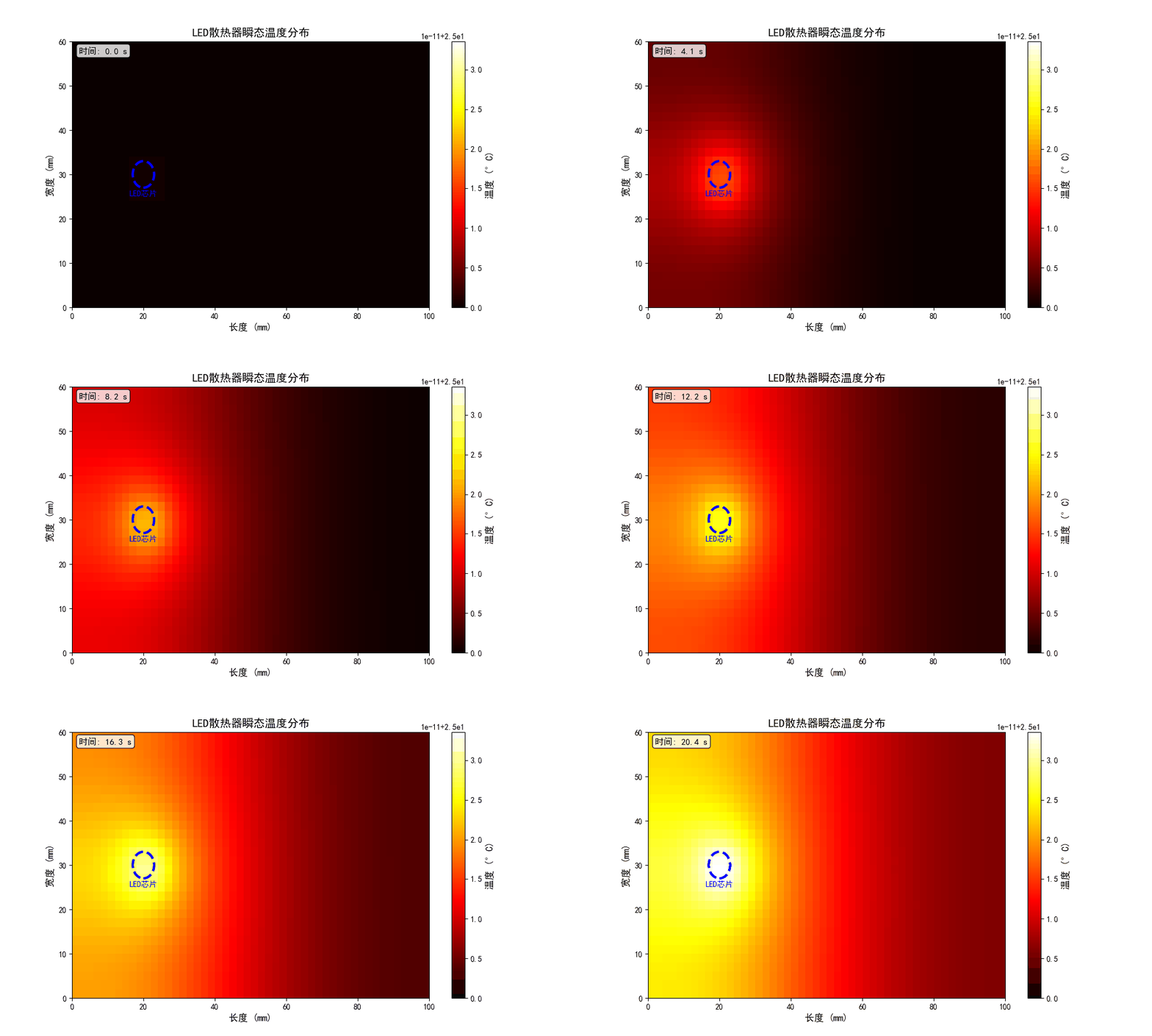
def create_temperature_animation():
"""
创建LED散热器温度分布瞬态变化的GIF动画
"""
print("\n" + "="*80)
print("生成GIF动画:LED散热器温度分布瞬态变化")
print("="*80)
# 仿真参数
nx, ny = 50, 30 # 网格数
dx = 0.002 # 网格间距 2mm
dt = 0.5 # 时间步长
alpha = 9.7e-5 # 铝的热扩散系数 m²/s
# 初始条件
T_initial = 25 # 初始温度 °C
T_ambient = 25 # 环境温度 °C
# 热源位置(LED芯片位置)
heat_source_x = 10
heat_source_y = ny // 2
q_dot = 5000 # 热源强度 W/m³
# 稳定性检查
stability = alpha * dt / dx**2
if stability > 0.25:
print(f"警告:稳定性条件不满足 ({stability:.3f} > 0.25)")
dt = 0.25 * dx**2 / alpha
print(f"调整时间步长为: {dt:.4f} s")
# 初始化温度场
T = np.ones((nx, ny)) * T_initial
# 存储结果
n_frames = 100
save_interval = 20
frames = []
print(" 正在计算温度场...")
for step in range(n_frames * save_interval):
T_new = T.copy()
# 内部节点
for i in range(1, nx-1):
for j in range(1, ny-1):
# 热源区域
if abs(i - heat_source_x) < 3 and abs(j - heat_source_y) < 3:
source = q_dot * dx**2 / (200 * 2700 * 900) * dt # 简化的热源项
else:
source = 0
T_new[i, j] = T[i, j] + alpha * dt / dx**2 * (
T[i+1, j] + T[i-1, j] + T[i, j+1] + T[i, j-1] - 4*T[i, j]
) + source
# 边界条件
# 左边界(对称)
T_new[0, :] = T_new[1, :]
# 右边界(对流+辐射)
h_eff = 15 # 等效换热系数 W/(m²·K)
T_new[-1, :] = T_new[-2, :] - h_eff * dx / 200 * (T_new[-2, :] - T_ambient)
# 上下边界(对流+辐射)
T_new[:, 0] = T_new[:, 1] - h_eff * dx / 200 * (T_new[:, 1] - T_ambient)
T_new[:, -1] = T_new[:, -2] - h_eff * dx / 200 * (T_new[:, -2] - T_ambient)
T = T_new
if step % save_interval == 0:
frames.append(T.copy())
print(f" 计算完成,生成 {len(frames)} 帧动画")
# 创建动画
fig, ax = plt.subplots(figsize=(10, 6))
im = ax.imshow(frames[0].T, cmap='hot', aspect='auto',
vmin=T_initial, vmax=np.max(frames[-1]),
extent=[0, nx*dx*1000, 0, ny*dx*1000])
cbar = plt.colorbar(im, ax=ax)
cbar.set_label('温度 (°C)', fontsize=12)
ax.set_xlabel('长度 (mm)', fontsize=12)
ax.set_ylabel('宽度 (mm)', fontsize=12)
ax.set_title('LED散热器瞬态温度分布', fontsize=14, fontweight='bold')
# 标记热源位置
circle = Circle((heat_source_x*dx*1000, heat_source_y*dx*1000), 3,
color='blue', fill=False, linewidth=3, linestyle='--')
ax.add_patch(circle)
ax.text(heat_source_x*dx*1000, heat_source_y*dx*1000 - 5, 'LED芯片',
ha='center', fontsize=10, color='blue', fontweight='bold')
time_text = ax.text(0.02, 0.98, '', transform=ax.transAxes, fontsize=11,
verticalalignment='top', bbox=dict(boxstyle='round',
facecolor='white', alpha=0.8))
def update(frame_idx):
im.set_array(frames[frame_idx].T)
time_text.set_text(f'时间: {frame_idx * save_interval * dt:.1f} s')
return im, time_text
anim = animation.FuncAnimation(fig, update, frames=len(frames),
interval=100, blit=True, repeat=True)
# 保存GIF
anim.save('led_temperature_animation.gif', writer='pillow', fps=10, dpi=100)
print("\n✓ GIF动画已保存: led_temperature_animation.gif")
plt.close()
# ============================================================================
# 主程序
# ============================================================================
def main():
"""
主程序:运行所有仿真案例
"""
print("\n" + "="*80)
print("主题054:LED照明热管理辐射 - Python仿真")
print("="*80)
print("\n本程序包含以下仿真案例:")
print(" 1. LED结温计算与辐射散热分析")
print(" 2. LED散热器优化设计")
print(" 3. LED寿命预测")
print(" 4. LED灯具热仿真")
print(" 5. 生成温度分布GIF动画")
print("\n" + "="*80)
# 运行案例1
case1_led_junction_temperature()
# 运行案例2
case2_heatsink_optimization()
# 运行案例3
case3_led_lifetime_prediction()
# 运行案例4
case4_led_luminaire_thermal_simulation()
# 生成GIF动画
create_temperature_animation()
print("\n" + "="*80)
print("所有案例运行完成!")
print("="*80)
print("\n生成的文件:")
print(" - case1_led_junction_temperature.png")
print(" - case2_heatsink_optimization.png")
print(" - case3_led_lifetime_prediction.png")
print(" - case4_led_luminaire_thermal.png")
print(" - led_temperature_animation.gif")
print("\n" + "="*80)
print("主题054:LED照明热管理辐射 - 仿真完成")
print("="*80 + "\n")
if __name__ == "__main__":
main()

北京人形旗下天工造物具身智能开源社区,聚焦具身天工与慧思开物两大平台
更多推荐
 0
0 0
0- 0



 已为社区贡献8条内容

所有评论(0)