《数据结构》上机实验(第四章)——串
·
1. 假设串采用顺序串存储,设计一个算法Strcmp(s),按字典顺序比较两个串s和t的大小。
- 算法思想:
- 比较s和t的长度:
①两者相等时返回0;
②s的长度大于t的长度,返回1;
③s的长度小于t的长度,返回-1。- 长度相等时比较对应字符:
①若s的字符大于的字符,返回1;
②若s的字符小于t的字符,返回-1;
③若s的字符等于t的字符,按上述规则继续比较。
int Compare(SqString s, SqString t)
{
	int i, result;
	if (s.length < t.length) result = -1;
	else if (s.length > t.length) result = 1;
	else result = 0;
	if (result == 0)
		for (i = 0; i < s.length; i++)
		{
			if (s.data[i] > t.data[i]) result = 1;
			if (s.data[i] < t.data[i]) result = -1;
			else result = 0;
		}
	return result;
}
运行结果
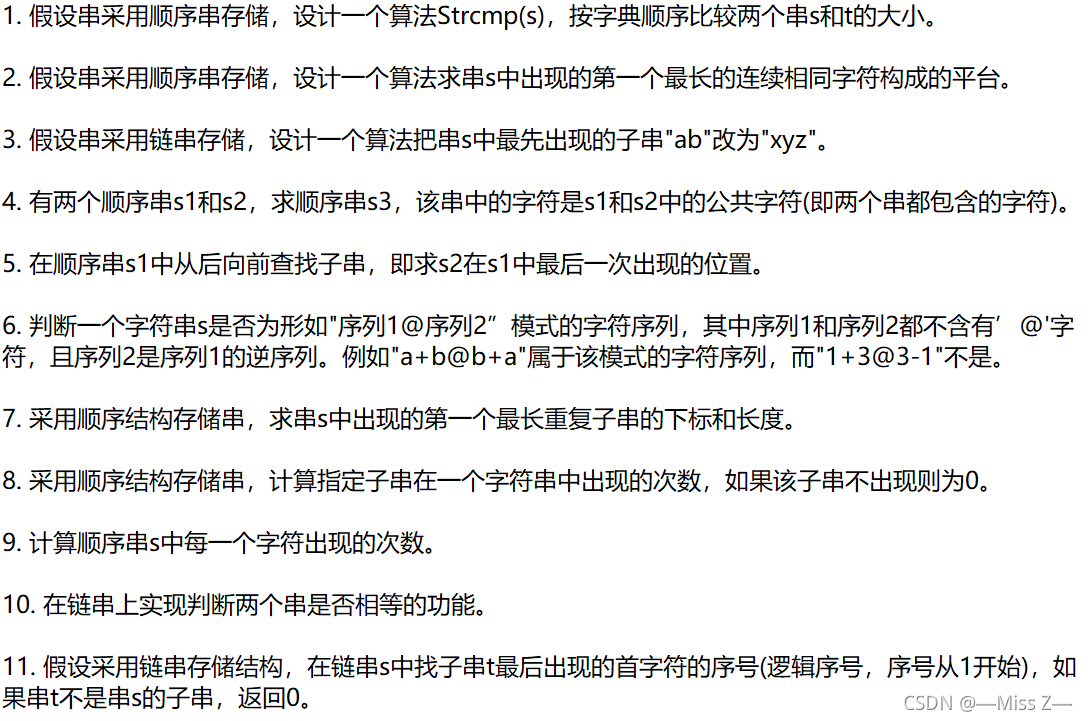
- s:“intermediary”
- t:"intermediary "
- "intermediary "是一个长度为13的串,其中含有一个空格字符。
- 运行结果:
2. 假设串采用顺序串存储,设计一个算法求串s中出现的第一个最长的连续相同字符构成的平台。
SqString LongestString(SqString s)
{
	SqString t;
	int maxlength = 0, i = 0, j, k = 0;
	while (k<s.length)
	{
		if (s.data[k] != ' ') i++; //i用来统计子串的长度
		else i = 0; //遇到空格后,i重新开始计数
		if (i >= maxlength)
		{
			maxlength = i;
			j = k; //j为每段子串的终止下标
		}
		k++; //遍历字符串
	}
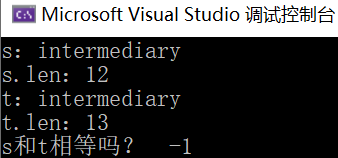
	printf("最长子串的长度为:%d\n该子串的终止下标为:%d\n", maxlength, j);
	for (i = 0; i < maxlength; i++)
	{
		t.data[i] = s.data[j - maxlength + 1 + i];
		printf("%c", t.data[i]);
	}
运行结果
- 根据子串的终止下标以及子串的长度推测出子串的起始下标,再进行赋值操作。
- 运行结果:
3. 假设串采用链串存储,设计一个算法把串s中最先出现的子串"ab"改为"xyz"。
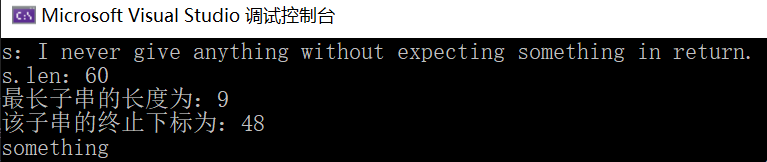
- 算法思想:在串s中找到最先出现的子串"ab",即p指向data域值为’a’的结点,其后继结点是data域值为’b"的结点。将它们的data域值分别改为’x和’z’,再创建一个data域值为’y’的结点(由q指向它),将其插人到p所指的结点之后。
bool Repl(LinkStrNode*& s)
{
	LinkStrNode* p = s->next, * q ;
	while (p != NULL)
	{
		if (p->data == 'a' &&  p->next->data == 'b')
		{
			p->data = 'x';
			p = p->next;
			p->data = 'y';
			q = (LinkStrNode*)malloc(sizeof(LinkStrNode));
			q->data = 'z';
			q->next = p->next;
			p->next = q;
			break;
		}
		else p = p->next;
	}
	if (p == NULL) return false;
	return true;
}
运行结果
- 运行结果:
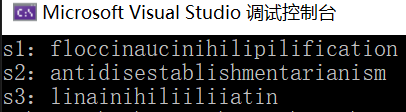
4. 有两个顺序串s1和s2,求顺序串s3,该串中的字符是s1和s2中的公共字符(即两个串都包含的字符)。
- 算法思想:扫描s1,对于当前字符s1.data[i],若它在s2中出现,则将其加人到串s3中,最后返回s3串。
#include<stdio.h>
#define MaxSize 50
typedef char ElemType;
typedef struct
{
	ElemType data[MaxSize];
	int length;
}SqString;

void CreateString(SqString& s, ElemType cstr[])
{
	int i;
	for (i = 0; cstr[i] != '\0'; i++)
		s.data[i] = cstr[i];
	s.length = i;
}

void PrintString(SqString s)
{
	for (int i = 0; i < s.length; i++)
		printf("%c", s.data[i]);
}

SqString CommonChar(SqString s1, SqString s2)
{
	SqString s3;
	int i=0 , j=0 , k = 0;
	while (i < s1.length)
	{
		if (s1.data[i] == s2.data[j])
		{
			s3.data[k++]=s1.data[i];
			i++;
			j = 0;
		}
		else
		{
			if (j < s2.length) j++;
			else
			{
				i++;
				j = 0;
			}
		}
	}
	s3.length = k;
	printf("\ns3:");
	PrintString(s3);
	return s3;
}

int main()
{
	SqString s1, s2;
	ElemType cstr1[] = "floccinaucinihilipilification";
	CreateString(s1, cstr1);
	printf("s1:");
	PrintString(s1);
	ElemType cstr2[] = "antidisestablishmentarianism";
	CreateString(s2, cstr2);
	printf("\ns2:");
	PrintString(s2);
	CommonChar(s1, s2);
	return 0;
}
运行结果
5. 在顺序串s1中从后向前查找子串,即求s2在s1中最后一次出现的位置。
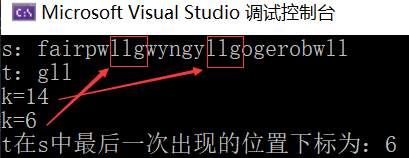
- 算法思想:采用简单模式匹配算法。用k来记录每次t子串成功出现的起始下标,k的初始值为-1。如果s循环结束,k的值没发生变化,说明t不是s的子串;否则返回k的值。
int index(SqString s,SqString t)
{
	int i = s.length - 1, j = 0, k = -1;
	while (i > 0)
	{
		if (s.data[i] == t.data[j])
		{
			i--;
			j++;
		}
		else
		{
			i--;
			j = 0;
		}
		if (j >= t.length)
		{
			k = i + 1;
			printf("\nk=%d", k);
			j = 0;
		}
	}
	return k;
}
运行结果
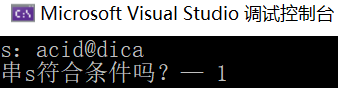
6. 判断一个字符串s是否为形如"序列1@序列2”模式的字符序列,其中序列1和序列2都不含有’@'字符,且序列2是序列1的逆序列。例如"a+b@b+a"属于该模式的字符序列,而"1+3@3-1"不是。
- 方法一:头尾进行对比。
bool symm(SqString s)
{
	int i=0, j=s.length-1;
	while (i != j)
	{
		if (s.data[i] == s.data[j])
		{
			i++; j--;
		}
		else return false;
	}
	DestoryStack(st);
	return true;
}
- 方法二:建立一个临时栈st并初始化为空,其元素为char类型。扫描顺序串s的字符,将"@"之前的字符进栈。继续扫描顺序串s中’@'之后的字符,每扫描个字符e,退栈一个字符x,若退栈时溢出或e或不等于x,则返回false。循环结束后,若栈不空,返回false。最后销毁栈st并返回最终结果。
bool symm(SqString s)
{
	SqStack st;
	char c;
	InitStack(st);
	int i = 0;
	while(i<s.length)
	{
		if (s.data[i] != '@') Push(st, s.data[i]);
		else break;
		i++;
	}
	i++;
	while (i < s.length)
	{
		if(!Pop(st, c)) return false; //第一个字符为@的情况
		if (c != s.data[i]) return false;
		i++;
	}
	if (!StackEmpty(st)) return false;
	DestoryStack(st);
	return true;
}
运行结果
7. 采用顺序结构存储串,求串s中出现的第一个最长重复子串的下标和长度。
void maxsubstr(SqString s)
{
	int count = 0, i = 0, j=1, maxlen = 0, k;
	while (j < s.length)
	{
		if (s.data[i] == s.data[j])
		{
			count++;
			i++; j++;
		}
		else
		{
			if (maxlen < count)
			{
				maxlen = count + 1;
				k = i - count;
			}
			count = 0;
			i++; j++;
		}
	}
	printf("\n下标:%d 长度:%d ", k, maxlen);
}
运行结果

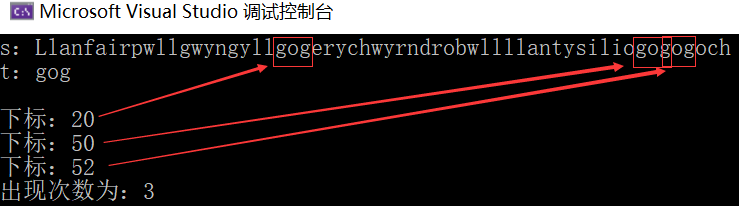
8. 采用顺序结构存储串,计算指定子串在一个字符串中出现的次数,如果该子串不出现则为0。
int substrcount(SqString s, SqString t)
{
	int i = 0, j = 0, count = 0;
	while(i < s.length)
	{
		if (s.data[i] == t.data[j])
		{
			i++; j++;
		}
		else
		{
			if (j >= t.length)
			{
				count++;
				printf("\n下标:%d", i-t.length);
				i = i - j + 1;
			}
			else i++;
			j = 0;
		}
	}
	return count;
}
运行结果
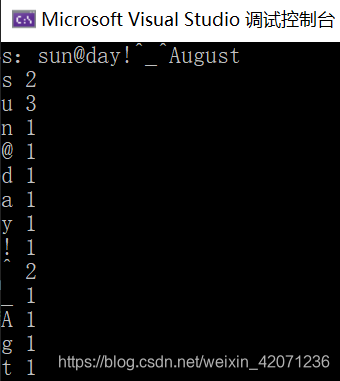
9. 计算顺序串s中每一个字符出现的次数。
- 算法思想:设计一个结构体数组cnum用于存放顺序串s中出现的字符和出现的次数。用i扫描s,用k记录cnum中的元素个数,对于s.data[i],若在cnum数组中没有对应字符,将s.data[i]直接放到cnum中,否则将对应字符的出现次数增1。
typedef struct
{
	char c; //字符
	int num; //字符计数
}CType;

int fun(SqString s,CType cnum[])
{
	int i, j, k = 0; //K记录cnum中的元素个数
	for (i = 0; i < s.length; i++)
	{
		if (k == 0) //cnum中没有元素时将s.data[i]直接放到cnum中
		{
			cnum[k].c = s.data[i];
			cnum[k].num = 1;
			k++;
		}
		else //cnum中存在元素时查找是否有相同的字符
		{
			for (j = 0; j < k && s.data[i] != cnum[j].c; j++);
			if (j >= k) //s.data[i]放入cnum数组中
			{
				cnum[k].c = s.data[i];
				cnum[k].num = 1;
				k++;
			}
			else cnum[j].num++;
		}
	}
	return k;
}

int main()
{
	SqString s;
	CType cnum[MaxSize];
	int i, k;
	ElemType cstr1[] = "sun@day!^_^August";
	StrAssign(s, cstr1);
	printf("s:");
	DispStr(s);
	printf("\n");
	k=fun(s, cnum);
	for (i = 0; i < k; i++)
		printf("%c %d\n", cnum[i].c, cnum[i].num);
	return 0;
}
运行结果
10. 在链串上实现判断两个串是否相等的功能。
- 算法思想:扫描两个链串,并同步比较当前结点值是否相等,若不相等返回false;否则继续比较到结束,若均相等且均结束,则返回true。
bool Equal(LinkStrNode* s, LinkStrNode* t)
{
	LinkStrNode* p=s->next, * q=t->next;
	while (p != NULL && q != NULL)
	{
		if (p->data == q->data)
		{
			p = p->next;
			q = q->next;
		}
		else return false;
	}
	if (p == NULL && q == NULL) return true;
	else return false;
}
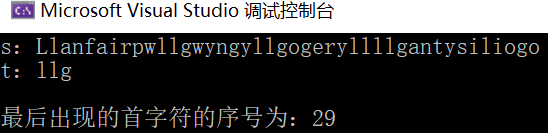
11. 假设采用链串存储结构,在链串s中找子串t最后出现的首字符的序号(逻辑序号,序号从1开始),如果串t不是串s的子串,返回0。
- 算法思想:采用BF模式匹配算法的思路。idx用于求子串在s中最后出现的首字符的序号,其初值为0。用p扫描链串s,i记录结点p的逻辑序号,初始值为0,当p不为NULL时循环:i增1,q=p,r指向串的首结点,当两结点的值相同时循环,即q、r指针均后移一个结点,如果r为NULL,表示找到了一个子串,置idx=i。循环结束,最后返回idx。
int LastPos(LinkStrNode* s, LinkStrNode* t)
{
	int i = 0, idx = 0;
	LinkStrNode* p = s->next, * q, * r;
	while (p != NULL)
	{
		i++;
		q = p;
		r = t->next;
		while (q != NULL && r != NULL && q->data == r->data)
		{
			q = q->next;
			r = r->next;
		}
		if (r == NULL) idx = i;
		p = p->next;
	}
	return idx;
}
运行结果

北京人形旗下天工造物具身智能开源社区,聚焦具身天工与慧思开物两大平台
更多推荐
 13
13 0
0- 0


 已为社区贡献5条内容

所有评论(0)