在保留静态相关功能的前提下,解决FreeRTOS裁剪Error: L6218E: Undefined symbol vApplicationGetTimerTaskMemory 等报错的一种思路
·
废话少说,直接上流程:
我使用的芯片为STM32F407,KEIL开发平台,freertos官网下载后手动移植,没使用cubemx,这些步骤会影响裁剪后的freertos的功能和文件的内容。
先找到vApplicationGetTimerTaskMemory vApplicationGetIdleTaskMemory 这两个函数在裁剪过的freertos里的相关说明(以vApplicationGetTimerTaskMemory为例
):
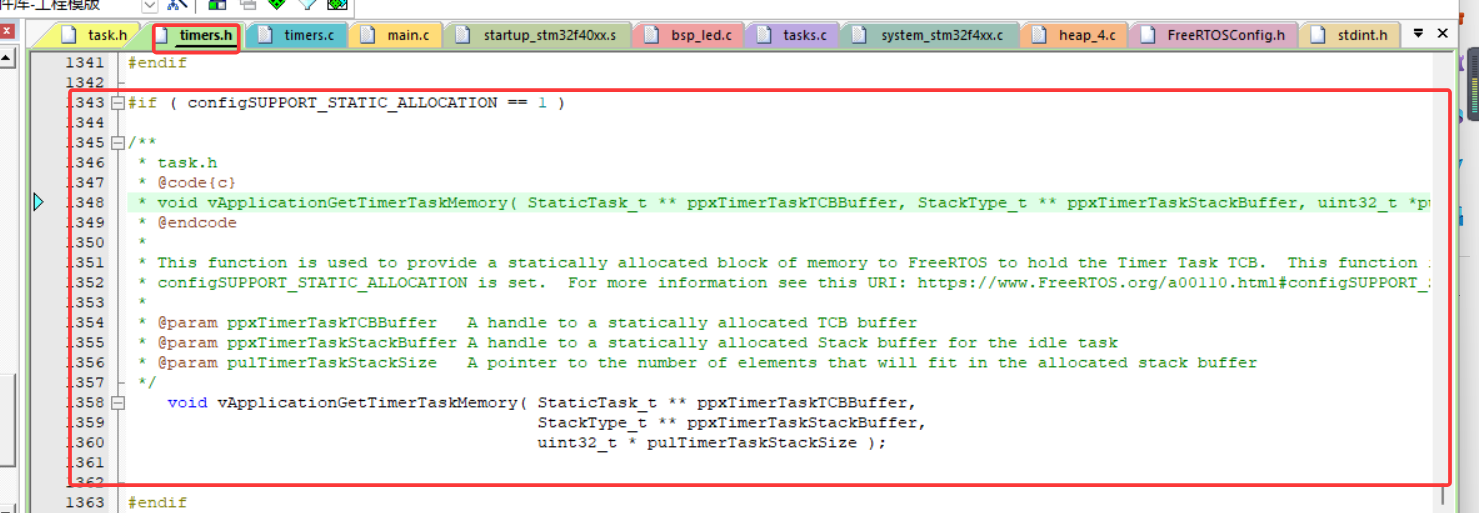
注释的大意是:这个函数用于为FreeRTOS提供一个静态分配的内存块来保存定时器任务TCB。此功能在以下情况时需要使用。好像说了个寂寞,没啥用。去FREERTOS的官网:Customization - FreeRTOS™找到了相关段落:
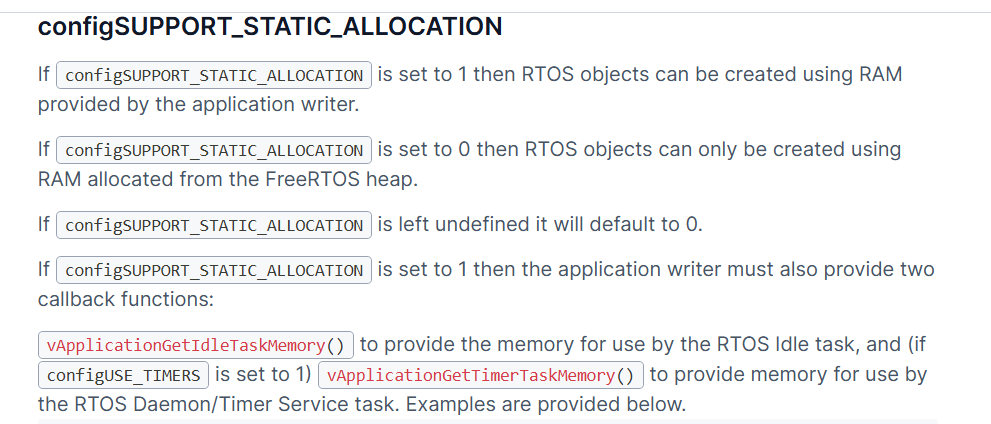 这段话的意思大概是:
如果配置支持静态分配若设置为1,则应用程序编写者还必须提供两个回调函数:应用程序获取空闲任务内存()为 RTOS 空闲任务提供内存,并(如果配置定时器设定为1)应用程序获取计时任务内存()为 RTOS 守护进程/计时服务任务提供内存。示例如下。
把对应的示例代码复制下来。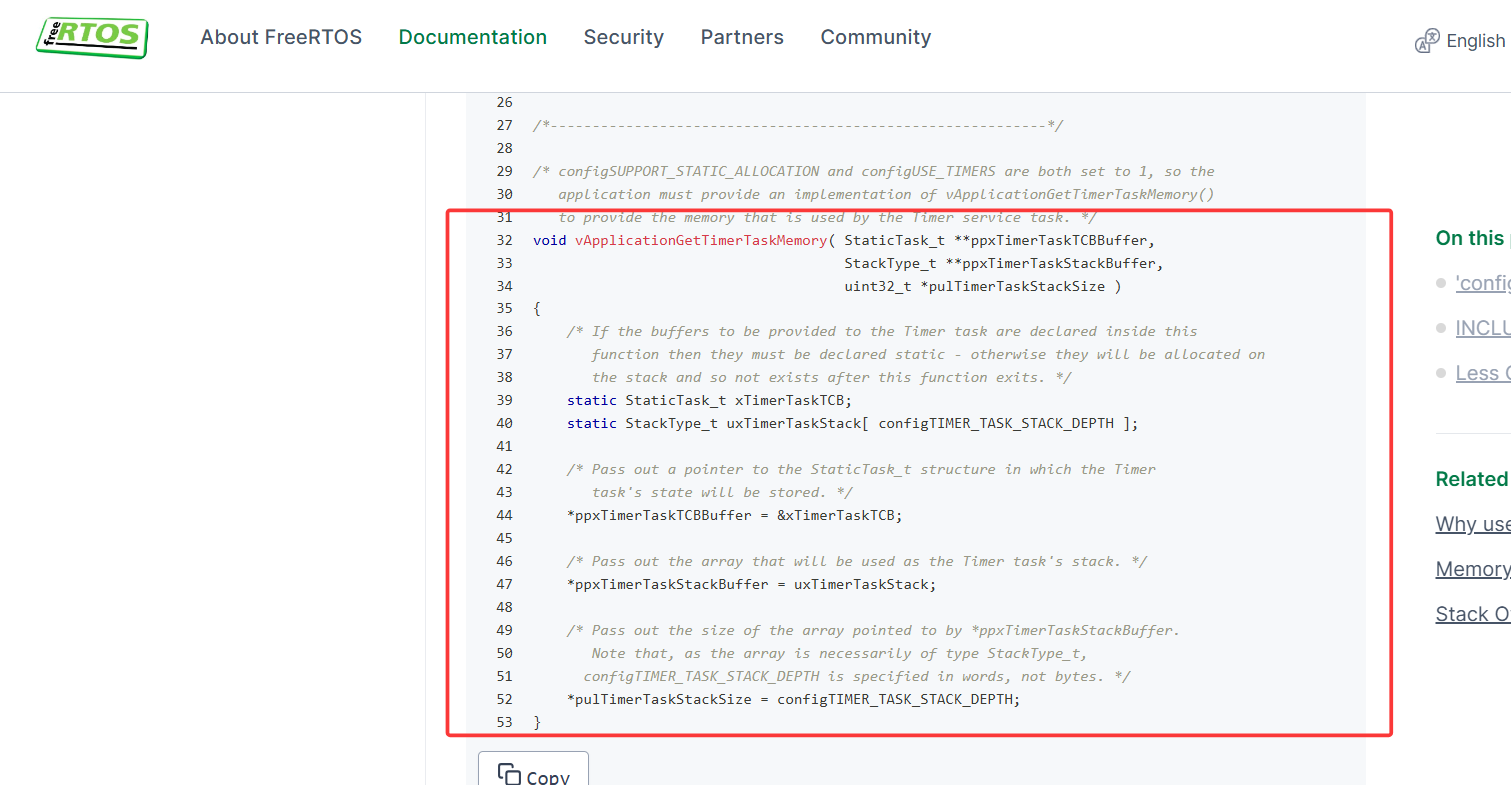
把这段代码复制到timer.c文件的静态创建任务紧挨着下面。这样只要configSUPPORT_STATIC_ALLOCATION == 1,启用静态功能,这段代码就会编译生效。
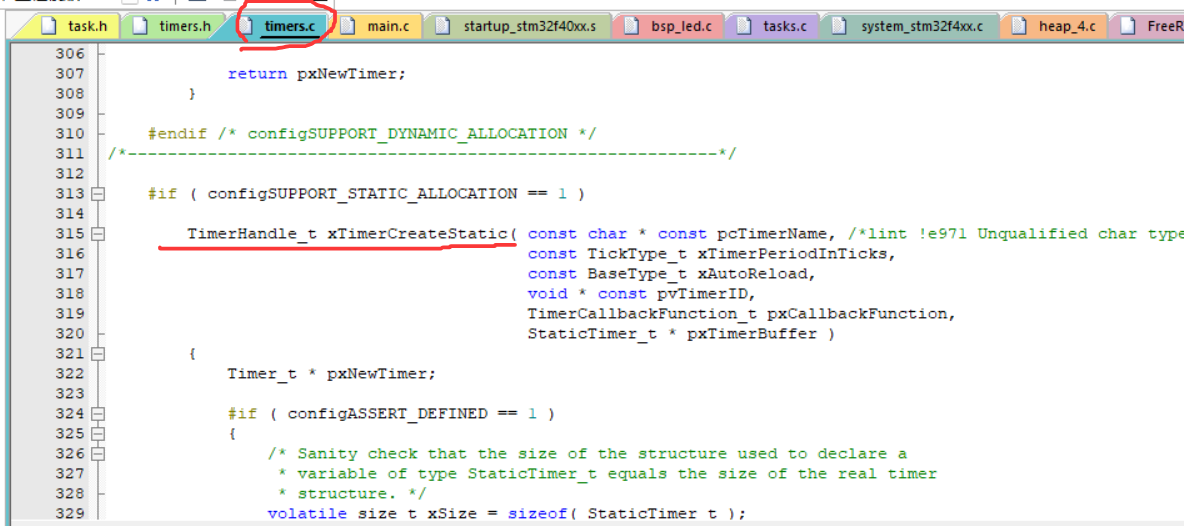
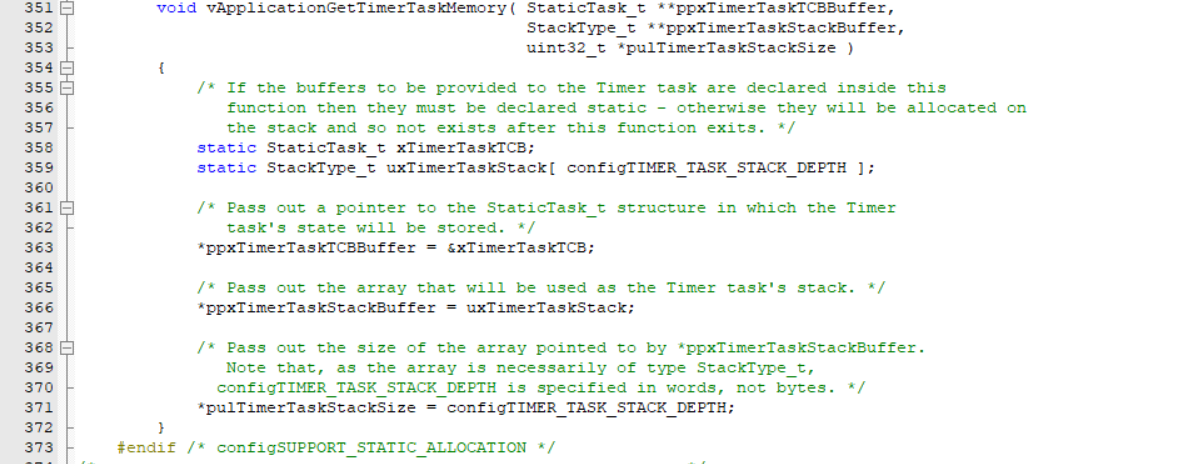 在博主之前的的工程条件下,2个报错消失了,测试用例也顺利运行。但不知道有没有其他隐患,因为博主的用例很简单,只是一个用静态任务创建函数写的3优先级跑马灯。仅供参考。
代码如下:
/* configSUPPORT_STATIC_ALLOCATION is set to 1, so the application must provide an
   implementation of vApplicationGetIdleTaskMemory() to provide the memory that is
   used by the Idle task. */
void vApplicationGetIdleTaskMemory( StaticTask_t **ppxIdleTaskTCBBuffer,
                                    StackType_t **ppxIdleTaskStackBuffer,
                                    uint32_t *pulIdleTaskStackSize )
{
    /* If the buffers to be provided to the Idle task are declared inside this
       function then they must be declared static - otherwise they will be allocated on
       the stack and so not exists after this function exits. */
    static StaticTask_t xIdleTaskTCB;
    static StackType_t uxIdleTaskStack[ configMINIMAL_STACK_SIZE ];

    /* Pass out a pointer to the StaticTask_t structure in which the Idle task's
       state will be stored. */
    *ppxIdleTaskTCBBuffer = &xIdleTaskTCB;

    /* Pass out the array that will be used as the Idle task's stack. */
    *ppxIdleTaskStackBuffer = uxIdleTaskStack;

    /* Pass out the size of the array pointed to by *ppxIdleTaskStackBuffer.
       Note that, as the array is necessarily of type StackType_t,
       configMINIMAL_STACK_SIZE is specified in words, not bytes. */
    *pulIdleTaskStackSize = configMINIMAL_STACK_SIZE;
}

/*-----------------------------------------------------------*/

/* configSUPPORT_STATIC_ALLOCATION and configUSE_TIMERS are both set to 1, so the
   application must provide an implementation of vApplicationGetTimerTaskMemory()
   to provide the memory that is used by the Timer service task. */
void vApplicationGetTimerTaskMemory( StaticTask_t **ppxTimerTaskTCBBuffer,
                                     StackType_t **ppxTimerTaskStackBuffer,
                                     uint32_t *pulTimerTaskStackSize )
{
    /* If the buffers to be provided to the Timer task are declared inside this
       function then they must be declared static - otherwise they will be allocated on
       the stack and so not exists after this function exits. */
    static StaticTask_t xTimerTaskTCB;
    static StackType_t uxTimerTaskStack[ configTIMER_TASK_STACK_DEPTH ];

    /* Pass out a pointer to the StaticTask_t structure in which the Timer
       task's state will be stored. */
    *ppxTimerTaskTCBBuffer = &xTimerTaskTCB;

    /* Pass out the array that will be used as the Timer task's stack. */
    *ppxTimerTaskStackBuffer = uxTimerTaskStack;

    /* Pass out the size of the array pointed to by *ppxTimerTaskStackBuffer.
       Note that, as the array is necessarily of type StackType_t,
      configTIMER_TASK_STACK_DEPTH is specified in words, not bytes. */
    *pulTimerTaskStackSize = configTIMER_TASK_STACK_DEPTH;
}

北京人形旗下天工造物具身智能开源社区,聚焦具身天工与慧思开物两大平台
更多推荐
 1
1 0
0- 0


 已为社区贡献1条内容

所有评论(0)