数字人:OpenAvatarChat
https://github.com/HumanAIGC-Engineering/OpenAvatarChat
配套UI:https://github.com/HumanAIGC-Engineering/OpenAvatarChat-WebUI
快速开始
git clone https://github.com/HumanAIGC-Engineering/OpenAvatarChat.git
本项目子模块以及依赖模型都需要使用git lfs模块,请确认lfs功能已安装
sudo apt install git-lfs
git lfs install
本项目通过git子模块方式引用三方库,运行前需要更新子模块
git submodule update --init --recursive
本项目的运行依赖CUDA,请确保本机NVIDIA驱动程序支持的CUDA版本>=12.4
uv安装
推荐安装uv,使用uv进行进行本地环境管理。
官方独立安装程序
# On Windows.
powershell -ExecutionPolicy ByPass -c "irm https://astral.sh/uv/install.ps1 | iex"
# On macOS and Linux.
curl -LsSf https://astral.sh/uv/install.sh | sh
PyPI安装
# With pip.
pip install uv
# Or pipx.
pipx install uv
依赖安装
安装全部依赖
uv venv --python 3.11.11

source .venv/bin/activate

uv pip install setuptools pip

uv sync --all-packages
仅安装所需模式的依赖
uv venv --python 3.11.11

source .venv/bin/activate

uv pip install setuptools pip

uv run install.py --uv --config <配置文件的绝对路径>.yaml
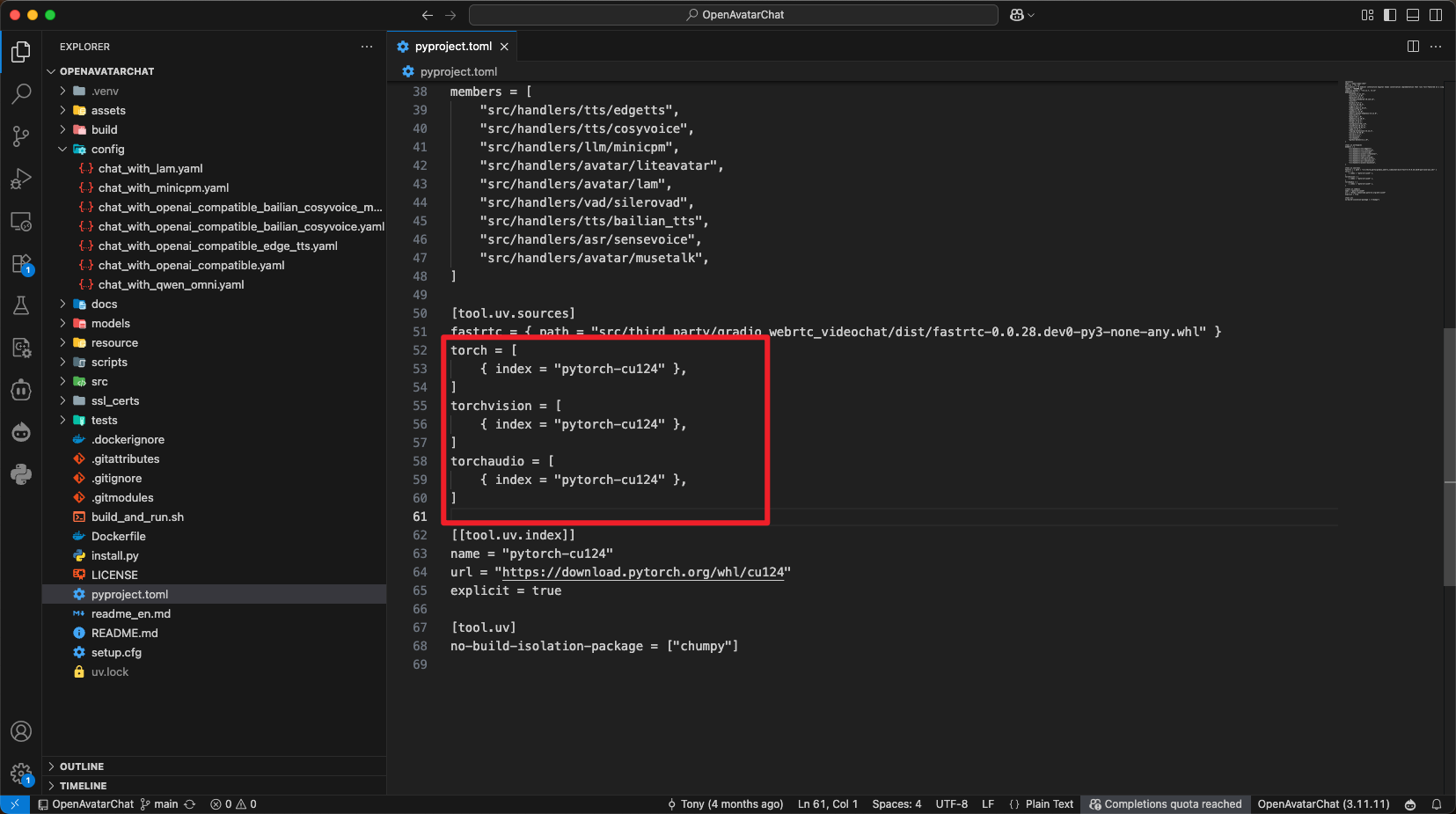
注意:非NVIDIA环境需要调整依赖,需要删除对torch相关依赖指定版本的设置。
下载所需模式的文件
运行
uv run src/demo.py --config <配置文件的绝对路径>.yaml
源码分析
开启debug
vscode添加 .vscode/launch.json
{
  "version": "0.2.0",
  "configurations": [
    {
      "name": "Debug demo.py",
      "type": "debugpy",
      "request": "launch",
      "program": "${workspaceFolder}/src/demo.py",
      "python": "${workspaceFolder}/.venv/bin/python",
      "console": "integratedTerminal",
      "env": {
        "PYTHONPATH": "${workspaceFolder}",
      },
      "args": [
        "--config",
        "./config/chat_with_lam.yaml"
      ],

    }
  ]
}
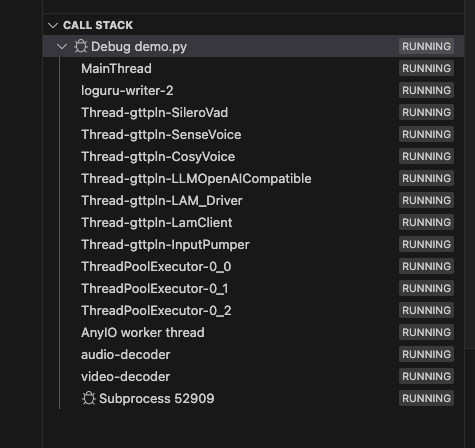
通过debug可以看到为每个用户session开启了相应的线程,通过不同的线程处理连续的任务。
core
chat_session:会话管理,为用户创建一系列的处理器来实现数字人处理流程。
handler_manger:handler处理器管理,初始化处理器。
在rtc创建时创建新的会话session。
其他
Mac上运行Lam
lam数字人是可以在mac电脑上运行的,需要简单的修改一下lam代码中torch设备分配方式,主要是OpenAvatarChat/src/handlers/avatar/lam/LAM_Audio2Expression/engines/infer.py
class InferBase:
    def __init__(self, cfg, model=None, verbose=False) -> None:
        torch.multiprocessing.set_sharing_strategy("file_system")
        self.logger = get_root_logger(
            log_file=os.path.join(cfg.save_path, "infer.log"),
            file_mode="a" if cfg.resume else "w",
        )
        self.logger.info("=> Loading config ...")
        self.cfg = cfg
        self.verbose = verbose
        if self.verbose:
            self.logger.info(f"Save path: {cfg.save_path}")
            self.logger.info(f"Config:\n{cfg.pretty_text}")
        if model is None:
            self.logger.info("=> Building model ...")
            self.model = self.build_model()
        else:
            self.model = model

        if torch.cuda.is_available():
            self.device = torch.device("cuda")
        elif hasattr(torch.backends, "mps") and torch.backends.mps.is_available():
            self.device = torch.device("mps")
        else:
            self.device = torch.device("cpu")

    def build_model(self):
        model = build_model(self.cfg.model)
        n_parameters = sum(p.numel() for p in model.parameters() if p.requires_grad)
        self.logger.info(f"Num params: {n_parameters}")

        if torch.backends.mps.is_available():
            device = torch.device("mps")
        else:
            device = torch.device("cpu")

        model = model.to(device)

        model = create_ddp_model(
            model,
            broadcast_buffers=False,
            find_unused_parameters=self.cfg.find_unused_parameters,
        )
        if os.path.isfile(self.cfg.weight):
            self.logger.info(f"Loading weight at: {self.cfg.weight}")
            checkpoint = torch.load(self.cfg.weight)
            weight = OrderedDict()
            for key, value in checkpoint["state_dict"].items():
                if key.startswith("module."):
                    if comm.get_world_size() == 1:
                        key = key[7:]  # module.xxx.xxx -> xxx.xxx
                else:
                    if comm.get_world_size() > 1:
                        key = "module." + key  # xxx.xxx -> module.xxx.xxx
                weight[key] = value
            model.load_state_dict(weight, strict=True)
            self.logger.info(
                "=> Loaded weight '{}'".format(
                    self.cfg.weight
                )
            )
        else:
            raise RuntimeError("=> No checkpoint found at '{}'".format(self.cfg.weight))
        return model


    def infer(self):
        raise NotImplementedError


@INFER.register_module()
class Audio2ExpressionInfer(InferBase):
    def infer(self):
        logger = get_root_logger()
        logger.info(">>>>>>>>>>>>>>>> Start Inference >>>>>>>>>>>>>>>>")
        batch_time = AverageMeter()
        self.model.eval()

        # process audio-input
        assert os.path.exists(self.cfg.audio_input)
        if(self.cfg.ex_vol):
            logger.info("Extract vocals ...")
            vocal_path = self.extract_vocal_track(self.cfg.audio_input)
            logger.info("=> Extract vocals at: {}".format(vocal_path if os.path.exists(vocal_path) else '... Failed'))
            if(os.path.exists(vocal_path)):
                self.cfg.audio_input = vocal_path

        with torch.no_grad():
            input_dict = {}
            input_dict['id_idx'] = F.one_hot(torch.tensor(self.cfg.id_idx),
                                             self.cfg.model.backbone.num_identity_classes).to(self.device)[None,...]
            speech_array, ssr = librosa.load(self.cfg.audio_input, sr=16000)
            input_dict['input_audio_array'] = torch.FloatTensor(speech_array).to(self.device)[None,...]

            end = time.time()
            output_dict = self.model(input_dict)
            batch_time.update(time.time() - end)

            logger.info(
                "Infer: [{}] "
                "Running Time: {batch_time.avg:.3f} ".format(
                    self.cfg.audio_input,
                    batch_time=batch_time,
                )
            )

        out_exp = output_dict['pred_exp'].squeeze().cpu().numpy()

        frame_length = math.ceil(speech_array.shape[0] / ssr * 30)
        volume = librosa.feature.rms(y=speech_array, frame_length=int(1 / 30 * ssr), hop_length=int(1 / 30 * ssr))[0]
        if (volume.shape[0] > frame_length):
            volume = volume[:frame_length]

        if(self.cfg.movement_smooth):
            out_exp = smooth_mouth_movements(out_exp, 0, volume)

        if (self.cfg.brow_movement):
            out_exp = apply_random_brow_movement(out_exp, volume)

        pred_exp = self.blendshape_postprocess(out_exp)

        if(self.cfg.save_json_path is not None):
            export_blendshape_animation(pred_exp,
                                        self.cfg.save_json_path,
                                        ARKitBlendShape,
                                        fps=self.cfg.fps)

        logger.info("<<<<<<<<<<<<<<<<< End Evaluation <<<<<<<<<<<<<<<<<")

    def infer_streaming_audio(self,
                           audio: np.ndarray,
                           ssr: float,
                           context: dict):

        if (context is None):
            context = DEFAULT_CONTEXT.copy()
        max_frame_length = 64

        frame_length = math.ceil(audio.shape[0] / ssr * 30)
        output_context = DEFAULT_CONTEXT.copy()

        volume = librosa.feature.rms(y=audio, frame_length=int(1 / 30 * ssr), hop_length=int(1 / 30 * ssr))[0]
        if (volume.shape[0] > frame_length):
            volume = volume[:frame_length]

        # resample audio
        if (ssr != self.cfg.audio_sr):
            in_audio = librosa.resample(audio.astype(np.float32), orig_sr=ssr, target_sr=self.cfg.audio_sr)
        else:
            in_audio = audio.copy()

        start_frame = int(max_frame_length - in_audio.shape[0] / self.cfg.audio_sr * 30)

        if (context['is_initial_input'] or (context['previous_audio'] is None)):
            blank_audio_length = self.cfg.audio_sr * max_frame_length // 30 - in_audio.shape[0]
            blank_audio = np.zeros(blank_audio_length, dtype=np.float32)

            # pre-append
            input_audio = np.concatenate([blank_audio, in_audio])
            output_context['previous_audio'] = input_audio

        else:
            clip_pre_audio_length = self.cfg.audio_sr * max_frame_length // 30 - in_audio.shape[0]
            clip_pre_audio = context['previous_audio'][-clip_pre_audio_length:]
            input_audio = np.concatenate([clip_pre_audio, in_audio])
            output_context['previous_audio'] = input_audio

        with torch.no_grad():
            try:
                input_dict = {}
                input_dict['id_idx'] = F.one_hot(torch.tensor(self.cfg.id_idx),
                                                 self.cfg.model.backbone.num_identity_classes).to(self.device)[
                    None, ...]
                input_dict['input_audio_array'] = torch.FloatTensor(input_audio).to(self.device)[None, ...]
                output_dict = self.model(input_dict)
                out_exp = output_dict['pred_exp'].squeeze().cpu().numpy()[start_frame:, :]
            except:
                self.logger.error('Error: faided to predict expression.')
                output_dict['pred_exp'] = torch.zeros((max_frame_length, 52)).float()
                return


        # post-process
        if (context['previous_expression'] is None):
            out_exp = self.apply_expression_postprocessing(out_exp, audio_volume=volume)
        else:
            previous_length = context['previous_expression'].shape[0]
            out_exp = self.apply_expression_postprocessing(expression_params = np.concatenate([context['previous_expression'], out_exp], axis=0),
                                                           audio_volume=np.concatenate([context['previous_volume'], volume], axis=0),
                                                           processed_frames=previous_length)[previous_length:, :]

        if (context['previous_expression'] is not None):
            output_context['previous_expression'] = np.concatenate([context['previous_expression'], out_exp], axis=0)[
                                                -max_frame_length:, :]
            output_context['previous_volume'] = np.concatenate([context['previous_volume'], volume], axis=0)[-max_frame_length:]
        else:
            output_context['previous_expression'] = out_exp.copy()
            output_context['previous_volume'] = volume.copy()

        output_context['first_input_flag'] = False

        return {"code": RETURN_CODE['SUCCESS'],
                "expression": out_exp,
                "headpose": None}, output_context
    def apply_expression_postprocessing(
            self,
            expression_params: np.ndarray,
            processed_frames: int = 0,
            audio_volume: np.ndarray = None
    ) -> np.ndarray:
        """Applies full post-processing pipeline to facial expression parameters.

        Args:
            expression_params: Raw output from animation model [num_frames, num_parameters]
            processed_frames: Number of frames already processed in previous batches
            audio_volume: Optional volume array for audio-visual synchronization

        Returns:
            Processed expression parameters ready for animation synthesis
        """
        # Pipeline execution order matters - maintain sequence
        expression_params = smooth_mouth_movements(expression_params, processed_frames, audio_volume)
        expression_params = apply_frame_blending(expression_params, processed_frames)
        expression_params, _ = apply_savitzky_golay_smoothing(expression_params, window_length=5)
        expression_params = symmetrize_blendshapes(expression_params)
        expression_params = apply_random_eye_blinks_context(expression_params, processed_frames=processed_frames)

        return expression_params

    def extract_vocal_track(
            self,
            input_audio_path: str
    ) -> str:
        """Isolates vocal track from audio file using source separation.

        Args:
            input_audio_path: Path to input audio file containing vocals+accompaniment

        Returns:
            Path to isolated vocal track in WAV format
        """
        separation_command = f'spleeter separate -p spleeter:2stems -o {self.cfg.save_path} {input_audio_path}'
        os.system(separation_command)

        base_name = os.path.splitext(os.path.basename(input_audio_path))[0]
        return os.path.join(self.cfg.save_path, base_name, 'vocals.wav')

    def blendshape_postprocess(self,
                               bs_array: np.ndarray
                               )->np.array:

        bs_array, _ = apply_savitzky_golay_smoothing(bs_array, window_length=5)
        bs_array = symmetrize_blendshapes(bs_array)
        bs_array = apply_random_eye_blinks(bs_array)

        return bs_array
Ascend上运行Lam
安装对应版本的torch_npu
https://gitee.com/ascend/pytorch/releases
- 进入安装目录,执行如下命令获取PyTorch插件的whl包。
wget https://gitee.com/ascend/pytorch/releases/download/v7.0.0.1-pytorch2.4.0/torch_npu-2.4.0.post5-cp311-cp311-manylinux_2_17_aarch64.manylinux2014_aarch64.whl
- 执行如下命令安装。如果使用非root用户安装,需要在命令后加–user。
uv pip install torch_npu-2.4.0.post5-cp311-cp311-manylinux_2_17_aarch64.manylinux2014_aarch64.whl
- 执行如下命令,若返回True则说明安装成功。
python -c "import torch;import torch_npu;print(torch_npu.npu.is_available())"
或者直接使用uv安装与torch相同版本号的torch_mpu
uv pip install torch-npu==x.x.x
修改一下lam代码中torch设备分配方式,主要是OpenAvatarChat/src/handlers/avatar/lam/LAM_Audio2Expression/engines/infer.py
import os
import math
import time
import librosa
import numpy as np
from collections import OrderedDict
import sys

import torch
import torch.utils.data
import torch.nn.functional as F
import torch_npu

from .defaults import create_ddp_model
import utils.comm as comm
from models import build_model
from utils.logger import get_root_logger
from utils.registry import Registry
from utils.misc import (
    AverageMeter,
)

from models.utils import smooth_mouth_movements, apply_frame_blending, apply_savitzky_golay_smoothing, apply_random_brow_movement, \
    symmetrize_blendshapes, apply_random_eye_blinks, apply_random_eye_blinks_context, export_blendshape_animation, \
    RETURN_CODE, DEFAULT_CONTEXT, ARKitBlendShape

INFER = Registry("infer")

class InferBase:
    def __init__(self, cfg, model=None, verbose=False) -> None:
        torch.multiprocessing.set_sharing_strategy("file_system")
        self.logger = get_root_logger(
            log_file=os.path.join(cfg.save_path, "infer.log"),
            file_mode="a" if cfg.resume else "w",
        )
        self.logger.info("=> Loading config ...")
        self.cfg = cfg
        self.verbose = verbose
        if self.verbose:
            self.logger.info(f"Save path: {cfg.save_path}")
            self.logger.info(f"Config:\n{cfg.pretty_text}")
        if model is None:
            self.logger.info("=> Building model ...")
            self.model = self.build_model()
        else:
            self.model = model

        self.device = torch.device("npu")

    def build_model(self):
        model = build_model(self.cfg.model)
        n_parameters = sum(p.numel() for p in model.parameters() if p.requires_grad)
        self.logger.info(f"Num params: {n_parameters}")

        device = torch.device('npu')  # 使用 npu 设备
        model.to(device)

        model = create_ddp_model(
            model,
            broadcast_buffers=False,
            find_unused_parameters=self.cfg.find_unused_parameters,
        )
        if os.path.isfile(self.cfg.weight):
            self.logger.info(f"Loading weight at: {self.cfg.weight}")
            checkpoint = torch.load(self.cfg.weight)
            weight = OrderedDict()
            for key, value in checkpoint["state_dict"].items():
                if key.startswith("module."):
                    if comm.get_world_size() == 1:
                        key = key[7:]  # module.xxx.xxx -> xxx.xxx
                else:
                    if comm.get_world_size() > 1:
                        key = "module." + key  # xxx.xxx -> module.xxx.xxx
                weight[key] = value
            model.load_state_dict(weight, strict=True)
            self.logger.info(
                "=> Loaded weight '{}'".format(
                    self.cfg.weight
                )
            )
        else:
            raise RuntimeError("=> No checkpoint found at '{}'".format(self.cfg.weight))
        return model


    def infer(self):
        raise NotImplementedError


@INFER.register_module()
class Audio2ExpressionInfer(InferBase):
    def infer(self):
        logger = get_root_logger()
        logger.info(">>>>>>>>>>>>>>>> Start Inference >>>>>>>>>>>>>>>>")
        batch_time = AverageMeter()
        self.model.eval()

        # process audio-input
        assert os.path.exists(self.cfg.audio_input)
        if(self.cfg.ex_vol):
            logger.info("Extract vocals ...")
            vocal_path = self.extract_vocal_track(self.cfg.audio_input)
            logger.info("=> Extract vocals at: {}".format(vocal_path if os.path.exists(vocal_path) else '... Failed'))
            if(os.path.exists(vocal_path)):
                self.cfg.audio_input = vocal_path

        with torch.no_grad():
            input_dict = {}
            input_dict['id_idx'] = F.one_hot(torch.tensor(self.cfg.id_idx),
                                             self.cfg.model.backbone.num_identity_classes).to(self.device)[None,...]
            speech_array, ssr = librosa.load(self.cfg.audio_input, sr=16000)
            input_dict['input_audio_array'] = torch.FloatTensor(speech_array).to(self.device)[None,...]

            end = time.time()
            output_dict = self.model(input_dict)
            batch_time.update(time.time() - end)

            logger.info(
                "Infer: [{}] "
                "Running Time: {batch_time.avg:.3f} ".format(
                    self.cfg.audio_input,
                    batch_time=batch_time,
                )
            )

        out_exp = output_dict['pred_exp'].squeeze().cpu().numpy()

        frame_length = math.ceil(speech_array.shape[0] / ssr * 30)
        volume = librosa.feature.rms(y=speech_array, frame_length=int(1 / 30 * ssr), hop_length=int(1 / 30 * ssr))[0]
        if (volume.shape[0] > frame_length):
            volume = volume[:frame_length]

        if(self.cfg.movement_smooth):
            out_exp = smooth_mouth_movements(out_exp, 0, volume)

        if (self.cfg.brow_movement):
            out_exp = apply_random_brow_movement(out_exp, volume)

        pred_exp = self.blendshape_postprocess(out_exp)

        if(self.cfg.save_json_path is not None):
            export_blendshape_animation(pred_exp,
                                        self.cfg.save_json_path,
                                        ARKitBlendShape,
                                        fps=self.cfg.fps)

        logger.info("<<<<<<<<<<<<<<<<< End Evaluation <<<<<<<<<<<<<<<<<")

    def infer_streaming_audio(self,
                           audio: np.ndarray,
                           ssr: float,
                           context: dict):

        if (context is None):
            context = DEFAULT_CONTEXT.copy()
        max_frame_length = 64

        frame_length = math.ceil(audio.shape[0] / ssr * 30)
        output_context = DEFAULT_CONTEXT.copy()

        volume = librosa.feature.rms(y=audio, frame_length=int(1 / 30 * ssr), hop_length=int(1 / 30 * ssr))[0]
        if (volume.shape[0] > frame_length):
            volume = volume[:frame_length]

        # resample audio
        if (ssr != self.cfg.audio_sr):
            in_audio = librosa.resample(audio.astype(np.float32), orig_sr=ssr, target_sr=self.cfg.audio_sr)
        else:
            in_audio = audio.copy()

        start_frame = int(max_frame_length - in_audio.shape[0] / self.cfg.audio_sr * 30)

        if (context['is_initial_input'] or (context['previous_audio'] is None)):
            blank_audio_length = self.cfg.audio_sr * max_frame_length // 30 - in_audio.shape[0]
            blank_audio = np.zeros(blank_audio_length, dtype=np.float32)

            # pre-append
            input_audio = np.concatenate([blank_audio, in_audio])
            output_context['previous_audio'] = input_audio

        else:
            clip_pre_audio_length = self.cfg.audio_sr * max_frame_length // 30 - in_audio.shape[0]
            clip_pre_audio = context['previous_audio'][-clip_pre_audio_length:]
            input_audio = np.concatenate([clip_pre_audio, in_audio])
            output_context['previous_audio'] = input_audio

        with torch.no_grad():
            try:
                input_dict = {}
                input_dict['id_idx'] = F.one_hot(torch.tensor(self.cfg.id_idx),
                                                 self.cfg.model.backbone.num_identity_classes).to(self.device)[
                    None, ...]
                input_dict['input_audio_array'] = torch.FloatTensor(input_audio).to(self.device)[None, ...]
                output_dict = self.model(input_dict)
                out_exp = output_dict['pred_exp'].squeeze().cpu().numpy()[start_frame:, :]

            except Exception as e:
                exc_type, exc_obj, exc_tb = sys.exc_info()
                fname = exc_tb.tb_frame.f_code.co_filename  # 获取文件名
                line = exc_tb.tb_lineno  # 获取行号
                self.logger.warning(f"Error: {e} in file {fname} at line {line}")
                self.logger.error('Error: faided to predict expression.')
                # output_dict['pred_exp'] = torch.zeros((max_frame_length, 52)).float()
                return

        # post-process
        if (context['previous_expression'] is None):
            out_exp = self.apply_expression_postprocessing(out_exp, audio_volume=volume)
        else:
            previous_length = context['previous_expression'].shape[0]
            out_exp = self.apply_expression_postprocessing(expression_params = np.concatenate([context['previous_expression'], out_exp], axis=0),
                                                           audio_volume=np.concatenate([context['previous_volume'], volume], axis=0),
                                                           processed_frames=previous_length)[previous_length:, :]

        if (context['previous_expression'] is not None):
            output_context['previous_expression'] = np.concatenate([context['previous_expression'], out_exp], axis=0)[
                                                -max_frame_length:, :]
            output_context['previous_volume'] = np.concatenate([context['previous_volume'], volume], axis=0)[-max_frame_length:]
        else:
            output_context['previous_expression'] = out_exp.copy()
            output_context['previous_volume'] = volume.copy()

        output_context['first_input_flag'] = False

        return {"code": RETURN_CODE['SUCCESS'],
                "expression": out_exp,
                "headpose": None}, output_context
    def apply_expression_postprocessing(
            self,
            expression_params: np.ndarray,
            processed_frames: int = 0,
            audio_volume: np.ndarray = None
    ) -> np.ndarray:
        """Applies full post-processing pipeline to facial expression parameters.

        Args:
            expression_params: Raw output from animation model [num_frames, num_parameters]
            processed_frames: Number of frames already processed in previous batches
            audio_volume: Optional volume array for audio-visual synchronization

        Returns:
            Processed expression parameters ready for animation synthesis
        """
        # Pipeline execution order matters - maintain sequence
        expression_params = smooth_mouth_movements(expression_params, processed_frames, audio_volume)
        expression_params = apply_frame_blending(expression_params, processed_frames)
        expression_params, _ = apply_savitzky_golay_smoothing(expression_params, window_length=5)
        expression_params = symmetrize_blendshapes(expression_params)
        expression_params = apply_random_eye_blinks_context(expression_params, processed_frames=processed_frames)

        return expression_params

    def extract_vocal_track(
            self,
            input_audio_path: str
    ) -> str:
        """Isolates vocal track from audio file using source separation.

        Args:
            input_audio_path: Path to input audio file containing vocals+accompaniment

        Returns:
            Path to isolated vocal track in WAV format
        """
        separation_command = f'spleeter separate -p spleeter:2stems -o {self.cfg.save_path} {input_audio_path}'
        os.system(separation_command)

        base_name = os.path.splitext(os.path.basename(input_audio_path))[0]
        return os.path.join(self.cfg.save_path, base_name, 'vocals.wav')

    def blendshape_postprocess(self,
                               bs_array: np.ndarray
                               )->np.array:

        bs_array, _ = apply_savitzky_golay_smoothing(bs_array, window_length=5)
        bs_array = symmetrize_blendshapes(bs_array)
        bs_array = apply_random_eye_blinks(bs_array)

        return bs_array
启动时会报错缺少依赖,需要下载相应依赖
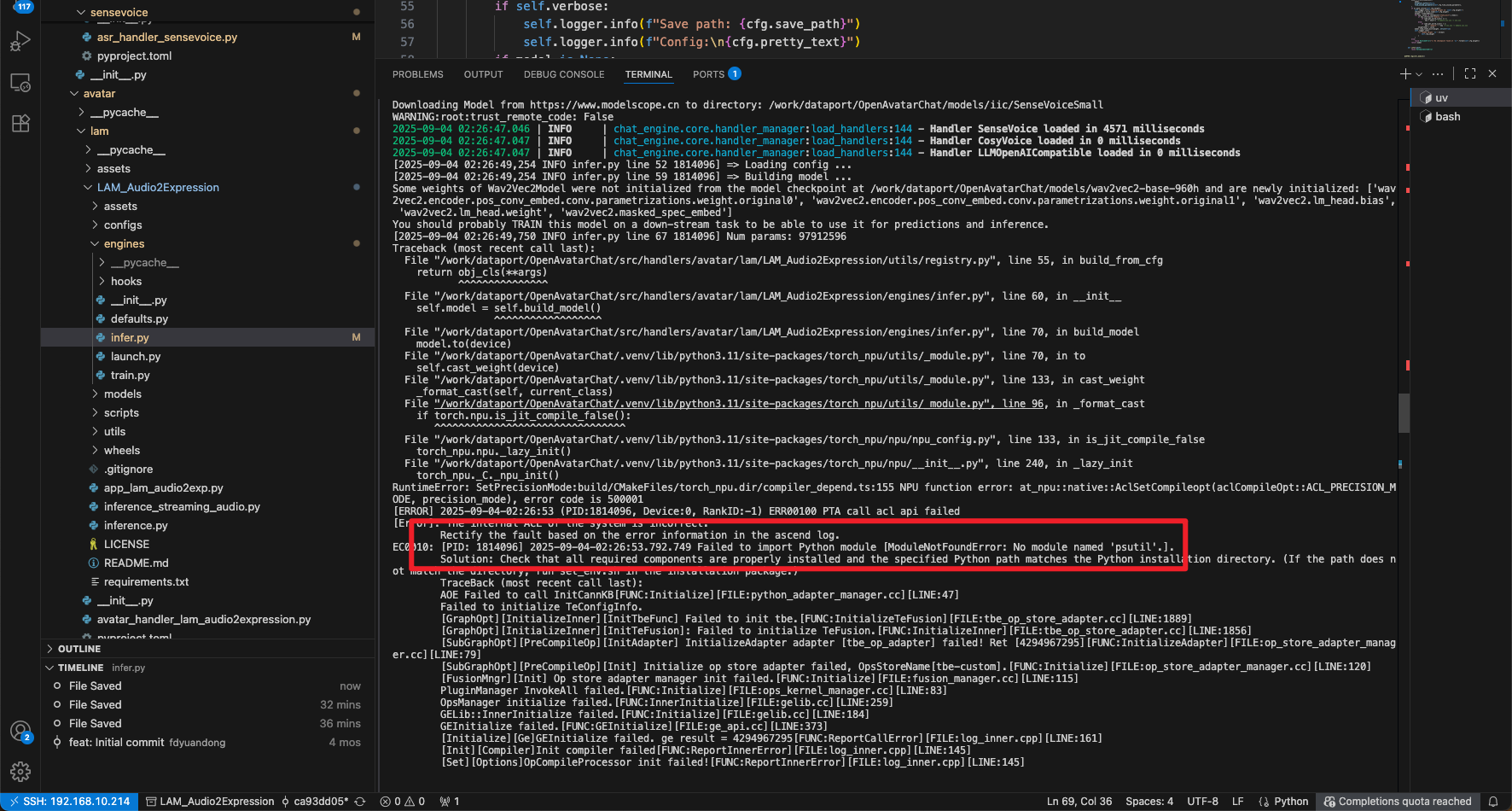
uv pip install psutil
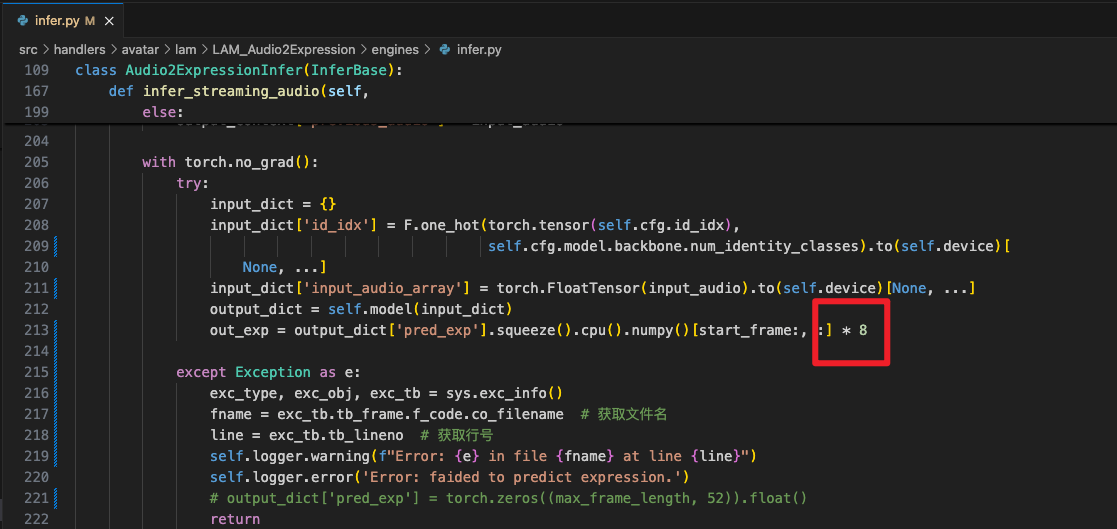
启动后,lam生成的头像眼部动作没有问题,但是嘴部动作非常小,可能是ascend npu 算子或计算精度的问题,可以放大lam的特征矩阵来放大头像动作(效果也不太好)

北京人形旗下天工造物具身智能开源社区,聚焦具身天工与慧思开物两大平台
更多推荐
 24
24 0
0- 0


 已为社区贡献2条内容

所有评论(0)