2025年6月智慧教育领域研究热点概览
本文聚焦于Computers and Education: Artificial Intelligence(CAEAI)期刊,通过图文结合的方式,梳理了2025年6月的研究热点,帮助读者把握教育技术与人工智能交叉领域的研究进展,深入了解智能学习系统、自适应学习环境、人机交互等方向的前沿动态。
本推文的作者是黄星宇,审校为邱雪和许东舟。
一、期刊介绍

Computers and Education: Artificial Intelligence(CAEAI)为Computers & Education的姊妹刊,为全球研究人员、开发者和教育工作者提供平台,交流人工智能在教育中的应用及AI教育相关的研究、创新与系统成果,涵盖智能辅导系统、教育数据分析、AI教育伦理等多个领域。
期刊官网:https://www.sciencedirect.com/journal/computers-and-education-artificial-intelligence
二、期刊内容
2025年6月该期刊共出版文章91篇,文章名称和关键词概览如表1所示。
表1 2025年6月期刊CAEAI论文概览
| 文章名称 | 关键词概览 |
| Systematically visualizing ChatGPT used in higher education: Publication trend, disciplinary domains, research themes, adoption and acceptance | Publication, Systematically, education, trend, disciplinary |
| Artificial intelligence in teaching and teacher professional development: A systematic review | Artificial, development, review, intelligence, teaching |
| How ChatGPT impacts student engagement from a systematic review and meta-analysis study | study, ChatGPT, impacts, student, engagement |
| Examining the effect of artificial intelligence in relation to students’ academic achievement: A meta-analysis | Examining, achievement, meta-analysis, effect, artificial |
| Artificial intelligence in computer programming education: A systematic literature review | Artificial, education, review, intelligence, computer |
| AI ethics education: A systematic literature review | education, review, ethics, systematic, literature |
| Implementing generative AI (GenAI) in higher education: A systematic review of case studies | GenAI, Implementing, education, studies, generative |
| Fostering responsible AI literacy: A systematic review of K-12 AI ethics education | Fostering, literacy, education, responsible, systematic |
| Retrieval-augmented generation for educational application: A systematic survey | Retrieval-augmented, application, survey, generation, educational |
| Artificial intelligence in multimodal learning analytics: A systematic literature review | Artificial, analytics, review, intelligence, multimodal |
| Assisting quality assurance of examination tasks: Using a GPT model and Bayesian testing for formative assessment | GPT, Bayesian, Assisting, tasks, assessment |
| Automatic item generation in various STEM subjects using large language model prompting | STEM, Automatic, prompting, item, generation |
| Addressing the use of generative AI in academic writing | Addressing, writing, generative, academic |
| Artificial intelligence in higher education: Modelling students’ motivation for continuous use of ChatGPT based on a modified self-determination theory | Modelling, Artificial, education, theory, intelligence |
| RICE AlgebraBot: Lessons learned from designing and developing responsible conversational AI using induction, concretization, and exemplification to support algebra learning | concretization, RICE, Lessons, AlgebraBot, induction |
| Effects of adaptive feedback generated by a large language model: A case study in teacher education | Effects, model, education, adaptive, feedback |
| A novel AI-driven model for student dropout risk analysis with explainable AI insights | insights, AI-driven, model, student, dropout |
| Pre-service teachers preparedness for AI-integrated education: An investigation from perceptions, capabilities, and teachers’ identity changes | capabilities, Pre-service, education, perceptions, teachers |
| Leveraging LLMs for optimised feature selection and embedding in structured data: A case study on graduate employment classification | Leveraging, data, classification, LLMs, optimised |
| AI-assisted audio-learning improves academic achievement through motivation and reading engagement | AI-assisted, engagement, audio-learning, improves, academic |
| Generative AI in higher education: A global perspective of institutional adoption policies and guidelines | Generative, education, guidelines, higher, global |
| AI-enhanced interview simulation in the metaverse: Transforming professional skills training through VR and generative conversational AI | Transforming, AI-enhanced, metaverse, interview, simulation |
| Generative AI in academic writing: Does information on authorship impact learners’ revision behavior? | Generative, writing, behavior, academic, information |
| AI advocates and cautious critics: How AI attitudes, AI interest, use of AI, and AI literacy build university students' AI self-efficacy | critics, attitudes, interest, self-efficacy, advocates |
| ChatGMP: A case of AI chatbots in chemical engineering education towards the automation of repetitive tasks | ChatGMP, tasks, case, chatbots, chemical |
| Developing and validating a scale of empowerment in using artificial intelligence for problem-solving for senior secondary and university students | Developing, students, validating, scale, empowerment |
| Exploring students’ experience of ChatGPT in STEM education | STEM, Exploring, education, students’, experience |
| Deep learning-based strategies for evaluating and enhancing university teaching quality | Deep, quality, learning-based, strategies, evaluating |
| Adaptive serious games assessment: The case of the blood transfusion game in nursing education | Adaptive, assessment, education, case, blood |
| Attitudes, perceptions and AI self-efficacy in K-12 education | Attitudes, education, perceptions, self-efficacy |
| Integrating generative artificial intelligence in K-12 education: Examining teachers’ preparedness, practices, and barriers | education, practices, Examining, Integrating, preparedness |
| A cross-national assessment of artificial intelligence (AI) Chatbot user perceptions in collegiate physics education | Chatbot, intelligence, education, cross-national, assessment |
| Can large language models meet the challenge of generating school-level questions? | questions, large, language, models, meet |
| The critical role of trust in adopting AI-powered educational technology for learning: An instrument for measuring student perceptions | learning, perceptions, critical, role, trust |
| Exploring the potential of GenAI for personalised English teaching: Learners' experiences and perceptions | Learners', English, Exploring, teaching, perceptions |
| Evaluation of early student performance prediction given concept drift | Evaluation, drift, early, student, performance |
| Safer interaction with IVAs: The impact of privacy literacy training on competent use of intelligent voice assistants | Safer, IVAs, assistants, interaction, impact |
| Towards the implementation of automated scoring in international large-scale assessments: Scalability and quality control | Scalability, assessments, control, implementation, automated |
| Opportunities, challenges and school strategies for integrating generative AI in education | Opportunities, challenges, education, school, strategies |
| Psychometrics of an Elo-based large-scale online learning system | Elo-based, Psychometrics, system, large-scale, online |
| Perceived MOOC satisfaction: A review mining approach using machine learning and fine-tuned BERTs | MOOC, Perceived, satisfaction, BERTs, review |
| The mediating role of academic stress, critical thinking and performance expectations in the influence of academic self-efficacy on AI dependence: Case study in college students | Case, academic, stress, critical, dependence |
| Technological self-efficacy and sense of coherence: Key drivers in teachers' AI acceptance and adoption | Key, Technological, coherence, adoption, self-efficacy |
| Enhancing data analysis and programming skills through structured prompt training: The impact of generative AI in engineering education | Enhancing, training, education, data, analysis |
| Extending the technology acceptance model: The role of subjective norms, ethics, and trust in AI tool adoption among students | ethics, Extending, model, norms, students |
| Understanding the practices, perceptions, and (dis)trust of generative AI among instructors: A mixed-methods study in the U.S. higher education | perceptions, dis, Understanding, practices, trust |
| Deep learning and fuzzy algorithm in improving the effectiveness of college English translation teaching | English, Deep, teaching, learning, fuzzy |
| The influence of AI literacy on complex problem-solving skills through systematic thinking skills and intuition thinking skills: An empirical study in Thai gen Z accounting students | skills, Thai, thinking, students, influence |
| “I just think it is the way of the future”: Teachers' use of ChatGPT to develop motivationally-supportive math lessons | Teachers', future, lessons, ChatGPT, develop |
| Asking generative artificial intelligence the right questions improves writing performance | performance, generative, artificial, intelligence, questions |
| U.S. college students’ acceptability and educational benefits of ChatGPT from a digital divide perspective | college, perspective, students’, acceptability, educational |
| Empower instructors with actionable insights: Mine and visualize student written feedback for instructors’ reflection | Mine, Empower, insights, reflection, instructors |
| Integrating AI-based adaptive learning into the flipped classroom model to enhance engagement and learning outcomes | Integrating, outcomes, learning, AI-based, adaptive |
| Optimising team dynamics: The role of AI in enhancing challenge-based learning participation experience and outcomes | Optimising, dynamics, outcomes, team, role |
| What influences college students using AI for academic writing? - A quantitative analysis based on HISAM and TRI theory | writing, influences, college, students, academic |
| The shifting landscape of student engagement: A pre-post semester analysis in AI-enhanced classrooms | engagement, classrooms, shifting, landscape, student |
| Co-designing AI with youth partners: Enabling ideal classroom relationships through a novel AI relational privacy ethical framework | Enabling, Co-designing, partners, framework, youth |
| Optimization method for educational resource recommendation combining LSTM and feature weighting | LSTM, Optimization, weighting, method, educational |
| Predicting learners' engagement and help-seeking behaviors in an e-learning environment by using facial and head pose features | Predicting, features, learners', engagement, help-seeking |
| A comparative analysis of pre-service teachers’ readiness for AI integration | integration, comparative, analysis, pre-service, teachers’ |
| Fine-tuning AI models for enhanced consistency and precision in chemistry educational assessments | Fine-tuning, assessments, models, enhanced, consistency |
| Beyond accuracy: Multimodal modeling of structured speaking skill indices in young adolescents | Multimodal, accuracy, adolescents, modeling, structured |
| What percentage of secondary school students do their homework with the help of artificial intelligence? - A survey of attitudes towards artificial intelligence | intelligence, artificial, percentage, secondary, school |
| Investigating the tripartite interaction among teachers, students, and generative AI in EFL education: A mixed-methods study | students, EFL, Investigating, teachers, education |
| Preparing future educators for AI-enhanced classrooms: Insights into AI literacy and integration | Insights, Preparing, classrooms, integration, future |
| Enhancing student reflections with natural language processing based scaffolding: A quasi-experimental study in a large lecture course | Enhancing, scaffolding, student, reflections, natural |
| AI4Design: A generative AI-based system to improve creativity in design–A field evaluation | design, evaluation, generative, AI-based, system |
| Leveraging generative AI for course learning outcome categorization using Bloom's taxonomy | Bloom, Leveraging, taxonomy, generative, learning |
| A cross-country analysis of self-determination and continuance use intention of AI tools in business education: Does instructor support matter? | education, matter, cross-country, analysis, self-determination |
| An early investigation of collaborative problem solving in conversational AI-mediated learning environments | environments, early, investigation, collaborative, problem |
| Learning behavior analysis and personalized recommendation system of online education platform based on machine learning | Learning, behavior, analysis, personalized, recommendation |
| Empowering preservice teachers’ AI literacy: Current understanding, influential factors, and strategies for improvement | Current, Empowering, literacy, understanding, influential |
| Analytics of self-regulated learning strategies and scaffolding: Associations with learning performance | Associations, Analytics, scaffolding, performance, learning |
| Assessing reading fluency in elementary grades: A machine learning approach | Assessing, grades, approach, reading, fluency |
| Artificial intelligence, job seeker, and career trajectory: How AI-based learning experiences affect commitment of fresh graduates to be an accountant? | Artificial, intelligence, job, seeker, trajectory |
| AI analysis reveals top predictors of first grade success: Insights from multifactorial screening students’ early days of school | Insights, success, school, analysis, reveals |
| Opportunities of natural language processing for comparative judgment assessment of essays | Opportunities, essays, natural, language, processing |
| Understanding AI adoption among secondary education teachers: A pls-sem approach | Understanding, teachers, approach, adoption, secondary |
| How do ChatGPT's benefit–risk-coping paradoxes impact higher education in Taiwan and Indonesia? | Indonesia, Taiwan, benefit, risk-coping, ChatGPT |
| Fairness perceptions of AI in grading systems: Examining how discontent with the status quo and outcome favorability reduce AI reluctance | Examining, Fairness, systems, reluctance, perceptions |
| Can generative AI Be an effective Co-Teacher? An experiment | Co-Teacher, generative, effective, experiment |
| Adapting teaching and learning with existing generative AI by higher education Students: Comparative study of Zayed University and King Abdulaziz University | Students, Comparative, University, Zayed, King |
| AI-driven competency recommendations based on attendance patterns and academic performance | AI-driven, performance, competency, recommendations, based |
| Developing and validating the scale of language teachers’ design thinking competency in artificial intelligence language teaching (LTDTAILT) | LTDTAILT, Developing, teaching, language, validating |
| Academic cheating with generative AI: Exploring a moral extension of the theory of planned behavior | Exploring, Academic, behavior, cheating, generative |
| Is GPT-4 fair? An empirical analysis in automatic short answer grading | fair, grading, empirical, analysis, automatic |
| A real-time AI tool for hybrid learning recommendation in education: Preliminary results | Preliminary, education, results, real-time, tool |
| Predicting student achievement through peer network analysis for timely personalization via generative AI | Predicting, student, achievement, peer, network |
| Evaluating the capability of large language models in characterising relational feedback: A comparative analysis of prompting strategies | Evaluating, feedback, strategies, capability, large |
| Teaching AI awareness in middle school classrooms: Design, implementation and evaluation of two education modules on algorithmic bias and filter bubbles | Design, Teaching, classrooms, implementation, bubbles |
| Assessing how accurately large language models encode and apply the common European framework of reference for languages | European, Assessing, accurately, large, models |
三、热点分析
图1展示的是基于2025年6月发表的91篇文章标题生成的关键词词云图,直观地反映了本期研究热点的分布。
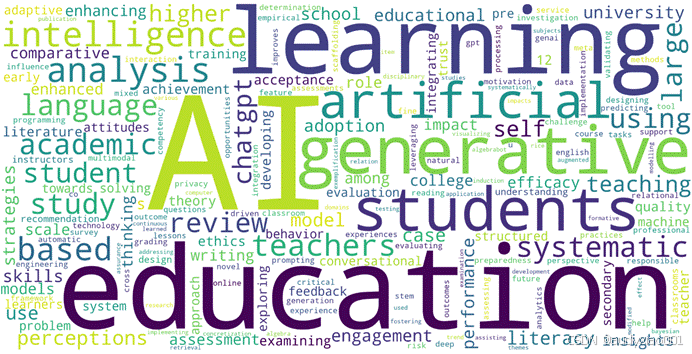
图1 由2025年6月标题高频词生成的词云
在本期文献中,“AI”以绝对优势频次居首(26次),凸显了人工智能在当前教育研究中的核心地位。词云图中,“Learning”、“Students”、“Teaching”、“Writing”、“Feedback”等关键词高频出现,反映出教育技术领域在AI应用层面的多元探索与深度融合。以下将围绕主要研究方向展开分析,挖掘其研究价值与未来发展动向:
1. 人工智能驱动的教学创新与教师角色重构
高频词:AI(26)、Teaching(5)、Educators(2)、Technology(3)
“AI”与“Teaching”的高频共现揭示出技术赋能教学成为研究热点。教师不再仅是知识的传递者,而逐步转向AI系统的设计者、监督者与引导者。相关研究强调了教师专业发展、教学策略转型及AI在备课、课堂互动和评估中的助力作用,展现出“教师—技术—学习”新型关系的形成过程。
2. 学生学习过程中的人机协作与个性化支持
高频词:Learning(8)、Students(7)、Feedback(4)、Support(3)
“Learning”与“Students”的强关联性表明学生依旧是研究关注的核心主体。AI技术通过自动化反馈、学习路径推荐及智能问答系统等手段,显著提升了学习的个性化与适应性。多项研究探讨了自适应学习平台、基于LLM的对话辅助及反馈调节机制对学习成效的影响,推动了学生“学会学习”的目标实现。
3. ChatGPT在语言学习与写作教育中的嵌入实践
高频词:ChatGPT(5)、Writing(4)、Language(3)、Support(3)
以ChatGPT为代表的大语言模型已广泛进入写作与语言学习场景。从语言输入到文本生成、从语法修正到结构优化,LLM正逐渐成为写作过程中的“智能导师”。此外,研究者也关注学生对AI写作辅助的伦理认知与使用意愿,尤其在修改行为、作者身份感知等方面的变化,揭示出AI介入写作教学所面临的双重挑战与机遇。
4. 编程教育中的AI应用与技能培养
高频词:Programming(4)、Skills(4)、Problem(2)、Model(2)
随着计算思维与AI素养成为基础教育的重要目标,AI在编程教学中的角色日益凸显。研究聚焦如何借助生成式AI提升学生的代码质量、调试能力与问题解决技巧,并通过任务分解、提示优化等机制加强教学支架设计,实现技能迁移与思维提升的双重目标。
5. 教育数据分析与评估机制的智能化转型
高频词:Assessment(3)、Data(2)、Model(2)、Analysis(2)
教育评估正朝着更具动态性与解释力的方向演进。LLM与机器学习技术被用于自动评分、能力画像构建与早期预警预测,辅助实现教学精准干预与个性化辅导。同时,生成式AI在任务生成、评分标准建模等环节的嵌入也不断丰富评估工具的智能化维度。
6. 教育伦理与AI信任机制的制度构建
高频词:Ethics(2)、Trust(2)、Perceptions(3)、Adoption(3)
AI在教育中的广泛应用引发了对伦理、公平性与信任机制的深度讨论。研究显示,教师和学生对AI使用的态度显著影响其采纳意愿。围绕作者身份、学术诚信、隐私保护等议题,越来越多的工作尝试建立责任明确、风险可控的AI教育生态系统。
本期研究展示了AI与生成式模型在教育中的多维渗透路径,从语言教学、编程教育到评估机制,从动机激发到信任构建,均体现出教育智能化的快速演进。未来,随着大模型技术不断成熟,如何实现“人机协同”下的有效学习,将成为教育技术领域的核心命题。

北京人形旗下天工造物具身智能开源社区,聚焦具身天工与慧思开物两大平台
更多推荐
 29
29 0
0- 0


 已为社区贡献15条内容

所有评论(0)