分布式系统时间同步方案设计与实践
·
在分布式系统中,时间同步是确保系统一致性和可靠性的基石。本文将深入探讨分布式环境下时间同步的挑战、解决方案和最佳实践,帮助你构建高精度、高可用的时间同步体系。
一、引言:为什么分布式系统需要精确时间同步?
1.1 分布式系统的时间困境
在单机系统中,我们可以依赖本地时钟来确定事件顺序。但在分布式系统中,不同节点的本地时钟存在时钟漂移,这会导致:
- 数据不一致:不同节点对"现在"的理解不同
- 事件顺序混乱:难以确定跨节点事件的因果关系
- 事务冲突:分布式事务依赖时间戳排序
- 监控困难:日志时间戳不一致,难以排查问题
1.2 典型案例:时间同步失败导致的问题
| 案例 | 问题描述 | 后果 |
|---|---|---|
| 2012年Knight Capital | 系统时钟不同步导致高频交易算法混乱 | 4.4亿美元损失 |
| 2017年Azure Storage | 时钟漂移导致元数据不一致 | 服务中断2小时 |
| 2020年某电商平台 | 订单系统与库存系统时间不同步 | 超卖数百件商品 |
二、时间同步基础理论
2.1 时钟精度与漂移
// 时钟漂移示例:计算时钟偏差
public class ClockDriftCalculator {

    // 典型的石英晶振漂移率:±10-100ppm
    // 1ppm = 每天误差0.0864秒
    private static final double TYPICAL_DRIFT_PPM = 50.0;

    /**
     * 计算指定时间内的最大时钟偏差
     * @param durationMs 时间长度(毫秒)
     * @param driftPpm 漂移率(ppm)
     * @return 最大偏差(毫秒)
     */
    public static double calculateMaxDrift(long durationMs, double driftPpm) {
        // ppm转换为每秒误差
        double errorPerSecond = driftPpm / 1_000_000.0;
        // 计算总误差
        return durationMs * errorPerSecond;
    }

    public static void main(String[] args) {
        // 计算一天内的最大时钟偏差
        long oneDayMs = 24 * 60 * 60 * 1000L;
        double maxDrift = calculateMaxDrift(oneDayMs, TYPICAL_DRIFT_PPM);
        System.out.printf("一天内最大时钟偏差:%.2f毫秒(约%d秒)\n",
                         maxDrift, (long)(maxDrift/1000));
    }
}
运行结果:
一天内最大时钟偏差:4320.00毫秒(约4秒)
2.2 时间同步的CAP权衡
在分布式系统中,时间同步需要在一致性、可用性和分区容忍性之间权衡:
- 强一致性:需要高精度同步,但可能降低可用性
- 最终一致性:容忍时钟偏差,但可能导致短暂的不一致
- 时钟不确定性:TrueTime(Spanner)等方案明确声明时间的不确定性范围
三、主流时间同步协议对比
3.1 NTP(Network Time Protocol)
# NTP配置示例(ntp.conf)
server 0.pool.ntp.org iburst
server 1.pool.ntp.org iburst
server 2.pool.ntp.org iburst
server 3.pool.ntp.org iburst

# 限制客户端访问
restrict default nomodify notrap nopeer noquery

# 启用本地时钟作为备份
server 127.127.1.0
fudge 127.127.1.0 stratum 10

# 日志配置
logfile /var/log/ntp.log
NTP特点:
- 精度:局域网内可达0.5ms,广域网1-10ms
- 层次结构:Stratum 0-15,数字越小越接近权威时间源
- 算法:Marzullo算法过滤异常值
3.2 PTP(Precision Time Protocol, IEEE 1588)
# PTP报文交换示例
class PTPProtocol:
    def __init__(self):
        self.sync_interval = 1  # 秒
        self.delay_req_interval = 2  # 秒

    def two_step_sync(self):
        # 主时钟发送Sync报文,记录发送时间t1
        sync_send_time = self.get_hardware_timestamp()
        self.send_sync_message()

        # 从时钟记录接收时间t2
        sync_receive_time = slave.get_hardware_timestamp()

        # 主时钟发送Follow_Up报文,携带t1
        self.send_follow_up(t1=sync_send_time)

        # 从时钟发送Delay_Req,记录发送时间t3
        delay_req_send_time = slave.get_hardware_timestamp()
        slave.send_delay_req()

        # 主时钟记录接收时间t4并发送Delay_Resp
        delay_req_receive_time = self.get_hardware_timestamp()
        self.send_delay_resp(t4=delay_req_receive_time)

        # 从时钟计算时间偏差和网络延迟
        offset = ((t2 - t1) - (t4 - t3)) / 2
        delay = ((t2 - t1) + (t4 - t3)) / 2

        return offset, delay
PTP优势:
- 亚微秒级精度(硬件支持可达纳秒级)
- 硬件时间戳,绕过操作系统延迟
- 支持边界时钟(BC)和透明时钟(TC)
3.3 时钟同步协议对比表
| 协议 | 精度 | 网络要求 | 硬件支持 | 适用场景 |
|---|---|---|---|---|
| NTP | 毫秒级 | 普通网络 | 软件实现 | 互联网应用、企业网络 |
| PTP | 微秒-纳秒级 | 专用网络 | 硬件时间戳 | 工业控制、金融交易 |
| GPS | 纳秒级 | 需要GPS天线 | GPS接收器 | 数据中心、电信基站 |
| 原子钟 | 极高 | 本地部署 | 专用设备 | 国家授时中心、科研 |
四、分布式系统时间同步架构设计
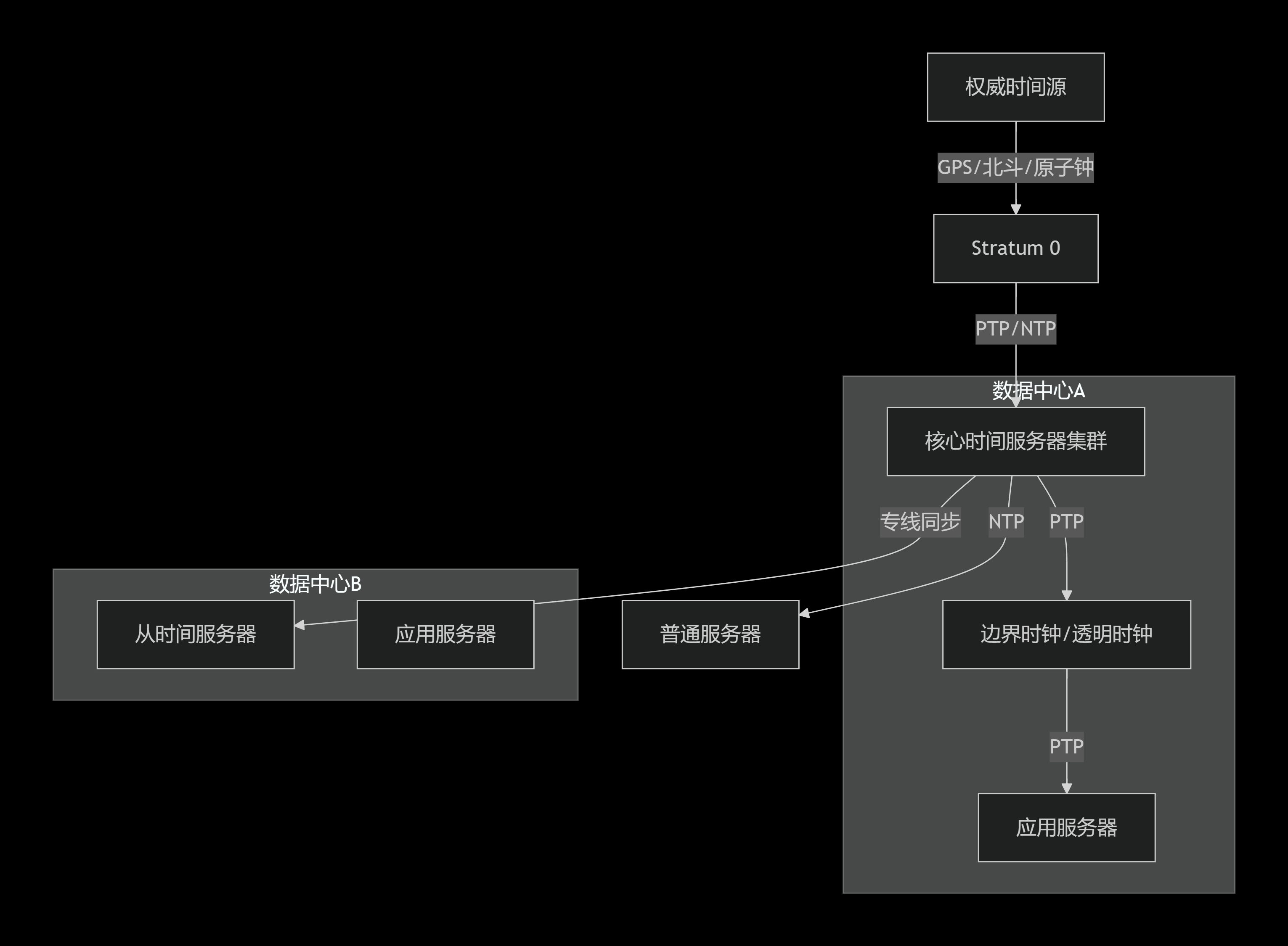
4.1 多层时间同步架构
4.2 高可用时间服务器集群设计
/**
 * 高可用时间服务器集群
 */
public class TimeServerCluster {

    private List<TimeServer> servers;
    private TimeSourceSelector selector;
    private ClockMonitor monitor;

    /**
     * 加权选择算法:综合考虑多个因素
     */
    public TimeServer selectBestServer() {
        return servers.stream()
            .max(Comparator.comparingDouble(this::calculateScore))
            .orElseThrow(() -> new IllegalStateException("No available time server"));
    }

    private double calculateScore(TimeServer server) {
        double score = 0.0;

        // 1. 层次评分(Stratum越低越好)
        score += (16 - server.getStratum()) * 10;

        // 2. 延迟评分(延迟越低越好)
        score += Math.max(0, 100 - server.getNetworkDelay());

        // 3. 稳定性评分(抖动越小越好)
        score += Math.max(0, 50 - server.getJitter());

        // 4. 健康状态评分
        if (server.isHealthy()) {
            score += 30;
        }

        // 5. 负载评分(连接数越少越好)
        score += Math.max(0, 50 - server.getConnectionCount() / 10);

        return score;
    }

    /**
     * 交叉校验机制:防止错误时间源
     */
    public boolean validateTimeConsensus(long currentTime) {
        // 获取多个服务器的时间
        List<Long> times = servers.stream()
            .filter(TimeServer::isHealthy)
            .limit(5)
            .map(TimeServer::getCurrentTime)
            .collect(Collectors.toList());

        if (times.size() < 3) {
            return false; // 有效样本不足
        }

        // 计算中位数
        Collections.sort(times);
        long median = times.get(times.size() / 2);

        // 判断当前时间是否在合理范围内
        long maxDeviation = 1000; // 1秒
        return Math.abs(currentTime - median) <= maxDeviation;
    }
}
4.3 客户端时间同步策略
/**
 * 智能时间同步客户端
 */
public class SmartTimeSyncClient {

    private final Clock localClock;
    private final List<TimeServer> servers;
    private final TimeSyncStrategy strategy;
    private final DriftCompensator compensator;

    // 同步状态
    private volatile SyncState state = SyncState.INITIAL;
    private volatile long lastSyncTime;
    private volatile double estimatedDriftRate; // 估计的漂移率

    /**
     * 自适应同步策略
     */
    public void syncTime() {
        switch (state) {
            case INITIAL:
                // 初始阶段:高频同步
                performFastSync();
                state = SyncState.STABILIZING;
                break;

            case STABILIZING:
                // 稳定阶段:根据漂移率调整同步频率
                if (needSyncBasedOnDrift()) {
                    performNormalSync();
                }
                break;

            case DEGRADED:
                // 降级模式:使用本地时钟和漂移补偿
                adjustWithDriftCompensation();
                break;
        }

        updateSyncMetrics();
    }

    /**
     * 基于时钟漂率的同步决策
     */
    private boolean needSyncBasedOnDrift() {
        long elapsed = System.currentTimeMillis() - lastSyncTime;

        // 计算预期最大偏差
        double maxExpectedDrift = elapsed * estimatedDriftRate;

        // 如果预期偏差超过阈值,需要同步
        return maxExpectedDrift > getSyncThreshold();
    }

    private double getSyncThreshold() {
        // 根据应用需求返回阈值
        // 金融交易:1毫秒
        // 分布式数据库:10毫秒
        // 日志系统:100毫秒
        return 10.0; // 10毫秒
    }

    /**
     * 渐进式时钟调整(避免时间跳变)
     */
    private void adjustClockGradually(long targetTime, long adjustment) {
        if (Math.abs(adjustment) < 100) {
            // 小调整:立即生效
            localClock.setTime(targetTime);
        } else {
            // 大调整:平滑调整(slewing)
            double adjustmentRate = adjustment / 1000.0; // 每毫秒调整量
            compensator.startSlewing(adjustmentRate);
        }
    }

    enum SyncState {
        INITIAL,        // 初始状态
        STABILIZING,    // 稳定同步
        DEGRADED,       // 降级运行
        FAILED          // 同步失败
    }
}
五、实践案例:大规模分布式数据库时间同步
5.1 Google Spanner的TrueTime API
/**
 * TrueTime API 模拟实现
 * 关键思想:时间的不确定性是明确的
 */
public class TrueTime {

    private final TimeMasterCluster timeMasters;
    private final long uncertaintyBound; // 不确定性边界

    public TrueTime() {
        this.timeMasters = new TimeMasterCluster();
        this.uncertaintyBound = 4; // Spanner典型值:4ms
    }

    /**
     * 获取时间区间,真实时间一定在这个区间内
     */
    public TimeInterval now() {
        long earliest = getEarliestTime();
        long latest = getLatestTime();
        return new TimeInterval(earliest, latest);
    }

    /**
     * 等待直到某个时间点肯定已经过去
     */
    public void waitUntil(long targetTime) {
        while (now().getLatest() < targetTime) {
            // 等待不确定性边界过去
            sleep(uncertaintyBound);
        }
    }

    /**
     * 基于TrueTime的分布式事务时间戳分配
     */
    public class TimestampOracle {

        public long getCommitTimestamp(Transaction tx) {
            TimeInterval now = TrueTime.this.now();

            // 返回区间的最晚时间,确保单调递增
            long candidate = now.getLatest();

            // 确保比之前的所有时间戳都大
            candidate = Math.max(candidate, getLastTimestamp() + 1);

            // 等待直到这个时间肯定已经过去
            TrueTime.this.waitUntil(candidate);

            return candidate;
        }
    }

    public static class TimeInterval {
        private final long earliest;
        private final long latest;

        public TimeInterval(long earliest, long latest) {
            this.earliest = earliest;
            this.latest = latest;
        }

        public boolean contains(long time) {
            return time >= earliest && time <= latest;
        }

        // getters省略
    }
}
5.2 阿里巴巴的TSO(Timestamp Oracle)服务
/**
 * TSO服务:集中式时间戳分配
 * 优势:保证全局单调递增
 */
public class TSOCluster {

    private final AtomicLong lastTimestamp = new AtomicLong(0);
    private final ZKCoordinator coordinator;
    private final int datacenterId;
    private final int workerId;

    /**
     * 获取全局唯一的时间戳
     */
    public synchronized long getTimestamp() {
        long current = System.currentTimeMillis();
        long last = lastTimestamp.get();

        // 确保时间戳单调递增
        if (current <= last) {
            current = last + 1;
        }

        // 组合时间戳:高32位时间戳 + 数据中心ID + 工作节点ID + 序列号
        long timestamp = (current << 22)
                       | (datacenterId << 17)
                       | (workerId << 12);

        lastTimestamp.set(current);
        return timestamp;
    }

    /**
     * 批量获取时间戳(减少RPC调用)
     */
    public List<Long> batchGetTimestamps(int count) {
        List<Long> timestamps = new ArrayList<>(count);
        synchronized (this) {
            for (int i = 0; i < count; i++) {
                timestamps.add(getTimestamp());
            }
        }
        return timestamps;
    }

    /**
     * 高可用:主备切换
     */
    @Override
    public void run() {
        while (true) {
            try {
                if (coordinator.isLeader()) {
                    // 主节点:提供服务
                    processRequests();
                } else {
                    // 备节点:同步状态
                    syncWithLeader();
                }
            } catch (Exception e) {
                handleFailure(e);
            }
        }
    }
}
六、时钟同步监控与告警
6.1 监控指标体系
# Prometheus监控配置示例
time_sync_monitoring:
  metrics:
    - name: "clock_offset_seconds"
      type: gauge
      description: "时钟偏移量(秒)"
      alert_threshold: "abs(value) > 0.1"  # 偏移超过100ms告警

    - name: "ntp_stratum"
      type: gauge
      description: "NTP层级"
      alert_threshold: "value > 5"  # 层级过高告警

    - name: "sync_frequency"
      type: counter
      description: "同步次数"

    - name: "sync_duration_seconds"
      type: histogram
      description: "同步耗时分布"
      buckets: [0.001, 0.005, 0.01, 0.05, 0.1]

    - name: "clock_drift_rate_ppm"
      type: gauge
      description: "时钟漂移率"
      alert_threshold: "abs(value) > 100"  # 漂移率过高告警
6.2 Grafana监控看板
{
  "dashboard": {
    "title": "时间同步监控看板",
    "panels": [
      {
        "title": "时钟偏移趋势",
        "type": "graph",
        "targets": [
          {
            "expr": "abs(clock_offset_seconds)",
            "legendFormat": "{{instance}}"
          }
        ],
        "alert": {
          "conditions": [
            {
              "evaluator": { "params": [0.1], "type": "gt" },
              "operator": { "type": "and" }
            }
          ]
        }
      },
      {
        "title": "同步状态热力图",
        "type": "heatmap",
        "targets": [
          {
            "expr": "sum(rate(sync_errors_total[5m])) by (instance)",
            "legendFormat": "{{instance}}"
          }
        ]
      }
    ]
  }
}
七、容错与灾难恢复
7.1 多级降级策略
/**
 * 时间同步降级策略
 */
public class TimeSyncDegradationStrategy {

    private static final List<TimeSource> TIME_SOURCES = Arrays.asList(
        new GpsTimeSource(),      // 一级:GPS
        new AtomicClockSource(),  // 二级:原子钟
        new NtpClusterSource(),   // 三级:NTP集群
        localClockWithDriftCompensation  // 四级:本地时钟+漂移补偿
    );

    /**
     * 逐步降级:从最高精度源开始尝试
     */
    public long getTimeWithDegradation() {
        for (int i = 0; i < TIME_SOURCES.size(); i++) {
            try {
                TimeSource source = TIME_SOURCES.get(i);
                if (source.isAvailable()) {
                    long time = source.getTime();
                    if (validateTime(time)) {
                        logDegradationLevel(i);
                        return time;
                    }
                }
            } catch (Exception e) {
                log.warn("Time source {} failed: {}", i, e.getMessage());
                continue;
            }
        }

        // 所有源都失败,使用本地时钟并告警
        triggerEmergencyAlert();
        return System.currentTimeMillis();
    }

    /**
     * 时间验证:交叉验证多个源
     */
    private boolean validateTime(long time) {
        // 获取多个独立源的时间
        List<Long> samples = new ArrayList<>();
        for (TimeSource source : TIME_SOURCES.subList(0, 3)) {
            if (source.isAvailable()) {
                samples.add(source.getTime());
            }
        }

        if (samples.size() < 2) {
            return true; // 样本不足,信任当前源
        }

        // 检查是否在合理范围内
        long median = getMedian(samples);
        return Math.abs(time - median) < getValidationThreshold();
    }
}
7.2 脑裂场景处理
/**
 * 处理时间服务器脑裂
 */
public class SplitBrainHandler {

    private final QuorumChecker quorumChecker;
    private final ConflictResolver conflictResolver;

    /**
     * 检测并处理脑裂
     */
    public void handleSplitBrain(List<TimeServer> servers) {
        // 1. 检测时间分歧
        Map<Long, List<TimeServer>> timeGroups = groupServersByTime(servers);

        if (timeGroups.size() > 1) {
            log.error("Split brain detected: {} different time groups", timeGroups.size());

            // 2. 选择多数派
            List<TimeServer> majorityGroup = findMajorityGroup(timeGroups);

            if (majorityGroup != null) {
                // 3. 隔离少数派
                isolateMinorityGroups(timeGroups, majorityGroup);

                // 4. 恢复服务
                recoverFromSplitBrain(majorityGroup);
            } else {
                // 没有明确多数派,进入安全模式
                enterSafeMode();
            }
        }
    }

    /**
     * 安全模式:停止时间服务,等待人工干预
     */
    private void enterSafeMode() {
        log.error("Entering safe mode: cannot resolve split brain automatically");

        // 停止对外服务
        stopTimeService();

        // 触发最高级别告警
        triggerCriticalAlert("TIME_SPLIT_BRAIN_UNRESOLVED");

        // 记录详细状态用于事后分析
        dumpDebugInfo();

        // 等待运维人员干预
        awaitManualIntervention();
    }
}
八、最佳实践总结
8.1 设计原则
- 防御性设计:假设时钟会出错,系统要有应对机制
- 渐进式调整:避免时间跳变,使用slewing技术平滑调整
- 多源校验:不信任单一时间源,交叉验证多个独立源
- 明确不确定性:像TrueTime那样明确声明时间的不确定性边界
- 分层架构:根据精度需求使用不同层级的时间同步
8.2 实施建议
# 时间同步配置检查清单
checklist:
  infrastructure:
    - 至少部署3个独立的时间源
    - 跨机房部署时间服务器
    - 使用不同运营商网络接入
    - 硬件时钟配置电池备份

  software:
    - 启用NTP/PTP服务监控
    - 配置合理的同步间隔
    - 实现时钟漂移补偿
    - 部署时间验证服务

  process:
    - 定期进行时间同步测试
    - 建立时间异常应急预案
    - 培训团队处理时间相关故障
    - 文档化时间同步架构

  testing:
    - 模拟时钟跳变测试
    - 网络分区下的时间同步测试
    - 时间服务器故障切换测试
    - 长期运行漂移测试
8.3 常见陷阱与规避
| 陷阱 | 现象 | 规避方法 |
|---|---|---|
| 单点故障 | 所有节点依赖单一NTP服务器 | 部署多台时间服务器,使用anycast |
| 网络不对称 | 同步路径延迟不对称 | 使用PTP硬件时间戳,双向测量 |
| 闰秒处理不当 | 系统在闰秒时异常 | 使用smear技术或明确处理闰秒 |
| 虚拟化时钟问题 | 虚拟机时钟不稳定 | 配置KVM/PTP支持,定期同步 |
| 防火墙阻断 | NTP/PTP端口被阻断 | 明确开放123/319-320端口 |
九、未来趋势
-
软件定义时间:SDN技术应用于时间同步网络
-
量子时钟同步:基于量子纠缠的下一代同步技术
-
卫星互联网同步:Starlink等低轨卫星提供全球高精度时间
-
边缘计算时间同步:5G边缘节点微秒级同步需求
-
区块链时间戳:去中心化的可信时间服务
结语
时间同步是分布式系统的"暗物质"——虽然看不见,但支撑着整个系统的运行。一个健壮的时间同步体系需要结合硬件、软件、网络和流程等多个层面。随着分布式系统越来越复杂,对时间同步的要求也会越来越高。
记住:在分布式系统中,唯一确定的是时间的不确定性。我们的目标是管理这种不确定性,而不是消除它。
延伸阅读:
实践项目:
- 搭建自己的NTP/PTP测试环境
- 实现一个简单的TrueTime API
- 设计跨数据中心的时间同步方案
欢迎在评论区分享你的时间同步实践经验和挑战!

北京人形旗下天工造物具身智能开源社区,聚焦具身天工与慧思开物两大平台
更多推荐
 30
30 0
0- 0



 已为社区贡献2条内容

所有评论(0)