大模型论文分享 | 多模态大模型最新进展
论文分享 | 多模态大模型相关研究进展
我们从2024-12-03到2024-12-05的57篇文章中精选出5篇优秀的工作分享给读者。
-
Quantization-Aware Imitation-Learning for Resource-Efficient Robotic Control
-
Understanding the World’s Museums through Vision-Language Reasoning
-
NLPrompt: Noise-Label Prompt Learning for Vision-Language Models
-
OODFace: Benchmarking Robustness of Face Recognition under Common Corruptions and Appearance Variations
-
VideoLights: Feature Refinement and Cross-Task Alignment Transformer for Joint Video Highlight Detection and Moment Retrieval
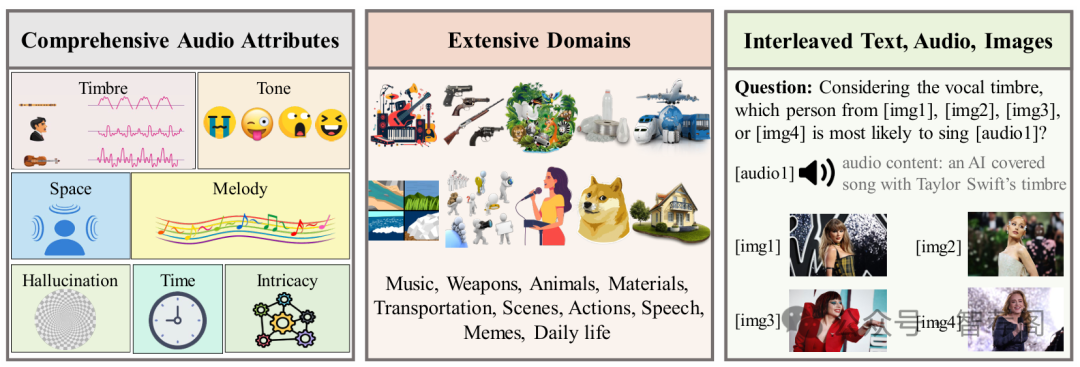
1.AV-Odyssey Bench: Can Your Multimodal LLMs Really Understand Audio-Visual Information?
Authors: Seongmin Park, Hyungmin Kim, Wonseok Jeon, Juyoung Yang, Byeongwook Jeon, Yoonseon Oh, Jungwook Choi
https://arxiv.org/abs/2412.01034
论文摘要
Recently, multimodal large language models (MLLMs), such as GPT-4o, Gemini 1.5 Pro, and Reka Core, have expanded their capabilities to include vision and audio modalities. While these models demonstrate impressive per formance across a wide range of audio-visual applications, our proposed DeafTest reveals that MLLMs often struggle with simple tasks humans find trivial: 1) determining which of two sounds is louder, and 2) determining which of two sounds has a higher pitch. Motivated by these observations, we introduce AV-Odyssey Bench, a comprehensive audio visual benchmark designed to assess whether those MLLMs can truly understand the audio-visual information. This benchmark encompasses 4,555 carefully crafted problems, each incorporating text, visual, and audio components. To successfully infer answers, models must effectively leverage clues from both visual and audio inputs. To ensure pre cise and objective evaluation of MLLM responses, we have structured the questions as multiple-choice, eliminating the need for humanevaluation or LLM-assisted assessment. We benchmark a series of closed-source and open-source mod els and summarize the observations. By revealing the limi tations of current models, we aim to provide useful insight for future dataset collection and model development.
论文简评
这篇论文针对当前多模态大语言模型(MLLMs)在音频视觉理解方面的不足,提出了AV-Odyssey Bench基准,为研究社区提供了一个全面且实用的评估工具。作者通过包含4555个多模态问题的数据集,系统地测试了模型在基本听觉任务和音频-视觉信息整合能力上的表现,并通过DeafTest揭示了当前模型在简单听觉辨别任务中的局限性。论文的贡献在于填补了现有基准中针对听觉理解的空白,同时为未来的数据集构建和模型优化提供了有价值的参考。整体而言,这项工作数据全面、问题设计合理,为多模态模型的研究提供了重要推动力。
2.Understanding the World’s Museums through Vision-Language Reasoning
Authors: Ada-Astrid Balauca, Sanjana Garai, Stefan Balauca, Rasesh Udayakumar Shetty, Naitik Agrawal, Dhwanil Subhashbhai Shah, Yuqian Fu, Xi Wang, Kristina Toutanova, Danda Pani Paudel, Luc Van Gool
https://arxiv.org/abs/2412.01370
论文摘要
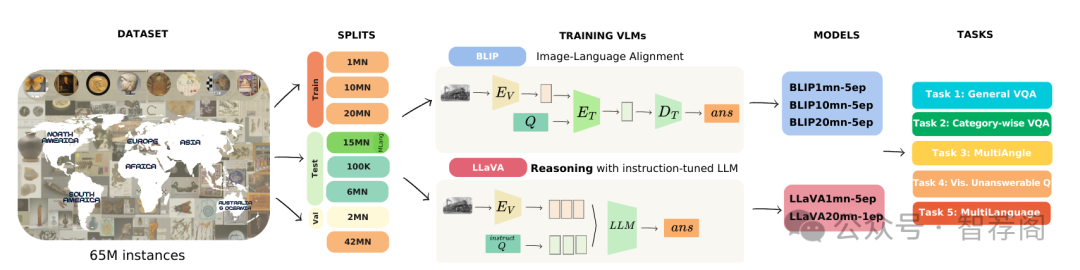
Museums serve as vital repositories of cultural heritage and historical artifacts spanning diverse epochs, civilizations, and regions, preserving well-documented collections. Data reveal key attributes such as age, origin, material, and cultural significance. Understanding museum exhibits from their images requires reasoning beyond visual features. In this work, we facilitate such reasoning by (a) collecting and curating a large-scale dataset of 65M images and 200M question-answer pairs in the standard museum catalog format for exhibits from all around the world; (b) training large vision-language models on the collected dataset; © benchmarking their ability on five visual question answering tasks. The complete dataset is labeled by museum experts, ensuring the quality as well as the practical sig- nificance of the labels. We train two VLMs from differ- ent categories: the BLIP model, with vision-language aligned embeddings, but lacking the expressive power of large language models, and the LLaVA model, a powerful instruction-tuned LLM enriched with vision-language reasoning capabilities. Through exhaustive experiments, we provide several insights on the complex and fine-grained understanding of museum exhibits. In particular, we show that some questions whose answers can often be derived directly from visual features are well answered by both types of models. On the other hand, questions that require the grounding of the visual features in repositories of human knowledge are better answered by the large vision-language models, thus demonstrating their superior capacity to perform the desired reasoning. Find our dataset, benchmarks, and source code at: github.com/insait-institute/Museum-65
论文简评
这篇论文介绍了一个名为MUSEUM-65的大规模数据集,包含650万张图像和2亿对问题-答案,旨在增强博物馆场景中的视觉问答(VQA)。它比较了两个视觉语言模型BLIP和LLaVA,并在多种与文化遗产相关的任务上评估它们的表现。该研究的主要贡献在于提供了丰富的资源,为未来的研究奠定了坚实的基础。此外,通过比较BLIP和LLaVA的性能,论文提出了有价值的见解,显示出这些模型在不同文化背景下的表现差异。此外,论文强调了MUSEUM-65对于教育和研究的重要性,因为它填补了现有数据集的空白,使研究者能够更深入地探索文化和历史知识的可视化表达方式。综上所述,本文不仅展示了MUSEUM-65的数据价值,也揭示了其对视觉问答领域的影响和意义,因此值得读者关注与研究。
3.NLPrompt: Noise-Label Prompt Learning for Vision-Language Models
Authors: Bikang Pan, Qun Li, Xiaoying Tang, Wei Huang, Zhen Fang, Feng Liu, Jingya Wang, Jingyi Yu, Ye Shi
https://arxiv.org/abs/2412.01256
论文摘要
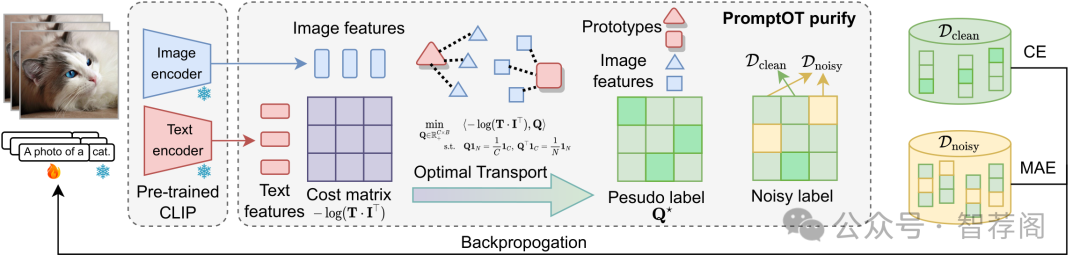
The emergence of vision-language foundation models, such as CLIP, has revolutionized image-text representation, enabling a broad range of applications via prompt learning. Despite its promise, real-world datasets often contain noisy labels that can degrade prompt learning performance. In this paper, we demonstrate that using mean absolute error (MAE) loss in prompt learning, named PromptMAE, significantly enhances robustness against noisy labels while maintaining high accuracy. Though MAE is straightforward and recognized for its robustness, it is rarely used in noisy-label learning due to its slow convergence and poor performance outside prompt learning scenarios. To elucidate the robustness of PromptMAE, we leverage feature learning theory to show that MAE can suppress the influence of noisy samples, thereby improving the signal-to-noise ratio and enhancing overall robustness. Additionally, we introduce PromptOT, a prompt-based optimal transport data purification method to further enhance robustness. PromptOT employs text encoder representations in vision-language models as prototypes to construct an optimal transportation matrix, effectively partitioning datasets into clean and noisy subsets, allowing for the application of cross-entropy loss to the clean subset and MAE loss to the noisy subset. Our Noise-Label Prompt Learning method, named NLPrompt, offers a simple and efficient approach that leverages the expressive representation and precise alignment capabilities of vision-language models for robust prompt learning. We validate NLPrompt through extensive experiments across various noise settings, demonstrating significant performance improvements.
论文简评
这篇论文探讨了如何通过引入NLPrompt方法来提高视觉语言模型中的提示学习效果。该方法的核心在于使用均方误差(Mean Absolute Error, MAE)损失函数以及PromptOT数据净化策略,旨在有效分离干净与有噪声的数据。实验结果表明,在不同噪声水平下,这种改进显著提高了模型性能。总的来说,这篇文章为机器学习中的一个重要问题——对抗性噪音标签,提供了一种有效的解决方案,为视觉语言模型的发展提供了新的思路。
4.OODFace: Benchmarking Robustness of Face Recognition under Common Corruptions and Appearance Variations
Authors: Caixin Kang, Yubo Chen, Shouwei Ruan, Shiji Zhao, Ruochen Zhang, Jiayi Wang, Shan Fu, Xingxing Wei
https://arxiv.org/abs/2412.02479
论文摘要
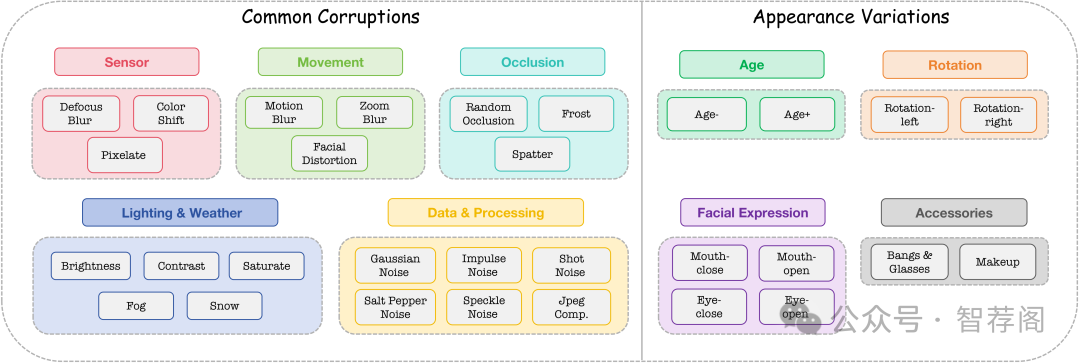
With the rise of deep learning, facial recognition technology has seen extensive research and rapid development. Although facial recognition is considered a mature technology, we find that existing open-source models and commercial algorithms lack robustness in certain real-world Out-of-Distribution (OOD) scenarios, raising concerns about the reliability of these systems. In this paper, we introduce OODFace, which explores the OOD challenges faced by facial recognition models from two perspectives: common corruptions and appearance variations. We systematically design 30 OOD scenarios across 9 major categories tailored for facial recognition. By simulating these challenges on public datasets, we establish three robustness benchmarks: LFW-C/V, CFP-FP-C/V, and YTF-C/V. We then conduct extensive experiments on 19 different facial recognition models and 3 commercial APIs, along with extended experiments on face masks, Vision-Language Models (VLMs), and defense strategies to assess their robustness. Based on the results, we draw several key insights, highlighting the vulnerability of facial recognition systems to OOD data and suggesting possible solutions. Additionally, we offer a unified toolkit that includes all corruption and variation types, easily extendable to other datasets. We hope that our benchmarks and findings can provide guidance for future improvements in facial recognition model robustness.
论文简评
OODFace作为面部识别系统对抗常见污染和外观变异的一套基准,是当前研究中一个重要方向。该文针对面部识别系统的弱点设计了30个OOD场景,并基于公开数据集建立了三个评估标准。实验结果表明,尽管模型和API在OOD挑战中的表现各异,但它们都存在一些共同的问题,如对局部细节的鲁棒性不足和泛化能力差等。这些发现为未来的研究提供了有价值的参考,并促使我们思考如何通过改进算法、优化特征提取过程等方式来提高面部识别系统的抗OOD能力。总的来说,该文深入分析了面部识别系统在OOD环境下的表现及其存在的问题,对于提升这一领域的研究具有重要意义。
5.VideoLights: Feature Refinement and Cross-Task Alignment Transformer for Joint Video Highlight Detection and Moment Retrieval
Authors: Dhiman Paul, Md Rizwan Parvez, Nabeel Mohammed, Shafin Rahman
https://arxiv.org/abs/2412.01558
论文摘要
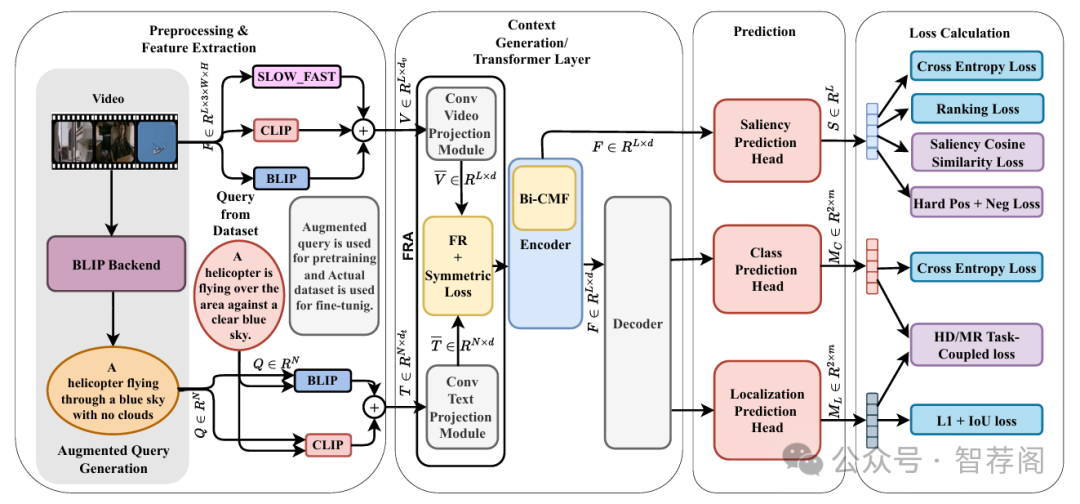
Video Highlight Detection and Moment Retrieval (HD/MR) are essential in video analysis. Recent joint prediction transformer models often overlook their cross-task dynamics and video-text alignment and refinement. Moreover, most mod els typically use limited, uni-directional attention mechanisms, resulting in weakly integrated representations and suboptimal performance in capturing the interdependence between video and text modalities. Although large-language and vision-language models (LLM/LVLMs) have gained prominence across various domains, their application in this field remains relatively un derexplored. Here we propose VideoLights, a novel HD/MR framework addressing these limitations through (i) Convolutional Projection and Feature Refinement modules with an alignment loss for better video-text feature alignment, (ii) Bi-Directional Cross-Modal Fusion network for strongly coupled query-aware clip representations, and (iii) Uni-directional joint-task feedback mechanism enhancing both tasks through correlation. In addi tion, (iv) we introduce hard positive/negative losses for adaptive error penalization and improved learning, and (v) leverage LVLMs like BLIP-2 for enhanced multimodal feature integra tion and intelligent pretraining using synthetic data generated from LVLMs. Comprehensive experiments on QVHighlights, TVSum, and Charades-STA benchmarks demonstrate state-of the-art performance. Codes and models are available at: https: //github.com/dpaul06/VideoLights.
论文简评
VideoLights 是一种开创性的方法,将视频和文本模态相结合,以解决视频中亮点检测与片段检索的联合任务问题。论文提出了一种新颖的框架,利用多个预训练的视觉-语言模型来实现更好的特征对齐和任务相互依赖性。作者引入了多个创新模块,提升了视频-文本的融合效果和性能,为计算机视觉与自然语言处理领域的研究人员和实践者提供了重要工具。在最新基准测试上取得了令人瞩目的成果,VideoLights 展现出其作为联合亮点检测和片段检索强大工具的潜力。
6. 最后分享
AI大模型作为人工智能领域的重要技术突破,正成为推动各行各业创新和转型的关键力量。抓住AI大模型的风口,掌握AI大模型的知识和技能将变得越来越重要。
学习AI大模型是一个系统的过程,需要从基础开始,逐步深入到更高级的技术。
这里给大家精心整理了一份
全面的AI大模型学习资源,包括:AI大模型全套学习路线图(从入门到实战)、精品AI大模型学习书籍手册、视频教程、实战学习、面试题等,资料免费分享!

1. 成长路线图&学习规划
要学习一门新的技术,作为新手一定要先学习成长路线图,方向不对,努力白费。
这里,我们为新手和想要进一步提升的专业人士准备了一份详细的学习成长路线图和规划。可以说是最科学最系统的学习成长路线。

2. 大模型经典PDF书籍
书籍和学习文档资料是学习大模型过程中必不可少的,我们精选了一系列深入探讨大模型技术的书籍和学习文档,它们由领域内的顶尖专家撰写,内容全面、深入、详尽,为你学习大模型提供坚实的理论基础。(书籍含电子版PDF)

3. 大模型视频教程
对于很多自学或者没有基础的同学来说,书籍这些纯文字类的学习教材会觉得比较晦涩难以理解,因此,我们提供了丰富的大模型视频教程,以动态、形象的方式展示技术概念,帮助你更快、更轻松地掌握核心知识。

4. 2024行业报告
行业分析主要包括对不同行业的现状、趋势、问题、机会等进行系统地调研和评估,以了解哪些行业更适合引入大模型的技术和应用,以及在哪些方面可以发挥大模型的优势。

5. 大模型项目实战
学以致用 ,当你的理论知识积累到一定程度,就需要通过项目实战,在实际操作中检验和巩固你所学到的知识,同时为你找工作和职业发展打下坚实的基础。

6. 大模型面试题
面试不仅是技术的较量,更需要充分的准备。
在你已经掌握了大模型技术之后,就需要开始准备面试,我们将提供精心整理的大模型面试题库,涵盖当前面试中可能遇到的各种技术问题,让你在面试中游刃有余。

全套的AI大模型学习资源已经整理打包,有需要的小伙伴可以
微信扫描下方CSDN官方认证二维码,免费领取【保证100%免费】


北京人形旗下天工造物具身智能开源社区,聚焦具身天工与慧思开物两大平台
更多推荐
 13
13 0
0- 0


 已为社区贡献35条内容

所有评论(0)