点云配准方法原理(NDT、ICP)
配准是点云处理中的一个基础问题,众多学者此问题进行了广泛而深入的研究,也出现了一系列优秀成熟的算法,在三维建模、自动驾驶等领域发挥着重要的作用。
本文主要介绍粗配准NDT (Normal Distribution Transform) 与 精配准ICP (Iterative Closest Point)两种经典算法。
NDT (Normal Distribution Transform)点云配准
在去年曾经对NDT原理进行了简单总结,大家可以参考链接:点云配准NDT (P2D)算法详解。
ICP (Iterative Closest Point)点云配准
参考:
基于SVD求解 3D-3D 点对匹配
该如何学习三维点云配准的相关知识?
ICP是经典的精配准算法,其以“点”为配准基元,不断迭代求得最优的位姿,最终使得目标函数最小。
点云集合
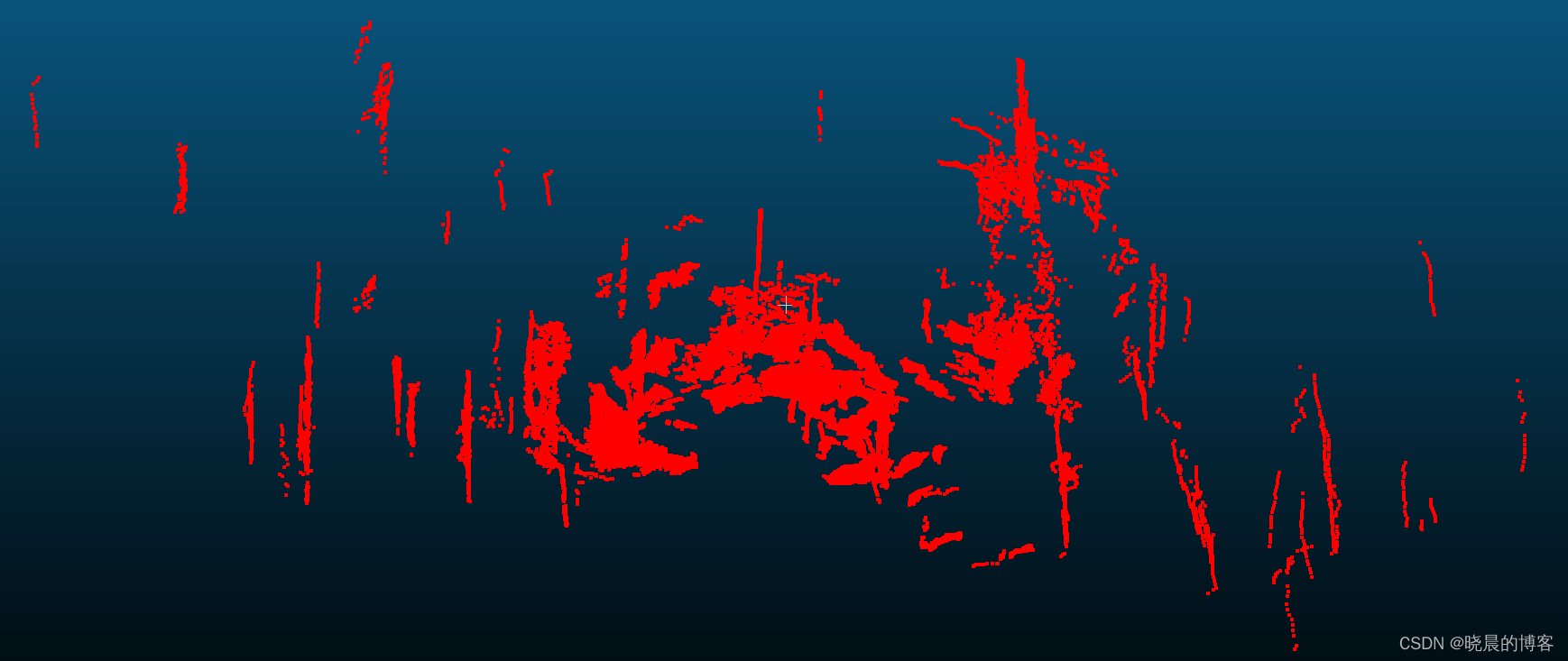
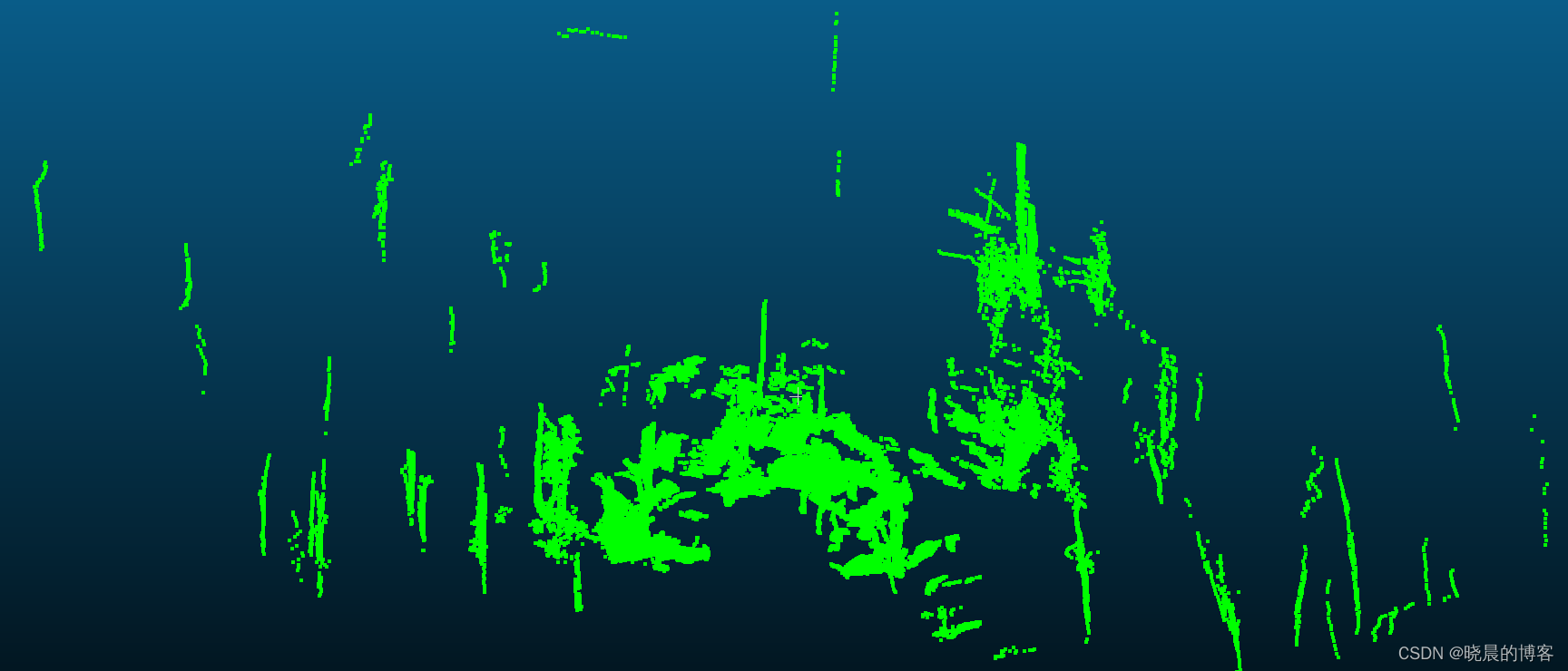
假设存在两个点云集合,
目标点云 (target cloud ):
P
=
{
p
1
,
p
2
,
p
3
,
.
.
.
,
p
n
}
P=\{p_1, p_2, p_3,..., p_n\}
P={p1,p2,p3,...,pn}
源点云 (source cloud):
Q
=
{
q
1
,
q
2
,
q
3
,
.
.
.
,
q
n
}
Q=\{q_1, q_2, q_3,..., q_n\}
Q={q1,q2,q3,...,qn}
两者叠加显示:
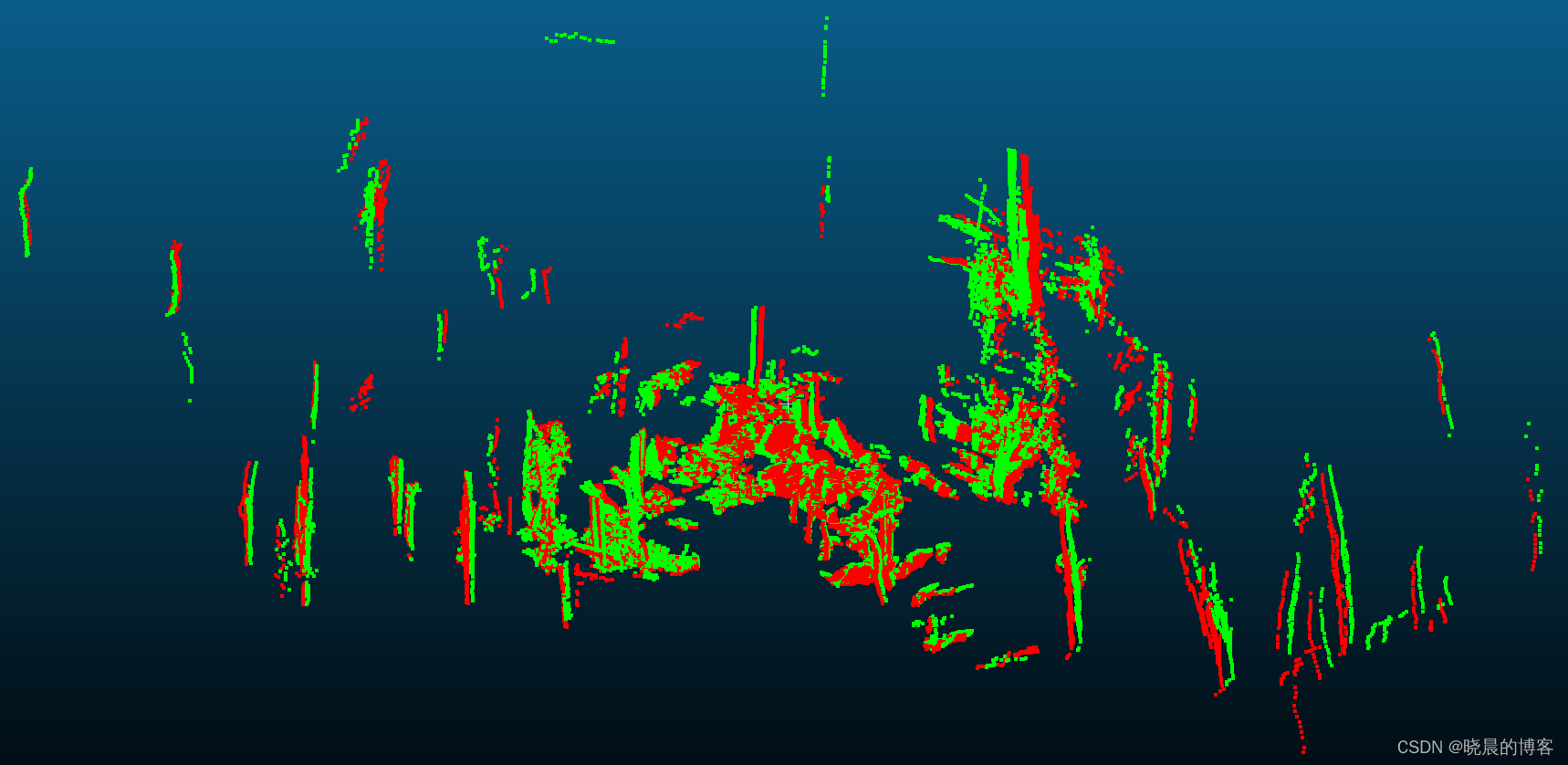
可以看到上图中的两帧点云之间存在一个偏差,这个偏差需要一个位姿变换
(
R
,
t
)
(R, t)
(R,t)进行转换。
构造目标函数
ICP算法则希望得到一个最优的位姿变换
(
R
∗
,
t
∗
)
(R^*, t^*)
(R∗,t∗)使得下式目标函数最小:
f
(
R
∗
,
t
∗
)
=
M
I
N
(
1
N
p
∑
i
=
1
N
p
∣
p
i
t
−
(
R
∗
q
i
s
+
t
∗
)
∣
2
)
f(R^*, t^*)=MIN(\frac{1}{N_p}{\textstyle \sum_{i=1}^{N_p}\left | p_{i}^{t}-(R^*q_{i}^{s}+t^*) \right |^2 } )
f(R∗,t∗)=MIN(Np1∑i=1Np∣pit−(R∗qis+t∗)∣2)
其中
N
p
N_p
Np为配对点云个数,
p
i
t
p_{i}^{t}
pit与
q
i
s
q_{i}^{s}
qis是目标点云与源点云中的一对配对点。
寻找对应点对
起始步骤中,我们只有一系列无序的三维点,并没有对应的 p i t p_{i}^{t} pit与 q i s q_{i}^{s} qis点对。ICP中定义了“最近邻点”的定义。
- 使用一个初始位姿 ( R 0 , t 0 ) (R^0, t^0) (R0,t0)对源点云 Q Q Q进行变换,得到一个变换后的点云 Q ′ Q' Q′。
- 对变换后的点云 Q ′ Q' Q′中的点 q i ′ q_{i}^{'} qi′在目标点云中查找最近邻点 p j p_{j} pj,如果两点之间的距离小于预先设置的阈值,则认为点 q i ′ q_{i}^{'} qi′与点 p j p_{j} pj为对应的点对。
优化位姿变换 ( R , t ) (R, t) (R,t)
找到所有合理的最近邻点对之后,则每一个点对都可以构建一个函数(每个点对类似于一个观测),而待求变量 ( R , t ) (R, t) (R,t)只有6个自由度。所以我们有了 N p N_p Np个观测,6个待求变量。使用最小二乘进行优化求解。
这样我们就更新了初始位姿 ( R 0 , t 0 ) (R^0, t^0) (R0,t0)为新的 ( R 1 , t 1 ) (R^1, t^1) (R1,t1)
迭代优化
得到新的位姿变换
(
R
1
,
t
1
)
(R^1, t^1)
(R1,t1)之后,我们再次回到寻找对应点对步骤中,重新转换源点云
Q
Q
Q为
Q
2
Q^2
Q2,查找
Q
2
Q^2
Q2与
P
P
P新的点对。
接着,进行新的 “优化位姿变换
(
R
,
t
)
(R, t)
(R,t)” 步骤,重复得到新的优化位姿
(
R
2
,
t
2
)
(R^2, t^2)
(R2,t2)
直到达到迭代停止条件,如:1)达到最大迭代次数,或2)位姿变化量小于阈值,或3)最近邻点对不再变化等则终止迭代。
调用PCL库
参考链接:Interactive Iterative Closest Point
  1#include <iostream>
  2#include <string>
  3
  4#include <pcl/io/ply_io.h>
  5#include <pcl/point_types.h>
  6#include <pcl/registration/icp.h>
  7#include <pcl/visualization/pcl_visualizer.h>
  8#include <pcl/console/time.h>   // TicToc
  9
 10typedef pcl::PointXYZ PointT;
 11typedef pcl::PointCloud<PointT> PointCloudT;
 12
 13bool next_iteration = false;
 14
 15void
 16print4x4Matrix (const Eigen::Matrix4d & matrix)
 17{
 18  printf ("Rotation matrix :\n");
 19  printf ("    | %6.3f %6.3f %6.3f | \n", matrix (0, 0), matrix (0, 1), matrix (0, 2));
 20  printf ("R = | %6.3f %6.3f %6.3f | \n", matrix (1, 0), matrix (1, 1), matrix (1, 2));
 21  printf ("    | %6.3f %6.3f %6.3f | \n", matrix (2, 0), matrix (2, 1), matrix (2, 2));
 22  printf ("Translation vector :\n");
 23  printf ("t = < %6.3f, %6.3f, %6.3f >\n\n", matrix (0, 3), matrix (1, 3), matrix (2, 3));
 24}
 25
 26void
 27keyboardEventOccurred (const pcl::visualization::KeyboardEvent& event,
 28                       void*)
 29{
 30  if (event.getKeySym () == "space" && event.keyDown ())
 31    next_iteration = true;
 32}
 33
 34int
 35main (int argc,
 36      char* argv[])
 37{
 38  // The point clouds we will be using
 39  PointCloudT::Ptr cloud_in (new PointCloudT);  // Original point cloud
 40  PointCloudT::Ptr cloud_tr (new PointCloudT);  // Transformed point cloud
 41  PointCloudT::Ptr cloud_icp (new PointCloudT);  // ICP output point cloud
 42
 43  // Checking program arguments
 44  if (argc < 2)
 45  {
 46    printf ("Usage :\n");
 47    printf ("\t\t%s file.ply number_of_ICP_iterations\n", argv[0]);
 48    PCL_ERROR ("Provide one ply file.\n");
 49    return (-1);
 50  }
 51
 52  int iterations = 1;  // Default number of ICP iterations
 53  if (argc > 2)
 54  {
 55    // If the user passed the number of iteration as an argument
 56    iterations = atoi (argv[2]);
 57    if (iterations < 1)
 58    {
 59      PCL_ERROR ("Number of initial iterations must be >= 1\n");
 60      return (-1);
 61    }
 62  }
 63
 64  pcl::console::TicToc time;
 65  time.tic ();
 66  if (pcl::io::loadPLYFile (argv[1], *cloud_in) < 0)
 67  {
 68    PCL_ERROR ("Error loading cloud %s.\n", argv[1]);
 69    return (-1);
 70  }
 71  std::cout << "\nLoaded file " << argv[1] << " (" << cloud_in->size () << " points) in " << time.toc () << " ms\n" << std::endl;
 72
 73  // Defining a rotation matrix and translation vector
 74  Eigen::Matrix4d transformation_matrix = Eigen::Matrix4d::Identity ();
 75
 76  // A rotation matrix (see https://en.wikipedia.org/wiki/Rotation_matrix)
 77  double theta = M_PI / 8;  // The angle of rotation in radians
 78  transformation_matrix (0, 0) = std::cos (theta);
 79  transformation_matrix (0, 1) = -sin (theta);
 80  transformation_matrix (1, 0) = sin (theta);
 81  transformation_matrix (1, 1) = std::cos (theta);
 82
 83  // A translation on Z axis (0.4 meters)
 84  transformation_matrix (2, 3) = 0.4;
 85
 86  // Display in terminal the transformation matrix
 87  std::cout << "Applying this rigid transformation to: cloud_in -> cloud_icp" << std::endl;
 88  print4x4Matrix (transformation_matrix);
 89
 90  // Executing the transformation
 91  pcl::transformPointCloud (*cloud_in, *cloud_icp, transformation_matrix);
 92  *cloud_tr = *cloud_icp;  // We backup cloud_icp into cloud_tr for later use
 93
 94  // The Iterative Closest Point algorithm
 95  time.tic ();
 96  pcl::IterativeClosestPoint<PointT, PointT> icp;
 97  icp.setMaximumIterations (iterations);
 98  icp.setInputSource (cloud_icp);
 99  icp.setInputTarget (cloud_in);
100  icp.align (*cloud_icp);
101  icp.setMaximumIterations (1);  // We set this variable to 1 for the next time we will call .align () function
102  std::cout << "Applied " << iterations << " ICP iteration(s) in " << time.toc () << " ms" << std::endl;
103
104  if (icp.hasConverged ())
105  {
106    std::cout << "\nICP has converged, score is " << icp.getFitnessScore () << std::endl;
107    std::cout << "\nICP transformation " << iterations << " : cloud_icp -> cloud_in" << std::endl;
108    transformation_matrix = icp.getFinalTransformation ().cast<double>();
109    print4x4Matrix (transformation_matrix);
110  }
111  else
112  {
113    PCL_ERROR ("\nICP has not converged.\n");
114    return (-1);
115  }
116
117  // Visualization
118  pcl::visualization::PCLVisualizer viewer ("ICP demo");
119  // Create two vertically separated viewports
120  int v1 (0);
121  int v2 (1);
122  viewer.createViewPort (0.0, 0.0, 0.5, 1.0, v1);
123  viewer.createViewPort (0.5, 0.0, 1.0, 1.0, v2);
124
125  // The color we will be using
126  float bckgr_gray_level = 0.0;  // Black
127  float txt_gray_lvl = 1.0 - bckgr_gray_level;
128
129  // Original point cloud is white
130  pcl::visualization::PointCloudColorHandlerCustom<PointT> cloud_in_color_h (cloud_in, (int) 255 * txt_gray_lvl, (int) 255 * txt_gray_lvl,
131                                                                             (int) 255 * txt_gray_lvl);
132  viewer.addPointCloud (cloud_in, cloud_in_color_h, "cloud_in_v1", v1);
133  viewer.addPointCloud (cloud_in, cloud_in_color_h, "cloud_in_v2", v2);
134
135  // Transformed point cloud is green
136  pcl::visualization::PointCloudColorHandlerCustom<PointT> cloud_tr_color_h (cloud_tr, 20, 180, 20);
137  viewer.addPointCloud (cloud_tr, cloud_tr_color_h, "cloud_tr_v1", v1);
138
139  // ICP aligned point cloud is red
140  pcl::visualization::PointCloudColorHandlerCustom<PointT> cloud_icp_color_h (cloud_icp, 180, 20, 20);
141  viewer.addPointCloud (cloud_icp, cloud_icp_color_h, "cloud_icp_v2", v2);
142
143  // Adding text descriptions in each viewport
144  viewer.addText ("White: Original point cloud\nGreen: Matrix transformed point cloud", 10, 15, 16, txt_gray_lvl, txt_gray_lvl, txt_gray_lvl, "icp_info_1", v1);
145  viewer.addText ("White: Original point cloud\nRed: ICP aligned point cloud", 10, 15, 16, txt_gray_lvl, txt_gray_lvl, txt_gray_lvl, "icp_info_2", v2);
146
147  std::stringstream ss;
148  ss << iterations;
149  std::string iterations_cnt = "ICP iterations = " + ss.str ();
150  viewer.addText (iterations_cnt, 10, 60, 16, txt_gray_lvl, txt_gray_lvl, txt_gray_lvl, "iterations_cnt", v2);
151
152  // Set background color
153  viewer.setBackgroundColor (bckgr_gray_level, bckgr_gray_level, bckgr_gray_level, v1);
154  viewer.setBackgroundColor (bckgr_gray_level, bckgr_gray_level, bckgr_gray_level, v2);
155
156  // Set camera position and orientation
157  viewer.setCameraPosition (-3.68332, 2.94092, 5.71266, 0.289847, 0.921947, -0.256907, 0);
158  viewer.setSize (1280, 1024);  // Visualiser window size
159
160  // Register keyboard callback :
161  viewer.registerKeyboardCallback (&keyboardEventOccurred, (void*) NULL);
162
163  // Display the visualiser
164  while (!viewer.wasStopped ())
165  {
166    viewer.spinOnce ();
167
168    // The user pressed "space" :
169    if (next_iteration)
170    {
171      // The Iterative Closest Point algorithm
172      time.tic ();
173      icp.align (*cloud_icp);
174      std::cout << "Applied 1 ICP iteration in " << time.toc () << " ms" << std::endl;
175
176      if (icp.hasConverged ())
177      {
178        printf ("\033[11A");  // Go up 11 lines in terminal output.
179        printf ("\nICP has converged, score is %+.0e\n", icp.getFitnessScore ());
180        std::cout << "\nICP transformation " << ++iterations << " : cloud_icp -> cloud_in" << std::endl;
181        transformation_matrix *= icp.getFinalTransformation ().cast<double>();  // WARNING /!\ This is not accurate! For "educational" purpose only!
182        print4x4Matrix (transformation_matrix);  // Print the transformation between original pose and current pose
183
184        ss.str ("");
185        ss << iterations;
186        std::string iterations_cnt = "ICP iterations = " + ss.str ();
187        viewer.updateText (iterations_cnt, 10, 60, 16, txt_gray_lvl, txt_gray_lvl, txt_gray_lvl, "iterations_cnt");
188        viewer.updatePointCloud (cloud_icp, cloud_icp_color_h, "cloud_icp_v2");
189      }
190      else
191      {
192        PCL_ERROR ("\nICP has not converged.\n");
193        return (-1);
194      }
195    }
196    next_iteration = false;
197  }
198  return (0);
199}
配准结果
图中红色为目标帧点云,蓝色为转换后的源点云。


北京人形旗下天工造物具身智能开源社区,聚焦具身天工与慧思开物两大平台
更多推荐
 2
 0
- 0


 已为社区贡献3条内容

所有评论(0)